

"Approved" is a dangerous word when nobody has recorded what was actually approved.
A fabric swatch can confirm a material direction without approving a custom color. A lab dip can address a dyed color without proving print execution. A print strike-off can show how artwork behaves on a substrate without proving the dimensions or construction of the finished bag. A pre-production sample can bring the product together, but it still does not prove that every unit in a later bulk lot will conform.
The practical solution is to treat sample development as a series of approval gates. Each gate should name the physical object, the decision it closes, the specification or reference it is judged against, and any items that remain open.
This guide uses common textile and cut-and-sew development terms, but supplier terminology is not perfectly standardized. If your supplier uses a term differently, the written object and approval scope should control the decision-not the nickname.
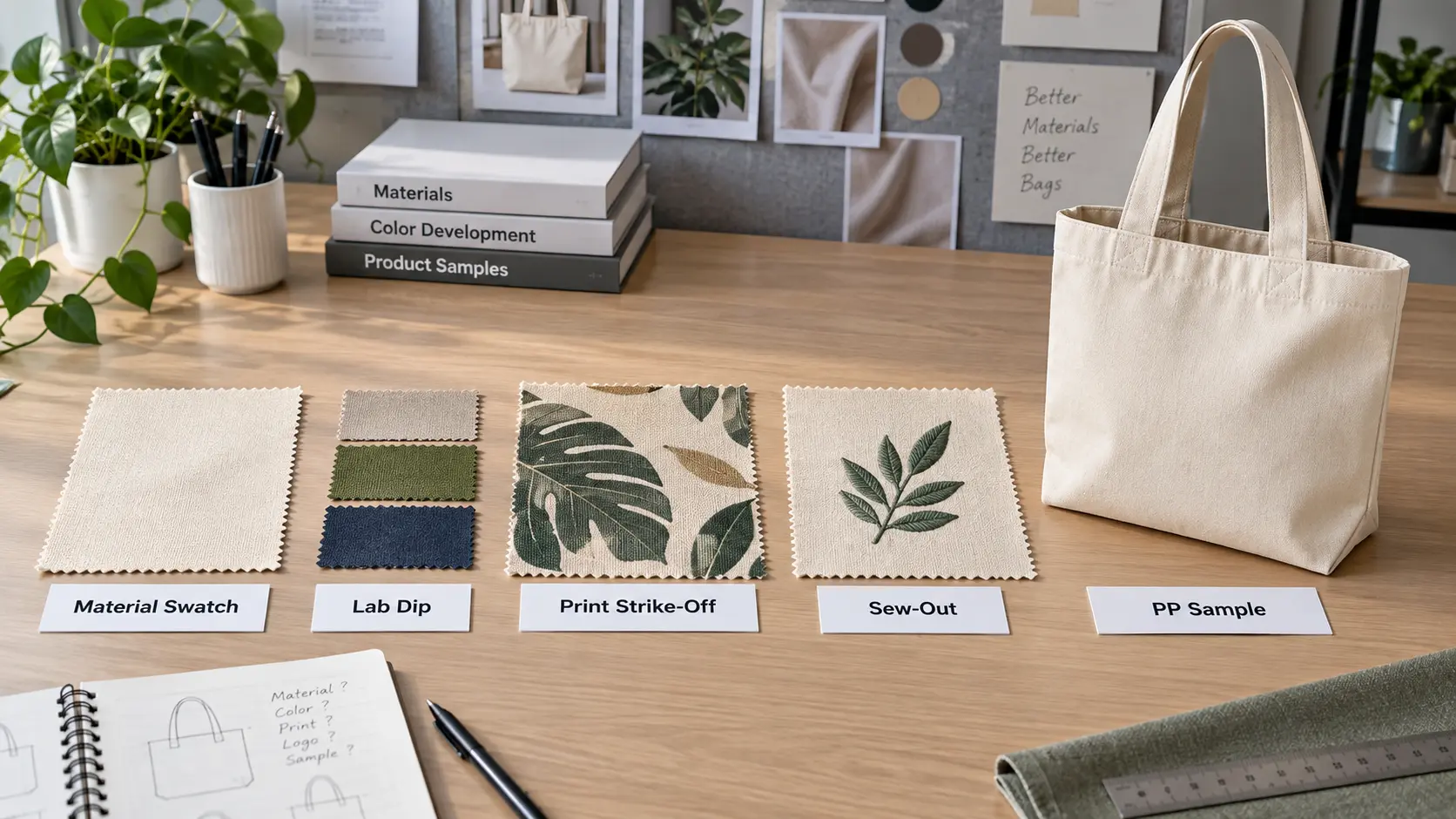
What Each Approval Stage Proves
| Approval Item | Main Question | What It Can Approve | What It Does Not Approve by Itself |
|---|---|---|---|
| Material swatch | Is this material quality or direction suitable? | Specified material identity or direction, surface, hand, visible construction, and other agreed material attributes | Custom dyed color, print execution, final bag construction, bulk-lot conformity |
| Lab dip | Is the proposed dyed color acceptable on the named substrate? | Color direction for a specified dyed material under the agreed evaluation method | Print artwork, final bag assembly, bulk shade consistency, colorfastness performance |
| Print strike-off | Does the proposed print work on the named substrate? | Agreed artwork execution such as scale, color direction, registration, coverage, and surface result | Final sewn placement, dimensions, construction, every bulk print |
| Embroidery sew-out | Does the digitized embroidery work on the intended material system? | Stitch interpretation, density direction, thread colors, edge quality, puckering risk, backing approach | Final bag dimensions, every bulk embroidery unit, unrelated construction details |
| Development / prototype sample | Does the proposed construction work? | Shape, access, pocket logic, handle position, closure, general construction direction | Production-intent materials or final decoration unless specifically built that way |
| Pre-production sample | Do the intended production inputs work together? | The agreed combination of material, dimensions, construction, decoration, labels, hardware, and packaging represented in that sample | Automatic conformity of every later bulk unit |
| Golden / sealed sample | What physical reference controls future comparison? | The approved physical reference and its linked written specification, when both parties explicitly designate it | Unwritten changes, later material substitutions, or a guarantee that the entire bulk lot is conforming |
Not every custom bag needs every row in this table. The correct sequence follows the product and the risks that need to be closed.
1. Material Swatch: Approve the Material Before You Approve the Product
A material swatch is useful when the buyer needs to select or confirm an exterior fabric, lining, trim, webbing, coating direction, or another material before the complete bag is built.
A good swatch approval identifies what is being accepted. "Fabric approved" is too broad if the submitted piece only demonstrates surface texture and hand while the final color, coating, or weight remains open.
For example, a buyer might approve a canvas quality direction while leaving the custom color unresolved. That decision should be written as a limited approval rather than allowing the swatch to become an accidental reference for every later property.
If you are comparing textile constructions before sampling, PrintTotes' cotton vs canvas guide and cotton canvas vs cotton twill guide can help separate fiber, weave, and material direction. Any exact weight, coating, or performance requirement still belongs to the actual order specification.
2. Lab Dip: Approve a Color Submission, Not the Whole Fabric Program
In many textile development workflows, a lab dip is a small dyed submission used to evaluate a proposed solid color on a specified substrate. It answers a color question; it does not automatically approve print, construction, bulk-lot consistency, or colorfastness performance.
Record the material being dyed and the color reference used for comparison. Pantone advises using a current physical color standard when evaluating physical products because on-screen color does not replace a real-world reference. Pantone's guidance on physical color samples explains that distinction.
A Pantone reference is still a target, not proof that a lab dip or later bulk material automatically meets your acceptance criteria. The approval record should identify the actual submitted option and the evaluation conditions your team agreed to use.
3. Print Strike-Off: Approve the Print on the Intended Substrate
A print strike-off is useful when the buyer needs to see how artwork behaves on the proposed material before relying on a fully assembled bag. Depending on the printing process and program, it can help close questions about scale, print color direction, registration, opacity, coverage, edge definition, and surface feel.
Put the words print strike-off in the approval record if that is what you mean. "Strike-off" can be used differently across textile workflows, so the physical object and decision should be named explicitly.
The substrate matters. A print result on a convenient substitute fabric is limited evidence for the production material if the ground color, weave, coating, surface energy, or texture changes. If a substitute must be used during development, record the limitation and reopen print approval when the production substrate becomes available.
The broader tote bag printing methods guide covers process selection. This page is narrower: it focuses on what a physical print submission can and cannot approve.
4. Embroidery Sew-Out: Approve Stitch Behavior Before It Becomes a Bag Problem
For embroidered branding, a sew-out lets the buyer review how the digitized artwork translates into thread on the intended or representative material system.
Useful checks include thread color, stitch interpretation, edge definition, density, small text, backing, puckering, and whether the fabric remains stable around the embroidered area. The exact result depends on the artwork, thread, backing, material, machine setup, and construction.
A sew-out should not be treated as approval of the complete bag unless the sewn sample itself is also being reviewed for construction. Keep the embroidery decision separate from dimensions, pockets, closures, or other product attributes.
5. Development Sample: Prove the Construction Logic
Before production-intent materials are available, a development or prototype sample can answer structural questions: Is the opening usable? Does the pocket fit the intended item? Does the handle position balance the loaded bag? Does the closure interfere with access? Does the gusset create the required internal volume?
The value of a prototype is lost when buyers approve appearance and forget that the sample used substitute materials or provisional hardware. Record which components are representative and which are not.
For broader product-development planning, PrintTotes' wholesale tote bag customization guide covers material, artwork, supplier, and production decisions that happen around the sampling process.
6. Pre-Production Sample: Bring the Approved Inputs Together
A pre-production (PP) sample should represent the production-intent combination closely enough for the buyer to review the complete result before bulk manufacturing is released. The exact scope must be written down rather than assumed from the phrase "PP sample."
Depending on the bag and order, the review may include:
- material identity and approved color reference;
- finished dimensions and construction;
- handles, straps, pockets, closures, lining, and hardware;
- artwork revision, decoration process, size, and placement;
- labels and required markings;
- packaging elements represented in the sample;
- open deviations or approved substitutions.
The existing PrintTotes canvas vs leather branded tote buyer's guide contains a product-level PP sample checklist for material, dimensions, branding, construction, and packaging. This article has a different job: it defines the approval stages that lead to that final combined sample.
7. Golden or Sealed Sample: Name the Control Reference Precisely
Some buyers and suppliers use "golden sample," "sealed sample," "approved sample," or "counter sample" for a retained physical reference used during bulk production and inspection. These terms are not safe to treat as universally interchangeable.
If a physical sample is intended to control production, identify it explicitly: sample ID, revision, date, approver, linked specification, and any accepted deviations. State who retains the reference and whether there are matched counterparts.
The physical sample should not be expected to carry every requirement by itself. Measurements, materials, artwork files, color references, workmanship criteria, packaging instructions, test requirements, and approved changes belong in controlled written records as well.
Approval Is Not the Same as Performance Testing
Visual and construction approvals answer different questions from standardized performance tests.
A lab dip can be visually accepted and still have an untested colorfastness requirement. ISO 105-C06:2010, for example, specifies methods for assessing textile color resistance to domestic and commercial laundering. ISO confirmed the standard again in 2026. ISO 105-C06 demonstrates why "color approved" and "colorfastness tested" are separate claims.
Likewise, approval of one PP sample does not establish that every unit in a production lot conforms. If the buyer uses lot-by-lot acceptance sampling by attributes, ISO 2859-1:2026 provides current AQL-indexed sampling schemes. ISO 2859-1:2026 is the relevant standard overview. The inspection plan and acceptance criteria still need to be defined for the actual order.
PrintTotes' Quality & Certifications page is the site's commercial owner for broad QC and compliance capability. Sample-stage approval should feed that quality process rather than replace final inspection or order-specific testing.
Choose Only the Approval Stages Your Bag Actually Needs
More samples are not automatically better. The sequence should close real risks without creating ceremonial approvals that add no information.
| Example Program | Likely Useful Gates | Why |
|---|---|---|
| Stock-color tote with a simple screen print | Material reference if needed → print strike-off or decorated sample → PP sample | No custom dye approval may be necessary if the stock material itself is the accepted reference. |
| Custom-dyed canvas tote with printed artwork | Material swatch → lab dip → print strike-off → PP sample | Material, solid color, print execution, and assembled result are separate decisions. |
| Stock fabric with embroidery | Material reference → embroidery sew-out → PP sample | The key decoration risk is stitch behavior rather than a print strike-off. |
| Fully custom multi-component bag | Material submissions → relevant color/decoration approvals → development sample → PP sample → controlled physical reference | Construction and component interactions need to be resolved before the production reference is sealed. |
These are generic examples, not PrintTotes standard sample routes or lead-time commitments. Actual sequencing depends on the material, decoration, product complexity, sourcing route, and order requirements.
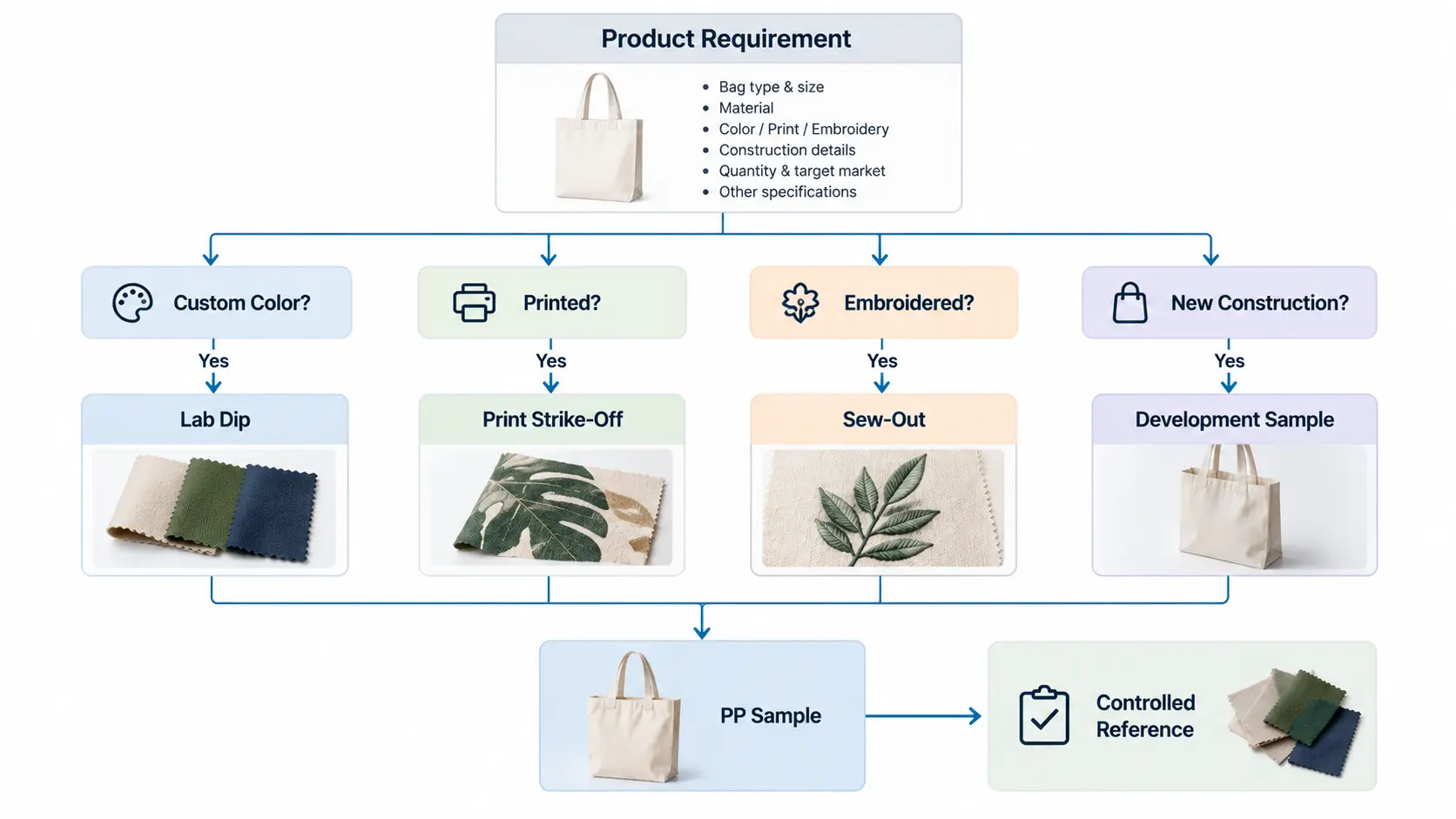
How to Write an Approval Record That Cannot Drift
A useful approval record answers six questions:
- What object was reviewed? Identify the swatch, lab dip option, print strike-off, sew-out, sample, or physical reference.
- Which revision was it? Record the sample ID, artwork revision, specification revision, and date where applicable.
- What decision was approved? State color, material direction, print execution, embroidery, construction, or another defined scope.
- What reference controlled the review? Name the drawing, material code, artwork file, physical color standard, or approved specification.
- What remains open? Record unresolved dimensions, substitute materials, temporary hardware, packaging, tests, or other outstanding items.
- Who authorized the decision? Record the buyer or designated approver so later comments do not silently override a closed gate.
"Looks good, approved" answers almost none of those questions.
When a Change Should Reopen an Approval
Approval only remains meaningful while the approved inputs remain the same. If a material, process, artwork, or construction changes, reopen the affected gate rather than assuming the old approval transfers automatically.
| Change | Likely Approval to Revisit | Reason |
|---|---|---|
| Base fabric or finish changes | Material; color; print or embroidery where affected | Surface, hand, shade, print behavior, or stitch stability may change. |
| Artwork revision changes | Print strike-off or embroidery sew-out; PP sample placement where relevant | Scale, registration, density, edge detail, and placement can change. |
| Custom color target changes | Lab dip and downstream decorated sample where color interaction matters | The previously approved color no longer represents the requirement. |
| Handle, pocket, zipper, gusset, or lining changes | Development / PP sample | The assembled product and usability have changed. |
| Printing process or substrate changes | Print approval | A prior result may not predict the new process/material combination. |
| Packaging that affects product shape changes | PP / packaging approval | Compression, folding, protection, or presentation may change. |
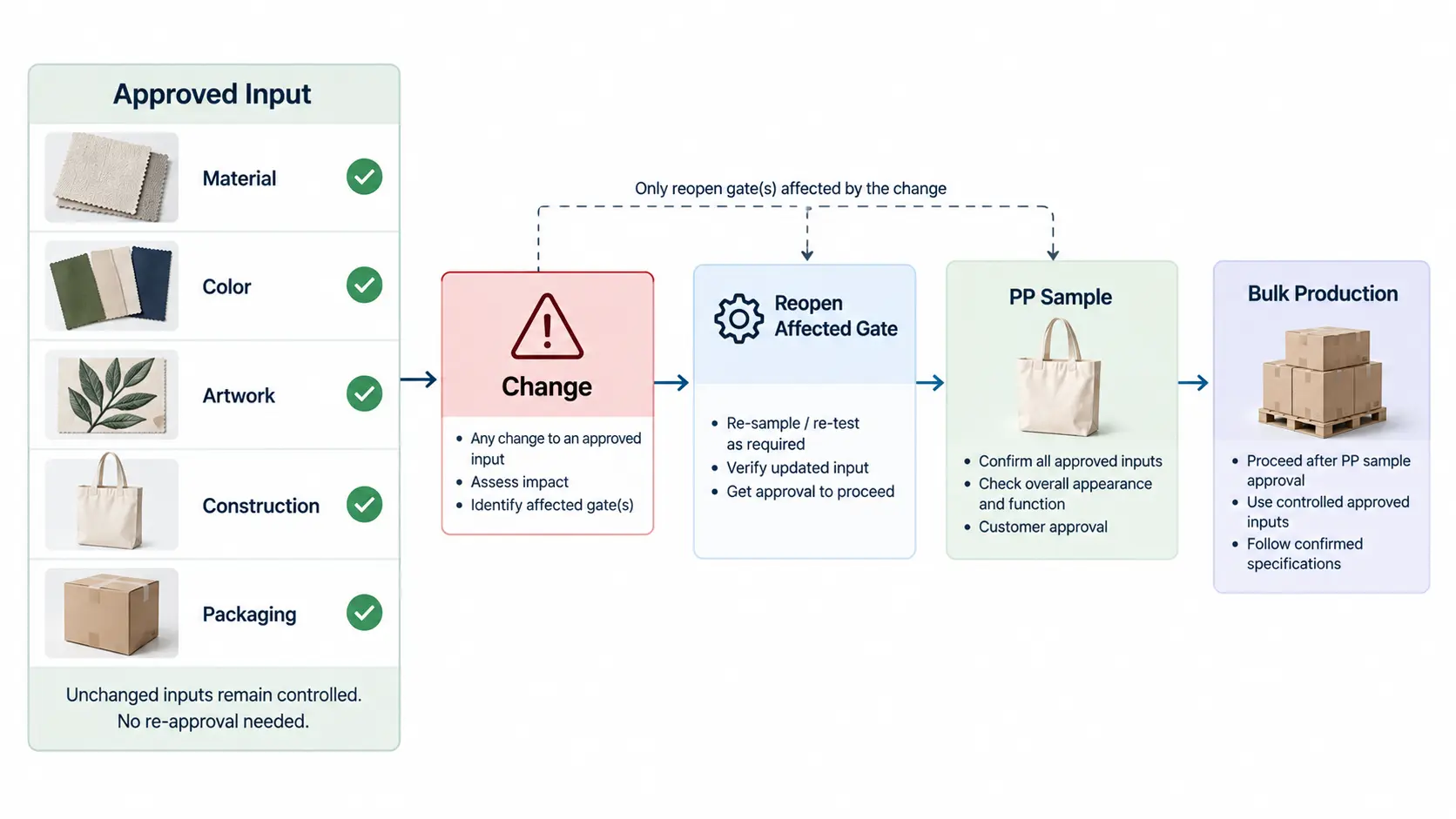
From PP Approval to Bulk Production
Before a PP sample becomes the production reference, close the handoff in writing.
- Identify the approved sample and the specification revision it represents.
- Attach or reference approved artwork and color decisions.
- List accepted deviations rather than leaving them in email history.
- Confirm which materials and components must not be substituted without reapproval.
- Define the inspections or tests that are separate from sample approval.
- Confirm packaging and labeling instructions that must carry into bulk.
- Make sure later production changes trigger the appropriate reapproval gate.
If the project has not yet reached this stage and the first requirement is simply to turn a concept into a manufacturable program, PrintTotes OEM/ODM custom bag service is the appropriate commercial next step. If the bag type is already known, the custom tote bag category provides another route into product-level options.
FAQ
Q: Is a material swatch the same as a lab dip?
A: No. A swatch commonly represents a material quality or material direction. A lab dip is used in custom dye development to evaluate a color on a specified substrate. A swatch can be the substrate for later color development, but approving one does not automatically approve the other.
Q: Can a Pantone code replace a lab dip?
A: No. A Pantone reference can define a color target, while a lab dip shows how a proposed dye result appears on the selected substrate. The physical submission still needs to be evaluated against the agreed reference and approval method.
Q: Is a print strike-off the same as a digital proof?
A: No. A digital proof can confirm artwork layout and production information, but it does not reproduce the physical interaction between print process and substrate. A print strike-off is a physical print submission used to review the result on a specified material.
Q: Does approving a PP sample mean the bulk order is automatically approved?
A: No. A PP sample can release the agreed production specification, but bulk conformity still depends on production control, inspection, and any required testing. One approved sample is a reference, not statistical evidence for every later unit.
Q: Does every custom bag need a lab dip, strike-off, sew-out, and PP sample?
A: No. Use only the gates relevant to the product. Stock-color material may not need a lab dip; a non-embroidered product does not need a sew-out; a simple decoration may be approved within a production-intent sample if the buyer and supplier clearly record what that sample is intended to prove.
Q: What should a "golden sample" mean?
A: It should mean whatever the buyer and supplier explicitly document it to mean. If the term is used for the production control reference, identify the physical sample, revision, linked specification, approver, and accepted deviations rather than relying on the nickname alone.
Q:
A: Good sample approval is not about collecting more samples. It is about closing the right decision at the right stage, recording the boundary of that decision, and reopening it when an approved input changes.


