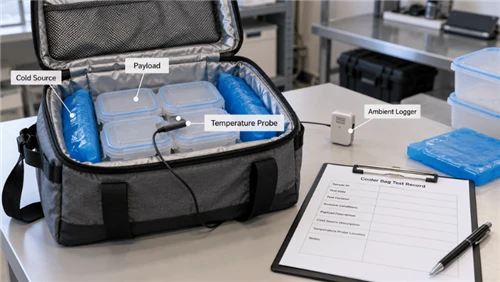
A cooler bag listing may promise "four to six hours of insulation," but that figure tells a buyer very little unless the test conditions are known. Four hours with pre-chilled drinks and frozen packs in a cool room is not the same result as four hours with a partly filled bag in a hot delivery vehicle.
For brands sourcing insulated totes, lunch bags or promotional coolers, a useful cooler bag cold-retention test measures the temperature of a defined payload over time. It documents what was inside the bag, how the bag was constructed, the conditions outside it, how often it was opened and what threshold counted as acceptable performance.
This guide is about evaluating a production-representative cooler bag before bulk approval. It does not rank exterior fabrics or prescribe a universal foam thickness. For material selection, use the existing PrintTotes insulated fabric guide. For custom cooler products and configurations, see the custom cooler bag category.
First Define What "Keeps Cold" Means
"Feels cool to the touch," "ice packs are still partly frozen" and "payload temperature remains within a defined limit" are different observations. They cannot be treated as interchangeable.
For a promotional drinks cooler, the buyer may care about how quickly a pre-chilled beverage warms under a typical event scenario. A grocery delivery program may need a temperature profile for a specified pack-out and delivery route. A program transporting temperature-sensitive food or medical products may require qualified procedures far beyond an ordinary bag comparison.
Write the decision in a form that can be tested: under a specified ambient profile, with a defined payload and coolant arrangement, how long does the measured payload remain within the program's specified temperature range? The threshold must come from the application, applicable food-safety requirements or other approved product criteria; it must not be invented by the article or supplier.
What Must Stay the Same Between Two Cooler Bag Tests?
| Variable | What to Record | Why It Matters |
|---|---|---|
| Finished bag | Sample ID, size, shell, insulation, lining, seams, closure and revision | Different assemblies can produce different temperature profiles |
| Ambient conditions | Surrounding air temperature and relevant exposure changes | A warmer environment changes the heat entering the bag |
| Payload | Contents or validated simulant, quantity, mass, starting temperature and arrangement | The load stores thermal energy and occupies interior space |
| Cold source | Gel pack or other coolant, number, mass, initial condition and placement | The cold source can dominate the result independently of insulation |
| Opening schedule | Whether the bag stays closed; if not, how often and for how long it is opened | Repeated access changes the thermal exposure |
| Sensor setup | Sensor identity, placement, calibration or verification status and recording interval | A sensor against an ice pack or wall can give an unrepresentative reading |
| Duration and endpoint | How long the run continues and what result counts as a pass, review or failure | Without a defined endpoint, "hours of cooling" has no consistent meaning |
It is possible to compare two bags fairly only if these conditions are aligned, or if the deliberate differences are documented as the purpose of the comparison.
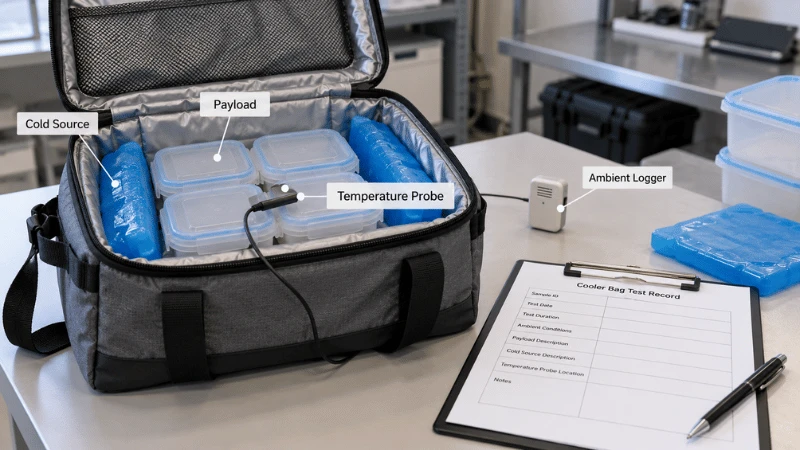
The Bag Assembly Is the Test Object-not the Foam Swatch
Insulation material affects heat transfer, but a complete cooler bag also has corners, stitch lines, closures, zipper ends, a bottom panel, handles and transitions between layers. Different assembly details can create paths for heat and air exchange that are not represented by an isolated insulation sample.
ASTM's active D3103-20(2025), Standard Test Method for Thermal Insulation Performance of Distribution Packages, describes how insulation performance depends on the package, internal energy source and payload, and recommends testing the actual package where possible. It is a standard for thermal distribution packages, not an automatic certification or universally mandatory test method for consumer soft cooler bags. Its central principle-evaluate the assembled system under documented conditions-is still useful when developing a buyer-specific protocol.
The PrintTotes thermal versus insulated bag comparison covers general construction trade-offs. The testing task here is narrower: determine whether one specific finished configuration meets a documented performance objective.
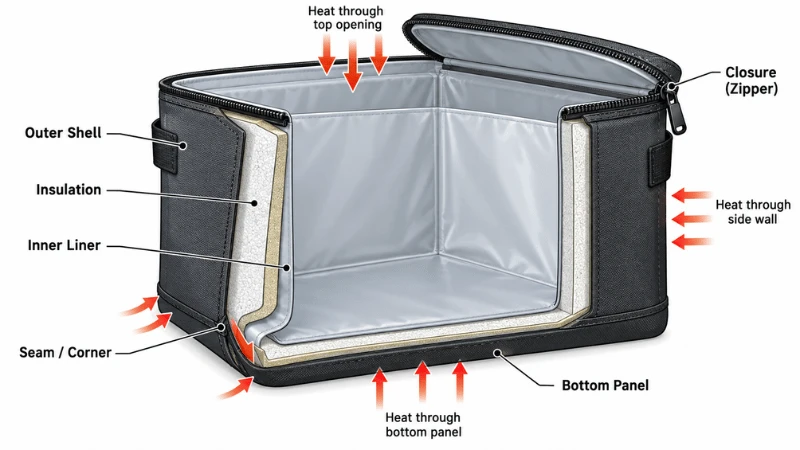
Build a Test Plan Around the Intended Use
1. Write a Scenario Before Picking a Bag
Describe who will use the cooler, where it will be carried, how long it will travel and whether it will be opened. Keep any scenario assumptions visible. A lunch tote kept in a climate-controlled office, for example, should not be evaluated as though it were a parcel left in full sunlight.
If multiple environments matter, use separate test scenarios. Do not average a mild-weather result and a hot-weather result into one unsupported marketing claim.
2. Freeze the Sample Configuration
Assign a sample ID and retain its build specification. Record the lining and insulation as used in that sample, but do not treat general labels such as "EPE foam" or "foil" as performance guarantees. Note closure position, gaps, internal dividers and packing format.
Any later change to insulation, lining, seam construction or zipper can invalidate the earlier thermal result. Use the custom bag change-control guide to decide which approval evidence must be reopened.
3. Prepare a Representative Payload
Choose the actual product when practical. If substitutes are used, document what properties they are intended to represent and what they do not reproduce. Match starting temperatures across comparative runs. Record both payload quantity and packing arrangement, since loosely packed items can behave differently from densely packed ones.
Do not replace a specified food or pharmaceutical product with a random bottle of water and describe the results as validated product protection. A simulant requires its own justification when the real payload is temperature-sensitive.
4. Standardize the Cold Source
Record each ice or gel pack type, mass, number, starting condition and location. If one design receives additional ice packs, the result tests a different cooling system-not merely a better bag.
Where packs touch a temperature sensor, the reading can be biased toward the coolant rather than the product. Position the instrument to capture the specified payload condition and record the placement. If multiple positions matter, measure them separately rather than declaring the coldest point representative of the full load.
5. Set the Exposure and Opening Schedule
Keep the surrounding air condition as consistent as practical for comparative testing. If the real use includes repeated access, specify the opening frequency and duration in advance. Do not adjust the schedule midway because a sample is warming faster than expected.
6. Record a Temperature Curve
Log the initial payload temperature and subsequent readings at a defined interval. A temperature-time curve reveals whether the payload warms gradually, develops a rapid rise after openings, or behaves differently in two tested configurations. A single reading at the end of a test can hide these distinctions.
Record the actual measured values, not a pre-filled "pass" result. If the logger failed or a probe moved, document the invalid run and repeat it rather than smoothing the problem away.
7. Apply a Predefined Acceptance Rule
Decide before testing what success means: a maximum allowable payload temperature, a permitted duration within a specified range, or another buyer-approved criterion. A test can also be comparative without claiming regulatory fitness, but the result must be described as such.
For perishable food in the United States, the FDA's outdoor food-handling guidance says cold perishable food should be kept at 40°F (about 4°C) or below until serving. That is food-handling guidance; it is not proof that any particular reusable cooler bag maintains that temperature. Requirements for commercial distribution, medical logistics or other regulated uses must be defined separately by the responsible specialists.
Compare Configurations Without Changing Everything at Once
Suppose a buyer wants to compare two soft cooler prototypes. One uses a different lining, closure and ice-pack arrangement from the other. A better temperature curve from the second sample would not show which of those changes caused the improvement.
A useful development comparison can either hold the coolant and load constant while changing a bag construction or test complete alternative systems as they would actually be used. Make the question explicit. The first approach helps isolate a construction decision. The second helps compare real operating solutions.
For a multi-condition program, record each run rather than declaring a single best-case run representative of every season or route.
How to Read the Result Without Overclaiming
| Observation | Reasonable Interpretation | What It Does Not Prove |
|---|---|---|
| Payload stays below a specified threshold during one controlled run | That configuration met that test's criterion | That every weather condition, lot or customer pack-out will pass |
| Ice is still present at the end | Some coolant remains | That the entire payload was held within a safe temperature range |
| Bag A performs better than B in matched conditions | A has a better measured result under that comparison | That A always performs better with other loads or ice arrangements |
| Water is visible inside after testing | Moisture or meltwater exists and needs investigation | That the lining is leaking; condensation is also possible |
Keep thermal retention, liquid leakage, material compatibility, food-contact compliance and physical strength as separate requirements. One successful temperature run does not automatically close all of them.
Use a Report That a Buyer Can Recheck
The most useful output is a short test record attached to the approved sample, not a marketing sentence about hours.
| Record Field | Entry for the Actual Test |
|---|---|
| Sample and revision | Production-representative bag ID and controlled build reference |
| Purpose | Comparison, development decision, or defined acceptance test |
| Ambient profile | Measured surrounding temperature and changes |
| Payload and coolant | Identity, quantity, masses, starting conditions and placement |
| Sensor plan | Devices, positions, verification status and logging interval |
| Operating sequence | Closure state, movement, opening events and test duration |
| Raw results | Time-stamped temperatures, deviations and observations |
| Decision | Acceptance criterion, outcome, reviewer and actions |
Sample-stage approvals establish what was built. The sample approval stages guide explains that foundation; a cooler performance test adds evidence about one measured function. Pre-shipment inspection may confirm that production units match the released construction, but an ordinary visual inspection does not replace a thermal test. See the pre-shipment inspection guide for that separate task.
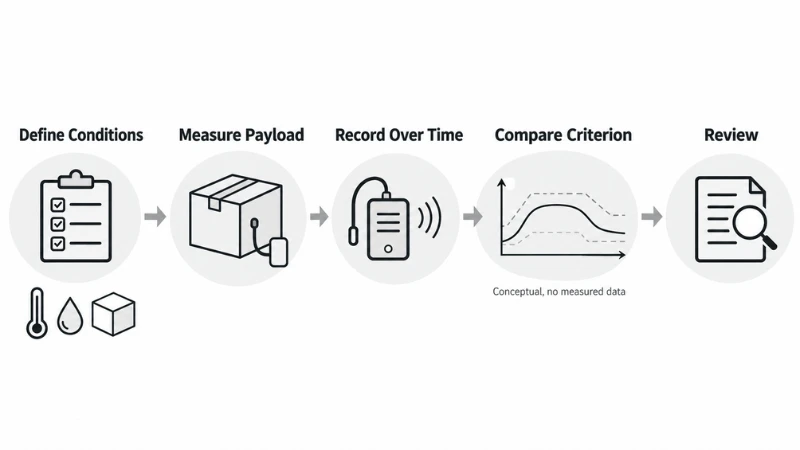
Questions to Answer Before Approving a Cooler Bag Claim
- Which real use case does the proposed claim describe?
- What exactly was measured: payload temperature, air temperature, or remaining ice?
- Were ambient conditions, starting temperatures, payload, coolant and openings recorded?
- Does the tested bag match the approved material and construction?
- Is there a temperature-time curve or only a single endpoint observation?
- What threshold and test duration were agreed before the run?
- Were atypical runs, deviations and sensor issues disclosed?
- Does the claim clearly limit itself to those tested conditions?
Final Takeaway
The strongest cooler bag specification begins with a testable use case, not an unsupported promise of hours. Establish the payload and cold source, document the assembled sample, control the external conditions, measure the relevant temperature and apply an agreed acceptance rule.
When the specification is ready for product development, the PrintTotes OEM/ODM service is the commercial route for discussing custom cooler construction, samples and order-specific testing requirements.
FAQ
Q: How many hours will a cooler bag keep food cold?
A: There is no reliable universal answer based on the fabric or foam label alone. The result depends on the assembled bag, coolant, payload, starting temperatures, ambient exposure and opening pattern. A defensible duration comes from a documented test of the relevant configuration and conditions.
Q: Is an ice-melt test enough to verify cold retention?
A: It can be a rough demonstration, but remaining ice is not the same measurement as the product's temperature over time. If the requirement concerns payload temperature, measure the payload with a defined method.
Q: Is ASTM D3103 required for every cooler bag?
A: No. ASTM D3103 addresses thermal distribution packages. It provides a useful reference for thinking about a complete package, external temperature and payload, but its applicability and any buyer-specific method must be established for the actual use. This article does not claim that a generic tote test is certified to ASTM D3103.
Q: Can I compare bags using different ice packs?
A: You can compare complete systems if that is the intended user decision, but the result cannot be attributed solely to the bag insulation. For a bag-only comparison, hold the coolant arrangement and other relevant conditions consistent.
Q: Does a passed thermal test prove a bag is leak-proof or food-safe?
A: No. Liquid containment, food-contact material suitability, seam integrity and thermal performance require different evidence and may be subject to different requirements.