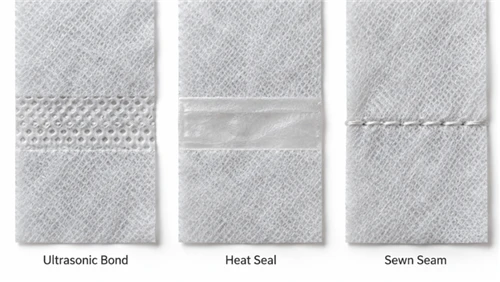
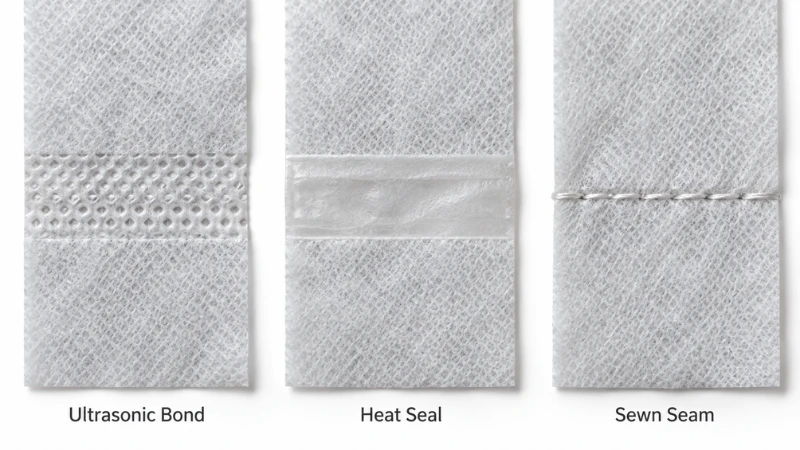
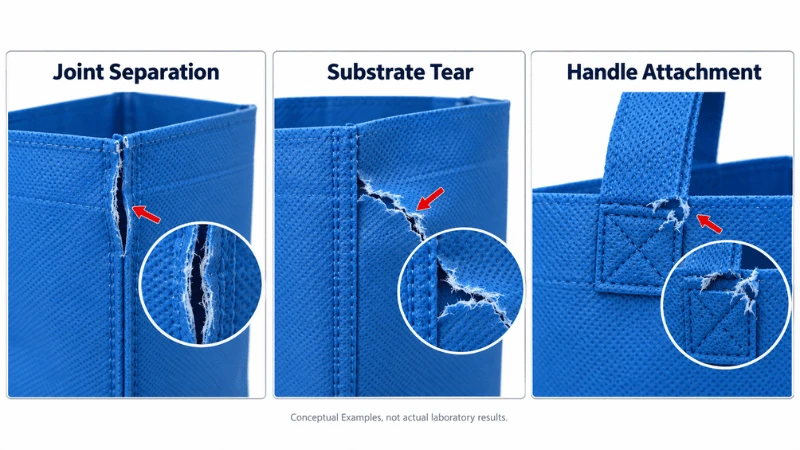
Two polypropylene non-woven shopping bags can use the same nominal fabric weight and still fail in very different places. One may separate along a welded side seam; another may tear around a line of stitches; a third may have sound body seams but a handle attachment that gives way first.
That is why buyers should not choose between ultrasonic welded vs sewn non-woven bags by looking at a catalog photo or by assuming one joining method is always stronger.
The useful decision starts with the specific bag construction, the type of non-woven material, the direction of load, the seam and handle geometry, the intended reuse pattern and the evidence available from an approved finished sample.
This is a construction-selection guide, not a wholesale pricing page. The non-woven shopping bag category owns product selection and enquiries; this article explains how to evaluate the joints that make a selected bag usable.
First Separate the Material from the Joining Method
Many promotional shopping bags use spunbond polypropylene non-woven fabric, a thermoplastic fiber web. This makes some thermal joining processes possible, but the phrase "non-woven" does not identify a single fiber, weight, laminate or finished construction.
Before deciding how to join it, identify the actual fabric or laminate, including any film, coating, backing, printed surface or reinforcement. A material combination that can be welded reliably in one form may behave differently when another surface or layer is introduced.
The PrintTotes non-woven duffel guide covers broader bag formats and material selection. Here the page job begins after the basic non-woven product direction is known: what seam construction and validation make sense for the load path?
Three Joining Routes That Buyers Commonly Encounter
Ultrasonic Welding
Ultrasonic equipment applies controlled mechanical vibration and pressure so suitable thermoplastic layers can bond at a joint. No sewing thread is required at the welded zone. Joint geometry, compatible materials, tool pattern and process conditions affect the result.
Herrmann Ultrasonics' guide to joining non-wovens describes longitudinal and cross seals, lamination and cut-and-seal operations. It also explains why compatible thermoplastic properties and process settings matter. The source is an equipment manufacturer's technical overview, not a claim that any particular PrintTotes bag has passed a specified strength test.
Conventional Heat Sealing
Heat-sealing methods use heat and pressure, rather than ultrasonic vibration, to join compatible thermoplastic materials. The exact equipment and seal construction must be identified. "Heat sealed" should not be assumed to mean "ultrasonically welded"; they are related but distinct processes.
Where films or laminates are involved, a buyer should confirm which layers actually form the joint. A sealed film surface does not automatically establish the load strength of the entire non-woven panel or its handle attachment.
Sewing with Thread
A sewn seam joins layers with stitches. It allows different seam shapes, binding, reinforcement and mixed materials, but it also creates a line of needle penetrations and depends on thread, needle choice, stitch pattern, seam allowance and fabric stability.
On low-strength or highly perforation-sensitive material, poor stitch selection can concentrate stress near the needle line. On an appropriate construction, sewing can support complex attachments and repairable details. Both outcomes need to be assessed in the actual design instead of being generalized across all bags.
Which Method Fits Which Bag Construction?
| Design Situation | Ultrasonic / Thermal Joining: Review | Sewing: Review |
|---|---|---|
| Simple flat panel or straight side seam | Tool access, compatible layers and repeatable bond geometry | Seam allowance, stitch pattern and consistency |
| Curved or complex shape | Whether tooling can follow the intended seam | Whether sewing can follow the curve without damaging the substrate |
| Woven webbing or dissimilar handle material | Material compatibility and attachment design; do not assume weldability | Thread, reinforcement, load path and fabric tearing |
| Laminated or printed panel | Which layer is bonded and whether the visible finish is affected | Needle holes, laminate behavior and visual finish |
| High-contact or repeated-use feature | Joint durability under relevant repeated handling | Stitch wear, hole growth and reinforcement durability |
These are engineering questions, not a universal ranking. A bag may also combine methods-for example, welded body panels with sewn or separately reinforced handles-if the overall construction is approved.
Look at the Load Path Before the Seam Appearance
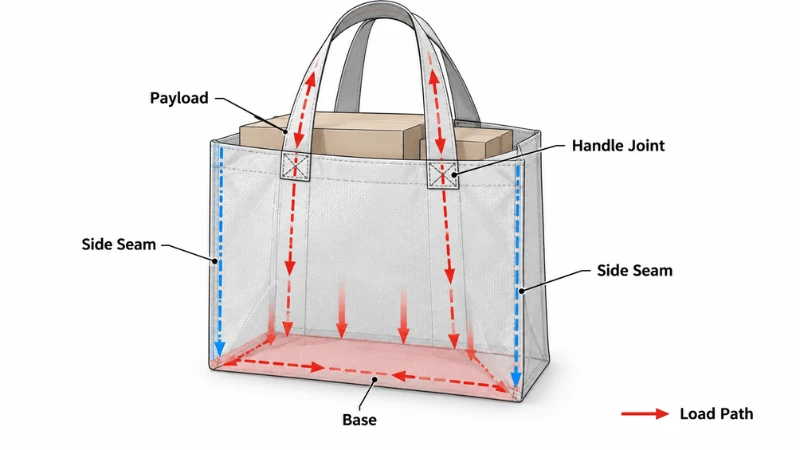
The load carried by a shopping bag travels through the contents to the bottom and body panels, up the side structure and through the handle attachment into the user's hand. The visible side seam may not be the weakest feature.
Ask where the load enters the joint and how it changes when the bag is lifted, swung, placed on a counter or carried with unevenly distributed contents. The force direction at a handle connection may be different from the force experienced along a flat side seam.
For ultrasonic bonding, joint shape, bonded area, material behavior and the direction in which the assembly is pulled can affect performance. For sewn construction, seam geometry, stitches and reinforcement have their own load-distribution behavior. Neither can receive a reliable general load rating from the label "welded" or "stitched" alone.
Do Not Confuse a Clean Edge with a Strong Joint
Ultrasonic joining can leave a clean-looking seam without thread; sewing leaves a recognizable stitch line. Those differences matter for appearance and production planning, but a neat exterior does not reveal whether the joint will hold under the intended load.
Inspect at least three separate conditions:
- Joint integrity: Does the welded zone separate, or do stitches loosen or break?
- Adjacent-material damage: Does the non-woven substrate split beside the weld or tear along needle penetrations?
- Handle and corner transitions: Does the joint remain stable where the load changes direction or multiple layers meet?
These observations lead to different corrective actions. More weld energy cannot necessarily solve insufficient material strength, just as denser stitching does not necessarily solve a weak, highly perforated panel.
Lamination and Printing Can Change the Decision
Some reusable non-woven shopping bags have a laminated print surface. That construction may change the way a proposed joining method interacts with the panel. Confirm the actual film, substrate, surface treatment and production sequence rather than assuming the same settings work for every bag marked "PP non-woven."
A printed or coated panel also raises appearance questions: does heat or pressure visibly mark the surface; do stitches interrupt artwork; will a fold or binding hide important information?
Material compatibility and decoration should be evaluated together. The PrintTotes printing-method guide covers the separate task of selecting artwork processes for the intended substrate.
How to Evaluate a Finished Non-Woven Bag Sample
It is not enough to pull a loose fabric strip by hand and declare the finished bag strong. The relevant sample must include the actual seam layout, handle placement, panel geometry and materials intended for bulk production.
Identify the Controlled Construction
Record fabric/article reference, any lamination, bag dimensions, joining method for each seam, handle material and attachment details. If the supplier uses a hybrid construction, identify exactly which joints are welded and which are sewn.
Check Appearance and Joint Continuity
Examine seam alignment, missing or inconsistent bonded sections, melted or distorted areas, loose threads, skipped stitches, puckering and damage near corners. Check whether the result is the same on the inside and outside of the bag.
Test a Representative Load Case
Define the payload, its distribution and the handling sequence before testing. Include conditions relevant to how the finished product will be used, such as lifting by both handles and carrying a partially loaded bag. Use a documented procedure and acceptance criterion appropriate to that product.
Do not invent a fixed 10 kg or 15 kg rating based on fabric GSM or joining method. A meaningful performance claim requires a specified test on the relevant finished construction.
Record Where Failure Starts
If a sample fails, record whether failure occurred inside the joint, in the adjacent fabric, at a handle attachment, at a bottom corner or elsewhere. The failure location is more informative than a simple pass/fail label when deciding how to revise the construction.
The custom bag sample approval stages guide explains why a development sample and a production-intent sample close different questions. Use the representative finished sample for the actual joining decision.
A Buyer-Facing Seam Specification
| Field | Specify or Attach |
|---|---|
| Body material | Approved non-woven material and laminate/article reference |
| Joint map | Side seams, bottom seam, gusset, binding and handle attachments |
| Joining process | Ultrasonic, other heat seal, stitched or defined hybrid method for each joint |
| Joint construction | Approved seam geometry, overlap, stitch/reinforcement or weld pattern reference |
| Critical transitions | Handle anchors, corners, gusset intersections and multi-layer areas |
| Appearance | Approved visible seam, printed surface and edge finish |
| Functional evidence | Representative sample review and any defined load/durability test |
| Control reference | Revision, approved physical sample and inspection criteria |
This information belongs in the controlled bag specification, not just in a marketing comparison of "premium stitched" versus "economical welded." The custom bag RFQ checklist helps buyers state whether a construction choice is fixed or open to supplier recommendation.
From Sample Approval to Production Inspection
Once an appropriate seam construction is approved, inspection should compare later production against the same material and joint references. An ordinary visual inspection can check seam placement and visible defects, but it cannot prove an untested tensile or handle-strength rating.
If a lot-specific performance check is required, define the sampling plan, test method, criterion and response to failure in advance. The PrintTotes pre-shipment inspection guide covers the broader lot-release decision.
If the supplier proposes replacing a welded seam with stitching, changing the non-woven article or altering a handle reinforcement after approval, use change control to reopen affected evidence before the revised build enters bulk production.
Final Takeaway
For non-woven shopping bags, joint design is a product specification, not a decorative detail. Ultrasonic welding, heat sealing and sewing each have appropriate uses and limitations. The right answer follows the material, geometry, load path, handle construction and approved test evidence.
For products that need custom seam design, branded surfaces and production sampling, use the PrintTotes OEM/ODM service to develop the complete bag specification. Keep performance promises tied to the approved sample and actual test conditions.
FAQ
Q: Are ultrasonic welded non-woven bags stronger than sewn bags?
A: Not automatically. The answer depends on material, joint geometry, handle attachment, loading direction and process quality. Compare production-representative finished bags with the same defined use and test criteria.
Q: Is ultrasonic welding the same as heat sealing?
A: No. Ultrasonic welding generates localized heating through mechanical vibration and pressure. Other heat-sealing processes apply heat through different equipment and mechanisms. The joining process should be named precisely in the specification.
Q: Can laminated non-woven fabric be ultrasonically welded?
A: Some material combinations can be joined, but suitability depends on the actual laminate and intended joint. Confirm compatible layers and test the selected materials and tooling rather than assuming all laminated non-woven products behave alike.
Q: Should handles be welded or sewn?
A: Decide from the handle material, geometry, expected load and finished-bag test. A hybrid construction may be appropriate. The appearance of the handle attachment is not sufficient evidence of its carrying performance.
Q: Does higher GSM guarantee a stronger seam?
A: No. Basis weight alone does not define non-woven structure, bond quality or finished-bag seam performance. Consider the actual material, joining process, geometry and test results together.
Q: Can a hand-pull check replace a formal load test?
A: A hand-pull can identify an obvious sample problem, but it should not be converted into a verified load rating. If performance is part of the procurement requirement, establish a documented method and acceptance rule.