

A custom bag quotation is only useful when the suppliers are pricing the same job. If one factory assumes stock fabric, another assumes custom-dyed material, and a third excludes retail packaging, three precise-looking unit prices can describe three different products.
A strong request for quotation (RFQ) does not need to predict every manufacturing detail. It needs to separate what your team has already decided from what is flexible, what is still unknown, and what the supplier must state as an assumption. That distinction gives procurement teams a much better basis for comparing offers and deciding what needs to be resolved during sampling.
This guide is for brand owners, sourcing managers, retailers, promotional agencies, and product-development teams preparing an enquiry for a custom tote, shopping bag, cooler bag, duffel, pouch, or related cut-and-sew bag. It explains the information to put into the RFQ without turning the document into a substitute for a full tech pack.

What a Custom Bag RFQ Needs to Accomplish
An RFQ has two jobs. First, it gives a manufacturer enough context to assess the requested product and quote scope. Second, it creates a common comparison basis for your own team.
The second job is easy to miss. A supplier can return a detailed quotation and still leave the buyer unable to compare it with another offer if the material, packaging, quantity split, sampling route, testing scope, or delivery basis is different.
If you already have a full tech pack, attach it and use the RFQ to define the commercial request, quantity, delivery requirement, open decisions, and quotation basis. If you do not have a tech pack, the RFQ should contain enough product information to make every important unknown visible rather than forcing the factory to guess.
For projects that are still at the broader customization stage, PrintTotes' wholesale tote bag customization guide covers the earlier product-planning decisions. The RFQ begins once you need suppliers to respond to one written brief.
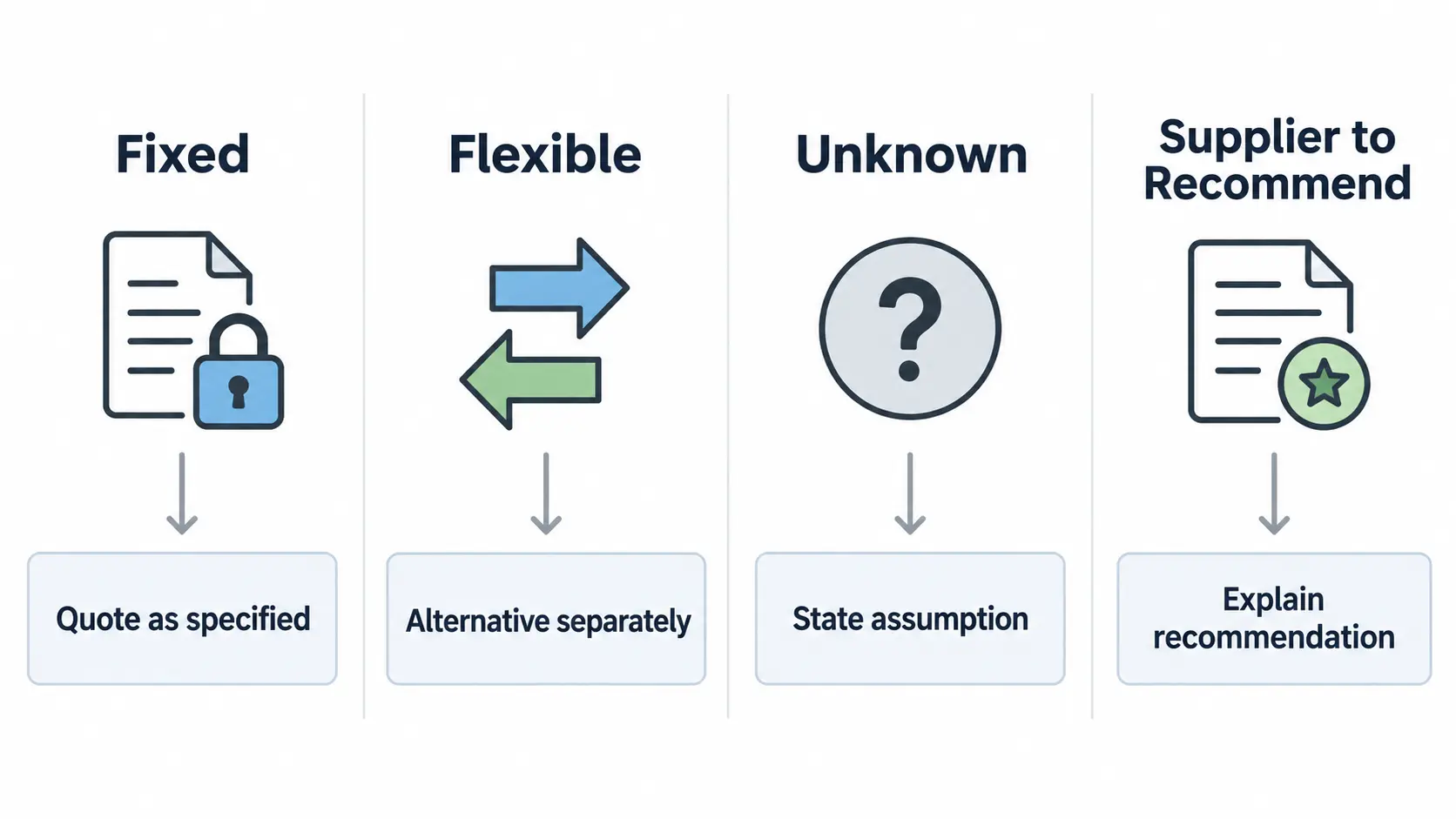
Use Four Status Labels Before You Send the RFQ
Before adding more detail, label each important field with one of four statuses. This prevents an unfinished decision from being mistaken for a firm specification.
| Status | Meaning | What the Supplier Should Do |
|---|---|---|
| Fixed | The requirement is already approved by the buyer. | Quote and sample to this requirement, or flag a feasibility conflict. |
| Flexible | The buyer has a preferred direction but will consider alternatives. | Quote the preferred option and clearly identify any proposed alternative. |
| Unknown | The buyer has not decided the requirement yet. | Do not silently fill the gap; state what information is needed or what assumption is being used. |
| Supplier to recommend | The buyer wants a recommendation against a stated use, appearance, performance, or budget objective. | Explain the proposed specification and why it fits the stated objective. |
This status system is especially useful for early-stage OEM projects. It lets a buyer say, for example, that the bag dimensions and artwork are fixed, the outer material is flexible, and the lining is supplier-to-recommend. The resulting quotation is more transparent than a request that simply says "please suggest the best material."
Custom Bag RFQ Checklist
1. Product Identity and Intended Use
Start with the product type and what the finished bag has to do. Name the category-such as tote, shopper, duffel, cooler, drawstring bag, or toiletry pouch-and describe the intended user and use case in one or two sentences.
"Premium tote" is not enough. A bag intended to carry boxed cosmetics, conference materials, groceries, or chilled food creates different construction questions even when the outside dimensions are similar.
If you are sourcing a tote specifically, the custom tote bag category can help identify common construction and branding directions before the RFQ is finalized. Treat any changing commercial specifications on a product page as project-specific inputs to reconfirm, not permanent assumptions for every order.
2. Reference Files and Revision Control
Attach the best available reference: a tech pack, drawing, marked-up photograph, physical sample reference, or dimensioned sketch. Give the RFQ and its attachments a revision number or date so that both sides can identify which version the quotation covers.
This matters because a small design change can alter more than appearance. A wider gusset, new zipper, extra pocket, different handle construction, or larger print area can change material usage, process sequence, sampling needs, and price.
Do not send an updated drawing in a separate email and assume every supplier has replaced the old one. State which revision supersedes the previous version.
3. Dimensions and Construction
Provide the dimensions that are genuinely decided. Depending on the bag, this may include finished width, height, depth or gusset, handle or strap dimensions, pocket positions, closure type, lining, base structure, and other functional features.
If a dimension is not final, mark it as approximate or supplier-to-recommend instead of presenting a guess as a controlled specification. For products that need to fit a known item, describe that item or the required usable space so the supplier understands the functional constraint.
Do not insert a generic seam tolerance, load rating, or handle strength target copied from another bag. Those values should come from the actual product requirement and an agreed test or inspection method.
4. Material Direction and Performance Need
If the exact material is known, identify it with the specification information you actually control. If it is not known, describe the outcome you need: hand feel, structure, weight sensitivity, surface appearance, washability, water resistance, recycled-content requirement, or another relevant performance objective.
A phrase such as "heavy-duty eco fabric" is not a reproducible specification. It combines a performance claim and an environmental claim without defining either one.
For canvas projects, do not assume that an ounce or GSM figure automatically defines thickness or durability across different constructions. Material identity, weave, finish, coating, lining, handles, and the rest of the bag still matter.
5. Branding, Artwork, and Color
State what will be branded, where it should appear, the approximate or fixed decoration size, and whether the artwork is one color, multiple spot colors, gradients, photographic imagery, embroidery, a woven label, a patch, or another treatment.
If the decoration method is not yet decided, provide the artwork and state the required visual result, quantity, substrate, and durability expectation so the supplier can recommend a process. PrintTotes' tote bag printing methods guide explains why the appropriate process depends on the substrate, surface treatment, artwork, color count, order quantity, and required durability rather than a universal "best" method.
For a critical brand color, identify the physical or standardized color reference your team controls. Pantone notes that a current physical color standard is important when a project moves from a digital environment into physical production, because the real-world color must be evaluated outside the screen. Pantone's guidance on physical color samples is a useful reference for this distinction.
6. Quantity and SKU Split
Give the expected total quantity and show how it is divided by color, size, artwork, or other SKU variable. A total program quantity can be misleading if the production requirement is actually split across several materially different versions.
If quantity is still a planning range, say so. Ask the supplier to identify which quoted assumptions change when the quantity or SKU split changes rather than treating one unit price as valid for every volume.
The separate guide on how MOQ affects bulk bag production is the better place to explore minimum-order mechanics. The RFQ itself should record the quantity you genuinely expect to buy and ask the supplier to state any applicable minimums or split restrictions.
7. Sample Route
Tell the supplier what you expect to approve physically before bulk production. That may involve a material swatch, color submission, print or embroidery test, development sample, or production-intent sample depending on the product.
Do not use "sample required" as if every sample proves the same thing. The RFQ should state the decisions that must be closed before production, while the supplier should explain the proposed sample sequence for those decisions.
8. Quality, Testing, and Compliance Requirements
Only request requirements that are relevant to the product, market, or buyer specification. If a performance test, restricted-substance requirement, social audit, material certification, recycled-content document, or inspection plan is mandatory, identify the required scope rather than writing "all certificates required."
Facility certifications, material certificates, product test reports, social audits, regulatory declarations, and order-specific transaction documents are different evidence types. The PrintTotes guide to environmental certifications for custom tote bags provides more context for keeping those scopes separate.
If final acceptance sampling is part of the buyer's quality plan, define the applicable standard and agreement instead of dropping an unexplained AQL number into the RFQ. ISO 2859-1:2026 is the current ISO standard for AQL-indexed lot-by-lot inspection by attributes. ISO's overview of ISO 2859-1:2026 explains its role. The actual inspection level and acceptance criteria still need to be agreed for the order.
For a broader view of the site's commercial quality owner, see Quality & Certifications. An RFQ guide should support that quality process, not replace order-specific QC planning.
9. Labels, Packaging, and Carton Requirements
State any required woven labels, care labels, hangtags, barcodes, inserts, individual bags, retail presentation, carton marks, or other packaging elements. If a requirement is not final, mark it as open rather than letting each supplier choose a different packing basis.
Packaging can change the delivered product, carton utilization, handling protection, and quotation scope. A supplier that includes retail-ready packing is not necessarily more expensive than one whose unit price excludes it.
10. Destination, Timing, and Quotation Basis
Provide the destination country and, when relevant, the destination city, port, warehouse, or delivery point needed for the requested price basis. State the required in-hands date if it is genuinely fixed, while allowing the supplier to propose the sampling, production, inspection, and shipping route needed to assess feasibility.
If you request an Incoterms® rule, name both the rule and the agreed place or port. The International Chamber of Commerce explains that Incoterms® 2020 rules allocate specified tasks, costs, and risks between seller and buyer; the three-letter rule alone is not a substitute for the named place. ICC's official Incoterms® rules resource is the authoritative reference.
Keep MOQ, sample timing, production timing, freight, and commercial terms order-specific. PrintTotes' MOQ, lead time, and cost guide can help frame the questions, but the final values belong in the current supplier quotation.
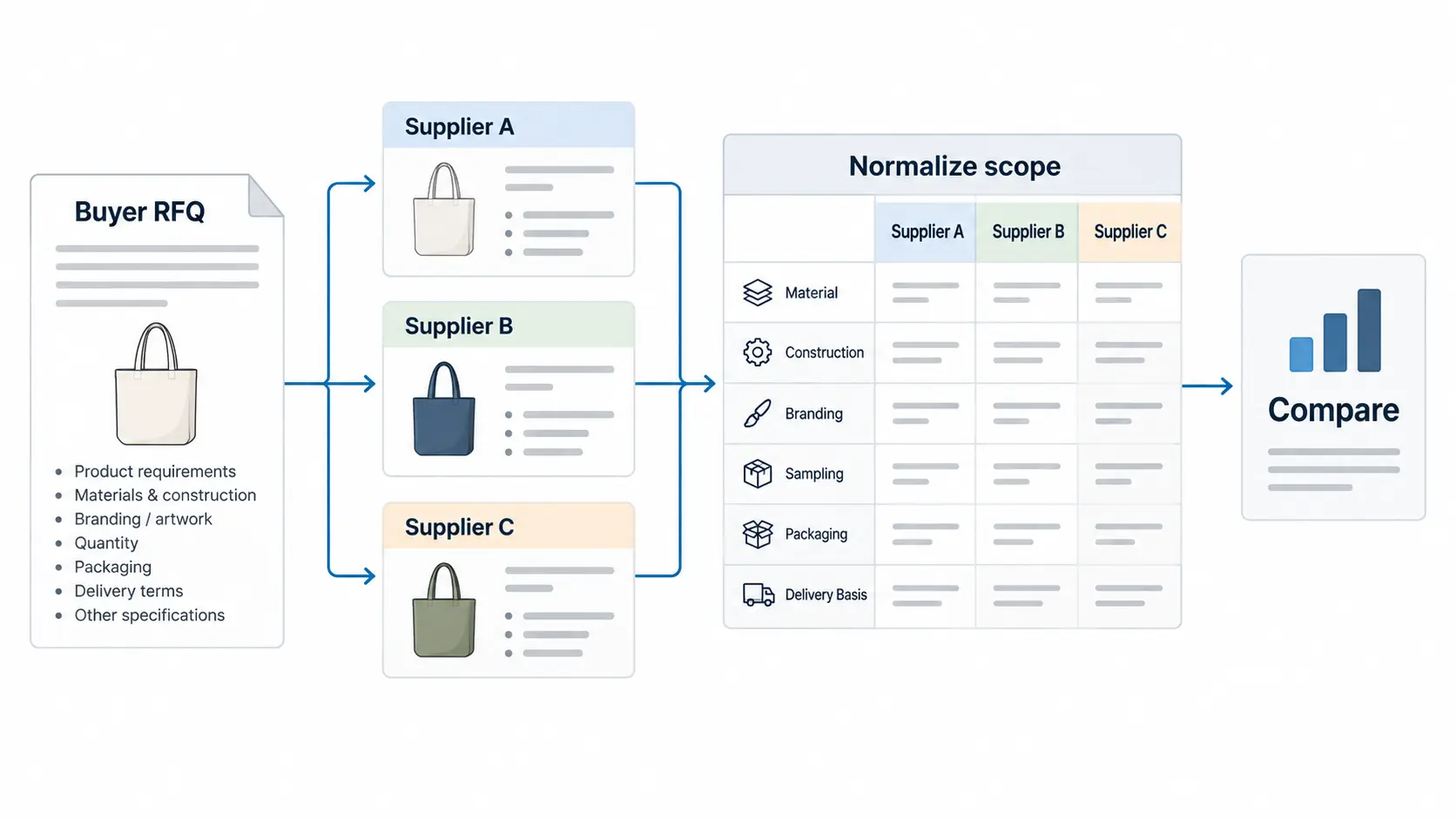
Turn Supplier Assumptions Into a Comparison Table
Once quotations arrive, do not compare only the headline unit prices. Build a normalization table and map every important RFQ field to the supplier's response.
| RFQ Field | Your Request | Supplier Response | Status |
|---|---|---|---|
| Outer material | Fixed / flexible / supplier to recommend | Quoted specification | Matches / alternative / unresolved |
| Construction | Requested features and revision | Included construction | Matches / excluded / alternative |
| Branding | Artwork, size, placement, required result | Quoted process and assumptions | Matches / needs sample confirmation |
| Quantity | Total and SKU split | Quoted quantity and minimums | Matches / different basis |
| Sampling | Approval needs | Proposed sample route and charges | Included / excluded / conditional |
| Quality / tests | Named requirements | Included evidence or test scope | Included / excluded / needs clarification |
| Packaging | Required packing | Quoted packing basis | Matches / different basis |
| Delivery basis | Named destination and price basis | Quoted basis | Comparable / not comparable |
The objective is not to force every supplier to propose the same technical solution. It is to make differences visible. A lower price based on a substitute material may be a useful value-engineering option; it becomes a procurement problem only when the substitution is hidden inside the quote.
The PrintTotes article on hidden costs behind cheap bag quotations explores why exclusions and specification differences matter once the project moves beyond the first unit-price comparison.
What to Do When the Specification Is Incomplete
An incomplete RFQ is not automatically a bad RFQ. Early product-development projects often contain unresolved choices. The important thing is to expose those choices.
| If You Know... | Write... | Avoid... |
|---|---|---|
| The exact requirement | "Fixed: use the attached Rev B drawing." | Calling a fixed item "preferred." |
| The desired outcome but not the material | "Supplier to recommend: exterior should hold its shape when loaded with the stated contents; propose material and construction." | Guessing a fabric weight copied from another product. |
| A preferred option with room to change | "Flexible: cotton canvas preferred; quote proposed alternative separately if recommended." | Allowing an alternative to silently replace the requested basis. |
| The decision is still open | "Unknown: closure type to be selected after first development sample." | Leaving the field blank and assuming everyone interprets the omission the same way. |
This is particularly useful when working through OEM/ODM custom bag development, where some projects start from a controlled design and others start from a use case, reference sample, or partial specification.
A Copy-Ready RFQ Structure
Project: [bag type + intended use]
RFQ revision: [revision/date]
Reference files: [tech pack/drawing/photos/sample reference]
Dimensions and construction: [fixed items + open items]
Material: [fixed / flexible / supplier to recommend + required outcome]
Branding: [artwork file, size, placement, color reference, preferred process if known]
Quantity: [total + color/size/artwork split]
Sample approvals required: [state decisions that must be approved physically]
Quality / testing / compliance: [only the requirements relevant to the order]
Labels and packaging: [requirements or open decisions]
Destination and required date: [location + in-hands date if fixed]
Quotation basis: [currency, requested Incoterms® rule + named place when applicable]
Supplier response: please identify assumptions, exclusions, alternatives, minimums, sample route, and any feasibility issues.
This is a generic planning template, not a PrintTotes quotation form and not a substitute for a product-specific contract or purchase specification.
Before You Send: The RFQ Quality Check
- Can another person identify the exact revision being quoted?
- Are fixed, flexible, unknown, and supplier-recommended items visibly different?
- Does the quantity show SKU or color splits rather than only a grand total?
- Does the artwork request identify the actual decoration requirement without forcing an unsuitable process?
- Are certifications, tests, and inspection requirements scoped to the relevant material, product, facility, order, or market?
- Are packaging and labels included rather than assumed?
- Is the quotation basis clear enough that freight and commercial terms can be compared?
- Have you asked suppliers to state assumptions and exclusions?
A good custom bag RFQ is not the longest document. It is the brief that makes uncertainty visible and turns supplier responses into information your team can actually compare.


