

A private-label bag may carry a large exterior logo, but the smaller label often does a different job: it identifies the brand, carries product information, supports SKU or care information, or gives the product a consistent identity across multiple bag styles.
That is why "add our label" is not a complete manufacturing instruction.
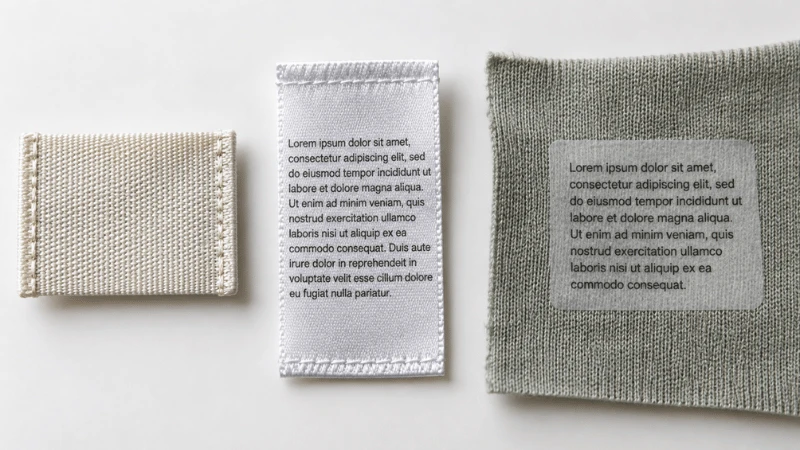
Woven labels, printed fabric labels and heat-transfer labels are different constructions. They handle artwork, small text, attachment, surface texture and future revisions differently. The correct choice depends on what information the label carries, where it sits on the bag, what material it touches and how the finished product will be used and cared for.
Avery Dennison's permanent-branding portfolio separates woven labels, printed fabric labels and internal heat-transfer labels as distinct label solutions. That distinction is useful for custom bag sourcing too, even though many of Avery Dennison's examples are apparel-focused. See the company's permanent branding overview.
Decide the Label's Job Before Choosing the Label Type
A bag can use more than one label because one small component should not be forced to solve every branding and information problem.
| Label Job | What the Buyer Is Trying to Achieve | Typical Direction to Evaluate |
|---|---|---|
| Permanent brand identity | Visible brand name, mark or collection identity that stays with the product | Woven label, printed fabric label, heat transfer or another approved permanent branding method |
| Detailed product information | Material, care, size, model, production or other text required by the program | Printed fabric label often deserves evaluation because dense text can be reproduced directly rather than through a weave |
| Variable information | SKU, lot, barcode, serial or changing data | Printed or separately managed variable-data solution |
| Retail presentation | Temporary price, campaign or point-of-sale information | Hangtag, sticker, sleeve or packaging component rather than a permanent sewn label |
The page job here is permanent and production-applied bag labeling. Retail packaging and carton labels belong in the packaging specification, while large exterior logo methods belong in the tote bag printing methods guide.
Woven Labels: The Design Is Built Into the Textile Structure
A woven label forms the graphic with yarns rather than printing ink onto the label surface. The result has a distinctly textile appearance and can work well when the label is meant to feel like part of the bag rather than a piece of printed information.
For custom bags, woven labels are often worth evaluating for side-seam brand flags, interior brand labels, small exterior brand marks, collection identity and products where a textile trim supports the material language.
The limitation is not simply "woven labels cannot show detail." The real question is whether the selected label size, yarn construction and weaving process can reproduce the specific artwork legibly.
Fine text, hairline strokes, small counters inside letters and subtle tonal gradients can become difficult when the design is translated into woven yarn. Approve the actual woven sample at the intended finished size instead of approving only a vector file.
Printed Fabric Labels: Better When Information Density Matters
A printed fabric label uses a textile label substrate with printed information or artwork. Because the design is printed rather than created by the weave structure itself, this route can be useful when the label needs smaller text, more information or easier artwork revision.
Avery Dennison lists printed fabric labels among its permanent-branding solutions and also uses printed fabric constructions for care and variable-information applications. Its care and content label overview illustrates why printed labels are often selected when the information function is as important as the brand mark.
For a bag program, approve the label substrate, printed artwork revision, finished dimensions, text size and legibility, cut edge or fold construction, sewing position and any program-specific durability requirement.
Do not assume that all printed label inks and substrates have the same wash, rub or chemical resistance. If durability matters, define how it will be tested on the actual label construction.
Heat-Transfer Labels: No Separate Sewn Label, but More Process Dependency
A heat-transfer label applies the graphic or information directly to the receiving surface using a transfer system rather than adding a sewn fabric label.
This can create a clean, low-profile result when the substrate and process are compatible. It can also eliminate a loose label edge inside a pouch or lightweight bag.
However, the label is now dependent on the receiving material, surface coating or finish, application temperature/pressure/dwell conditions for the selected transfer system, panel flexing, intended care method and production consistency.
Approve the physical result on the intended bag material and confirm that the application process does not damage the fabric, coating, lining or nearby construction.
Woven vs Printed vs Heat Transfer: Compare the Job, Not a Generic Ranking
| Decision Factor | Woven Label | Printed Fabric Label | Heat-Transfer Label |
|---|---|---|---|
| Physical form | Separate woven textile component | Separate printed textile component | Graphic/information applied to receiving surface |
| Brand texture | Visible woven textile character | Flatter printed appearance | Low-profile, no separate sewn tag |
| Fine text | Must be proven at actual weave and size | Often easier to reproduce, subject to print process and substrate | Can support fine detail, subject to transfer system and receiving surface |
| Attachment | Sewing / seam insertion / other approved construction | Sewing / seam insertion / other approved construction | Heat and pressure application |
| Main risk to review | Artwork legibility, edges, fold and sewing placement | Print legibility, abrasion/fading, cut/fold and sewing placement | Adhesion, surface compatibility, flexing and process control |
| Best approval evidence | Finished woven label plus bag sample | Finished printed label plus bag sample | Applied transfer on production-intent material |
This table is intentionally not a "best to worst" ranking. Different labels solve different product tasks.
Do Not Confuse a Label With a Large Exterior Decoration
If the goal is a prominent logo across the front panel, a woven side label may be the wrong scale. Screen printing, embroidery, transfer graphics, patches, embossing or another decoration route may better serve that job.
Conversely, a large exterior print does not replace an internal product-information label when the program needs persistent text.
- Primary visual branding: the logo or artwork customers see first.
- Permanent product identity: woven, printed or heat-applied label that stays with the bag.
- Product information: care, material, model, lot or other information required by the program.
- Retail information: hangtags, stickers, barcode cards or packaging elements that may be removed after purchase.
Specify Label Placement From a Physical Reference Point
"Inside the bag" or "near the side seam" is not precise enough for repeat production.
Use a stable construction reference such as centered on a named interior panel, inserted into a specific side seam, a defined distance from the top edge or pocket opening, or aligned with a zipper or lining seam.
Also state orientation. A vertically inserted side flag, horizontal interior label and folded loop label can all use the same artwork but behave differently in production.
Review the placement on the assembled sample. A label that appears well positioned on a flat panel can be hidden by a pocket, distorted by a gusset or caught in a zipper path after assembly.

Fold, Edge and Attachment Construction Matter
For sewn labels, the specification should identify how the label is finished and attached rather than assuming the sewing team will choose the same construction every time.
Depending on the label and supplier, options can include a flat cut label, center fold, end fold, loop fold or seam-inserted flag. The relevant choice depends on the artwork, placement, exposed edges and how the label interacts with the bag.
- Approve finished dimensions after folding.
- Check visible artwork area.
- Review edge appearance and fraying risk.
- Define seam allowance or insertion depth.
- Define stitch position and orientation after the seam is closed.
Build the Label Specification Around the Finished Object
| Field | What to Record |
|---|---|
| Label ID | Brand label, information label, size/SKU label or other defined function |
| Method | Woven, printed fabric, heat transfer or another approved process |
| Artwork revision | Controlled file name or revision |
| Finished size | Dimensions after fold/application |
| Base / material | Supplier article or approved physical sample where relevant |
| Color | Approved physical/sample reference or defined system where applicable |
| Fold / edge | Flat, end fold, center fold, loop or other approved construction |
| Placement | Measured or clearly referenced location on the bag |
| Attachment | Sewing, seam insertion, heat application or other approved method |
| Approval sample | Physical label and assembled bag reference |
| Performance requirement | Only the wash, rub, adhesion or other test actually required by the program |
The custom bag RFQ guide can be used earlier in the project to tell suppliers which label details are fixed and which are still open for recommendation.
Keep Legal and Market Labeling Requirements Separate From Manufacturing Advice
A permanent label may carry material, care, origin, safety, traceability or other information, but the exact legal requirement depends on the product and destination market.
This article does not create a universal compliance label template. The buyer should provide the information fields required by its market, customer or compliance team, then use the label specification to control how those approved fields are physically reproduced on the bag.
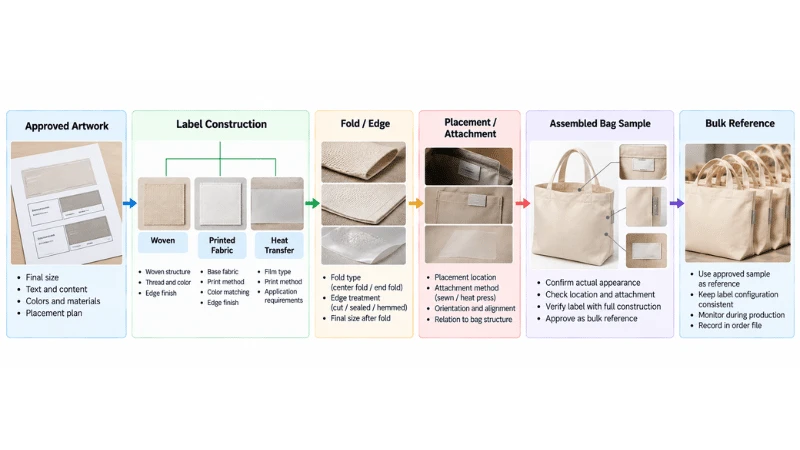
Approve the Label in Two Stages
Stage 1: Approve the Label Component
Check artwork, text, dimensions, colors, weave/print/transfer quality, fold, cut edge and any variable information represented by the sample.
Stage 2: Approve the Label on the Bag
Check placement, orientation, seam capture, accessibility, interaction with the lining or zipper, visibility and appearance when the bag is used normally.
This fits the broader custom bag sample approval framework: approve each input at the level where it can actually be judged, then confirm the combined result on the pre-production sample.
Label Color and Reorders Need Controlled References
Woven yarn, printed ink and a heat-transfer graphic can interpret the same brand color differently. If the label color is critical, give it its own approved reference instead of assuming the body-fabric color approval automatically covers it.
The custom bag color approval guide explains how to separate component-level color decisions.
For repeat orders, retain the approved label sample or supplier article reference together with the released artwork. If the yarn, base material, printing process, transfer system or label supplier changes, decide whether the old approval still predicts the new result. The reorder consistency guide provides the wider delta-review process.
Five Decisions to Make Before Sending the Label Brief
- What job does the label own? Separate permanent brand identity, detailed product information, variable data and removable retail information.
- Which construction fits that job? Compare woven, printed fabric and heat transfer against the actual artwork, receiving surface and use case rather than a generic quality ranking.
- How is the finished label built? Lock the size, fold or edge, attachment method and placement reference.
- What must the physical sample prove? Review legibility, color, edges, attachment and the label on the assembled bag.
- What information is controlled outside the factory artwork? Keep market-specific legal or compliance wording under the buyer's approved requirements instead of asking production to invent it.
Turn the Label Into a Production Reference
A good private-label bag label starts with its job, not with a supplier catalog.
Use woven labels when the woven textile character supports the brand. Use printed fabric labels when information density and print flexibility matter. Use heat-transfer labels when a low-profile applied solution fits the substrate and production process. Then specify size, fold, placement, attachment, artwork and approval evidence so the same label can be reproduced in bulk.
For a project that needs the full private-label bag developed around the branding, labels, materials and packaging, the PrintTotes OEM/ODM custom bag service is the commercial next step.


