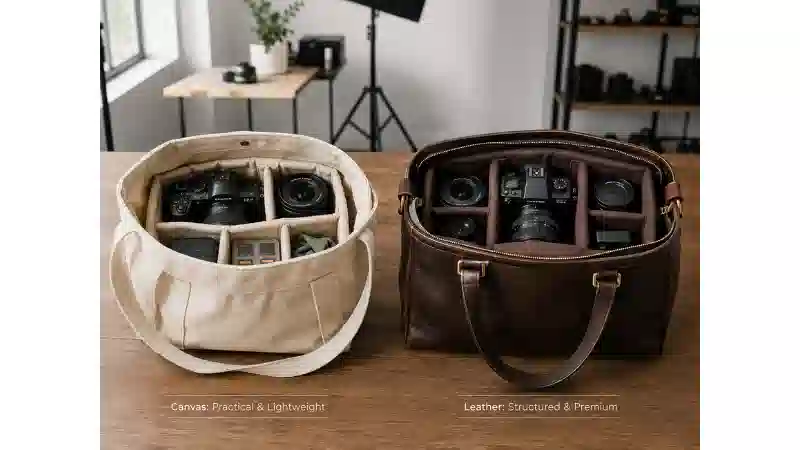
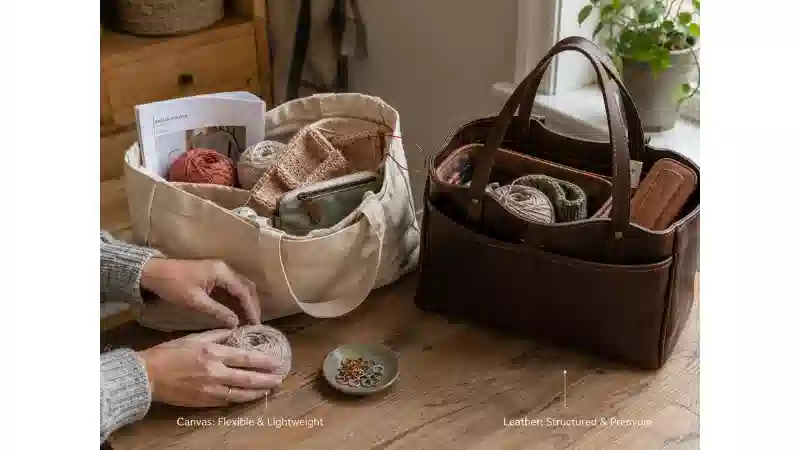
This guide covers the full process, from choosing a fabric to pricing your product, with separate guidance where the two goals genuinely diverge.

Step 1: Choose the Right Material for Your Project
Material weight affects print quality, product durability, and how much a customer is willing to pay. Getting this decision right before you talk to a printer saves time and avoids reprints.
Understanding fabric weight in ounces
Tote bags are measured by fabric weight in ounces per square yard. The number tells you how dense the weave is. In practice, here is what each range means for your project:
- 5–6 oz cotton: Lightweight and economical. Works for high-volume giveaways where cost per unit matters most. Ink can bleed through on the thinnest versions, and the bag lacks structure under a full load.
- 8–10 oz canvas: The most common range for general commercial use. Holds its shape, accepts screen printing cleanly, and has enough body to feel like a considered product.
- 12 oz and above: Heavyweight canvas that communicates quality at a glance. Appropriate for retail pricing above $20, artisan markets, and corporate gifting where premium positioning matters.
For a deeper comparison of how cotton and canvas differ in weight, weave, and print behaviour, this breakdown of cotton tote bags vs canvas tote bags covers the practical differences buyers most often overlook. If you want to understand canvas specifications in more detail before requesting samples, the canvas fabric types and weights guide is a useful reference.
Material types and what each suits
Natural cotton canvas is the most versatile and printable option. It accepts screen printing, DTG, and embroidery with predictable results and is the default choice for most commercial projects.
Recycled or organic cotton carries a sustainability credential that matters to specific audiences - eco-conscious brands, zero-waste retailers, environmental nonprofits. Expect a moderate cost premium. For buyers comparing the environmental claims of different materials, this material sustainability comparison lays out the evidence clearly. For a broader look at natural fabric trade-offs, see cotton, jute, and canvas compared.
Non-woven polypropylene is the lowest-cost option and common for single-event giveaways at very high quantities. It is not suitable for detailed printing and communicates budget more than quality.
Polyester is required for sublimation printing. If edge-to-edge all-over printing is part of your concept, the bag must be polyester.
The most common material mistake: choosing too-thin a fabric for the intended print method. Anything under 6 oz carries a real risk of ink bleed-through with screen printing. If you are investing in printing, invest proportionally in material that supports it.

Step 2: Pick a Printing Method That Matches Your Order
The five main printing methods are genuinely different in cost structure, minimum order quantities, design limitations, and durability. Matching the method to your situation is a decision, not a preference.
How the five methods compare
| Method | Best For | Cost Efficiency | Typical MOQ | Color Range | Durability |
|---|---|---|---|---|---|
| Screen Printing | Bulk logos, brand campaigns | High at 50+ units | 12–24 pcs | Up to 4–6 spot colors | Excellent |
| Heat Transfer (HTV) | Small runs, names, simple shapes | Low setup cost | 1 piece | Simple flat colors | Good |
| Direct-to-Garment (DTG) | Photo-quality, multi-color designs | Best under 50 units | 1 piece | Unlimited | Good (gentle care required) |
| Sublimation | All-over prints on polyester | Good at 12–50+ units | 1 piece | Unlimited (polyester only) | Excellent |
| Embroidery | Premium retail, structured logos | Higher per unit | 12 pcs typically | Thread palette | Excellent |
One detail that catches first-time buyers off guard: screen printing charges a setup fee per color, per design - typically $25–$75 per color. At 50 units, a two-color design might add $2–$3 per unit in setup costs that do not appear in the per-unit price quote. Always request an all-in cost. For a more detailed walkthrough of each method's technical requirements, this printing methods guide covers the process side in depth.
Quick decision guide
- Promotional giveaway, 100+ units, company logo: Screen printing
- Small Etsy shop, testing designs, under 30 units: DTG or HTV
- Premium retail product above $25: Embroidery or screen print on heavyweight canvas - browse embroidered cotton shopping bags for examples of how this looks in production
- Fashion-forward all-over design: Sublimation on polyester
DTG on dark fabrics requires a white underbase layer to make colors show correctly. Some suppliers include this as standard; others charge extra or skip it. Confirm before ordering and request a proof print on the actual dark bag you plan to produce.

Step 3: Prepare Your Design File Correctly
Incorrect file preparation is one of the most consistent sources of delays and reprints. It is also one of the most avoidable problems.
Format requirements
For screen printing and embroidery, use vector files - Adobe Illustrator (.ai), .eps, or .svg. Vector files scale to any size without losing sharpness because they are built from mathematical paths, not pixels. A logo saved as a 72 DPI JPEG will print with visible pixelation on a bag.
For DTG and sublimation, 300 DPI raster files at the intended print size are the standard. A file that looks sharp on screen at 72 DPI will print poorly - always check resolution at actual print dimensions, not at the small thumbnail you use for previews.
Color mode and brand accuracy
Screens display color in RGB. Printers reproduce color in CMYK. Certain colors - electric blues, hot oranges, vivid greens - shift noticeably in conversion. Always provide CMYK-converted files to your printer. For brand-critical work, specify colors using Pantone (PMS) codes. PMS is a standardized physical color matching system; a Pantone number gives your printer something specific to match. A hex code from your website does not.
Sublimation does not support Pantone matching. If exact brand color accuracy is required, sublimation is the wrong method.
Design file checklist before submitting
- Vector file (AI/EPS/SVG) for screen printing or embroidery
- 300 DPI at actual print dimensions for DTG or sublimation
- Color mode set to CMYK
- Pantone colors specified if brand accuracy is required
- Print size and placement documented in writing
- Digital mockup or physical proof approved before production begins
Step 4: Source from a Supplier You Can Actually Rely On
Most quality problems in this category trace back to insufficient vetting before the order is placed, not the printing method itself.
What to confirm before committing
Ask these questions before placing any bulk order:
- What is your MOQ for blank bags? For custom printed bags?
- Do you offer a printed sample before production begins - and who pays for it?
- What file formats do you require for artwork?
- What is the production turnaround after proof approval?
- Are setup fees included in your per-unit quote, or billed separately?
- What is your policy if the finished print does not match the approved proof?
- What are the exact imprint area dimensions for this specific bag?
- Is this style consistently in stock year-round?
On the sample question: a reliable supplier will allow you to order a physical sample, either blank or with a test print, before committing to production. Fabric weight feels very different in hand compared to a spec sheet. A bag that reads "10 oz canvas" from two different suppliers can feel substantially different in use. If a supplier discourages sampling, that is worth noting. For more on how MOQ structures affect your pricing and planning, this MOQ guide for bulk bag production explains the trade-offs clearly, and the MOQ, lead time, and cost reference gives a practical overview of what to expect at different quantity levels.
For buyers considering a custom manufacturing partner rather than sourcing from catalog stock, PrintTotes' OEM customization service offers specification-level control over materials, printing, and labeling.
Domestic vs. overseas sourcing
Domestic suppliers offer faster turnaround, simpler communication, and easier quality resolution. Per-unit costs are higher. Overseas sourcing reduces unit cost at higher quantities but introduces longer lead times, higher MOQs, and more complex logistics. For a first order or for quantities under a few hundred units, starting domestic reduces risk significantly.

Making Money: The Profit Path
Know your real cost before setting any price
First-time sellers consistently underestimate their landed cost because they calculate from the blank bag price alone. Your actual cost per unit includes:
- Blank bag (wholesale price at your quantity)
- Printing (including setup fees amortized across the run)
- Inbound shipping from supplier
- Packaging (hang tags, tissue paper, branded packaging if applicable)
- Platform fees: Etsy charges a transaction percentage plus listing fees; Shopify charges a monthly fee plus payment processing
From cost to retail price
A common starting point for handmade and independent retail products is a 2.5–3× multiplier on your total landed cost. At a landed cost of $7–$9 per unit (blank bag + printing + shipping, typical for a mid-weight screen-printed cotton bag at around 100 units), a retail price of $20–$25 falls within a range that buyers on Etsy and at local markets find reasonable for a quality canvas tote. That margin needs to cover platform fees, outbound shipping, and any returns - factor those in before confirming your price.
Build your pricing from actual supplier quotes, not from general estimates. The spread between estimated and real per-unit cost is wider than most new sellers expect.
Where to sell
Etsy is the most accessible starting point. Its search surfaces niche designs organically, and buyers specifically look for independent products. Shopify offers higher margins and full brand control but requires your own traffic. Print-on-demand platforms (Printful, Printify) eliminate inventory risk and are the right starting point for testing designs - margins are lower, but there is no upfront cost. Once a specific design proves out, switching to wholesale printing cuts per-unit cost significantly. Local markets and pop-ups offer the highest effective margins (no platform fees, direct buyer connection) and provide immediate feedback on which designs actually sell. Corporate gifting and B2B events generate high-volume, repeatable orders that individual sellers often overlook. Browse cotton shopping bags available for wholesale customization for a sense of what's available at production scale, including options like silk-screen printed cotton shopping bags that work well across all these channels.
Why niche selection matters more than design quality alone
A technically excellent generic tote bag competes on price. A bag designed specifically for dog breed owners, elementary school teachers, avid readers, or local city fans commands a meaningful price premium and generates organic social sharing that generic products do not. Spend time on Etsy search and Google Trends to identify underserved communities before committing to a design direction.
Getting Maximum Value from Promotional Bags
According to the Promotional Products Association International (PPAI), reusable bags consistently rank among the promotional products with the highest number of impressions per dollar spent - because unlike a brochure or a branded pen, a bag people actually use generates ongoing brand exposure at no additional cost.
The bag that gets used daily is worth far more than the cheaper bag that ends up in a closet. That trade-off is worth keeping in mind when comparing per-unit costs. For inspiration on how reusable bag giveaways work across different campaign types, this guide to customizable swag bag giveaways covers real use cases.
Match the bag to the context
- Trade shows and conferences: Mid-to-heavyweight canvas with long shoulder handles and enough capacity for a catalog, a water bottle, and a laptop. Practicality determines carry rate at these events.
- Product launches and brand activations: A bag that functions as an accessory, not just a tote. Color, silhouette, and handle length matter as much as the logo. A bag someone would carry on a Saturday to a market is a more powerful brand vehicle than one that reads as swag.
- Community events and high-volume giveaways: Lightweight cotton or non-woven at scale. Be honest about whether these will be carried after the event - that honesty leads to better budget decisions.
- Employee onboarding: Heavyweight canvas with embroidery or quality screen print. Employees who receive a genuinely good bag become ongoing brand ambassadors.
One design principle most brands get wrong
Oversizing the logo is the single most common design mistake in promotional tote bags. A bag covered edge-to-edge with a corporate logo reads immediately as promotional merchandise, which reduces the likelihood that anyone carries it daily. Consider a design where the brand name or logo is present but the overall bag has visual appeal on its own - a well-crafted illustration, a typographic treatment that communicates brand personality, something a person would carry independent of the promotional context. That is the bag that generates daily impressions.
Caring for Printed Tote Bags
The longevity of a print depends as much on washing habits as on the printing method. Whether you are including care instructions in an order, or advising customers after a sale: cold water, gentle cycle, and air drying preserve both the fabric and the print. Turn the bag inside-out before washing to reduce friction on the print surface. Avoid ironing directly on printed areas. DTG prints especially benefit from gentle care in the first several washes while the ink fully cures. For more on keeping cotton bags looking their best, this care guide for cotton bags covers the key steps.
Frequently Asked Questions
What is the minimum order for custom wholesale tote bags?
It depends on the supplier and method. Many domestic suppliers have no minimum for blank bags. Custom screen-printed orders typically start at 12–24 pieces. DTG and print-on-demand platforms can fulfill single units.
Is screen printing or DTG better for bulk tote bag orders?
Screen printing is more cost-effective for orders above 50 units with designs of one to four colors. DTG is better for small quantities, photographic images, or complex artwork where per-color screen printing setup fees are not justified by the run size.
What fabric weight is best for printed tote bags?
For most commercial and retail purposes, 8–12 oz canvas provides the best balance of print quality, durability, and perceived value. Below 6 oz, ink bleed-through becomes a real risk and the bag lacks the structural feel that supports premium pricing.
Can I customize tote bags at home and sell them?
Yes. A heat press and heat transfer vinyl is the most accessible home setup, producing durable results on cotton canvas. A basic heat press typically costs between $100 and $300. This approach works well for small batches and simple designs.
How do I find a reliable wholesale tote bag supplier?
Request a printed sample before committing to bulk. Confirm fabric weight and imprint area dimensions in writing. Ask about setup fees upfront and get a fully landed per-unit price at your target quantity. Reviews from B2B buyers are more relevant than general consumer reviews.
What colors work best for branded tote bags?
Natural and white bases give the most accurate color reproduction for multi-color logos. For a fashion-forward promotional item, deep tones - forest green, charcoal, navy - paired with a single-color imprint consistently perform well and carry genuine retail appeal.
Summary
Customizing wholesale tote bags successfully comes down to a sequence of well-made decisions: material weight sets your quality ceiling and retail pricing potential; printing method determines cost structure and design flexibility; file preparation determines whether the final print matches what you approved; supplier vetting determines whether the product you receive matches what you ordered.
If your goal is retail profit, build your pricing model from confirmed per-unit costs before committing to any design, use print-on-demand to test designs before investing in inventory, and focus on niche positioning to avoid competing purely on price. If your goal is brand promotion, invest in design quality over logo scale, match material weight to the event context, and think in terms of carry rate - a $4 bag someone uses daily is worth more than a $1.50 bag that sits unused.
Ready to move forward? Browse the full product range or submit a customization inquiry to get started with specific requirements.