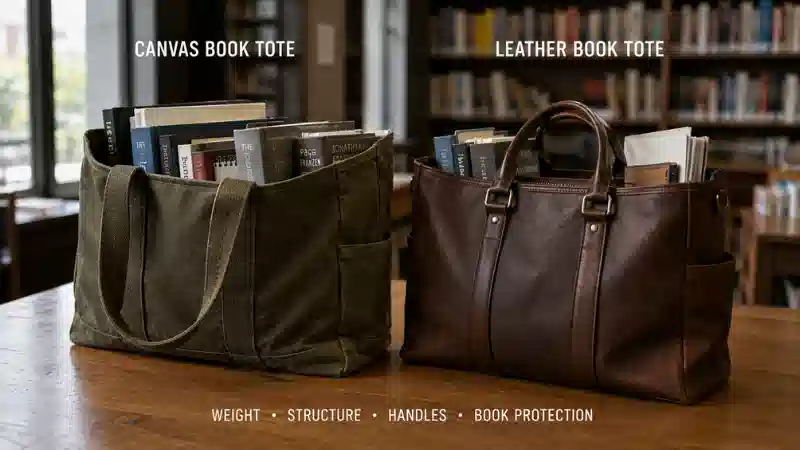
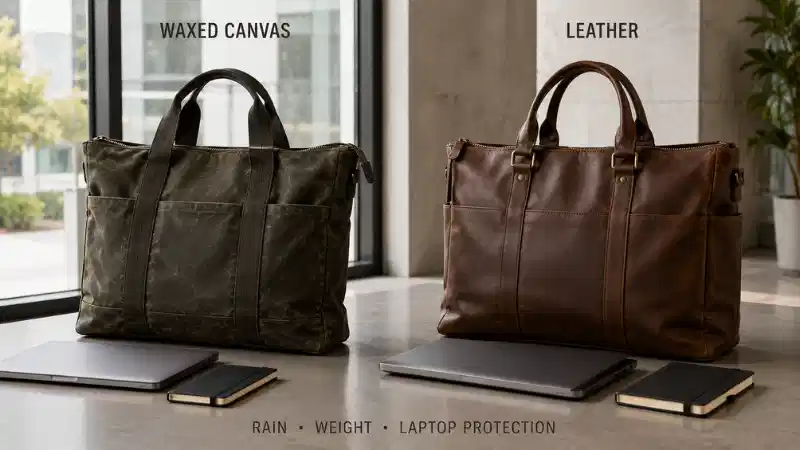
A teacher tote rarely carries just one type of item. During a normal school day, the same bag may hold a laptop, charger, folders, graded papers, textbooks, pens, a water bottle, lunch, keys, and personal belongings.
That mixed load makes choosing a teacher work bag more complicated than comparing canvas and leather by appearance alone.
For frequent classroom use, a well-constructed canvas teacher tote is usually the more practical choice. It can offer lower empty weight, flexible pocket layouts, a broad decoration area, and enough capacity for books and teaching supplies.

A leather teacher tote may be more appropriate when the daily load is controlled, formal presentation matters, and the user accepts more material-specific care. It may suit meetings, conferences, administrative work, or a premium individual gift.
The best tote bag for teachers is the one designed around the actual contents. Material narrows the choice, but usable dimensions, organization, handles, closure, lining, and base determine whether the tote works throughout the school day.
Quick Answer and Material Comparison
Choose canvas when the tote must carry a varied school-day load, remain reasonably light, provide visible school or teacher artwork, and support practical features such as a gusset, laptop sleeve, bottle pocket, and full zipper.
Choose leather when a structured professional appearance, restrained personalization, and premium presentation are higher priorities than minimum weight or maximum capacity.
| Decision Factor | Canvas Teacher Tote | Leather Teacher Tote |
|---|---|---|
| Typical empty weight | Usually lower in comparable constructions | Often higher when substantial leather, lining, panels, and hardware are used |
| Daily mixed load | Practical when the tote includes suitable pockets, handles, gusset, and base support | Suitable when the load is controlled and the internal organization is carefully designed |
| Appearance | Casual to polished, depending on color, shape, finish, and hardware | Often structured and compatible with formal dress codes |
| Routine care | Depends on fiber, fabric finish, decoration, lining, and washing instructions | Depends on the exact leather type, surface finish, and manufacturer guidance |
| Personalization | Supports visible printing, embroidery, patches, labels, and school artwork | Often suits embossing, debossing, stamping, initials, and restrained details |
| Best use | Classroom work, school events, staff gifts, and teacher appreciation programs | Meetings, administrative roles, conferences, and premium individual gifts |
Teachers considering a simple canvas format can review common cotton shopping bag constructions as a starting point. A teacher tote will normally require additional organization and reinforcement beyond a basic open shopping bag.
What Does a Teacher Tote Actually Need to Carry?
A useful way to evaluate capacity is to build a realistic school-day load before choosing the material or bag dimensions.
Example Teacher Workday Load
A representative load may include:
- one laptop or tablet;
- one charger and a small set of cables;
- two folders or a binder;
- one textbook or several workbooks;
- a notebook or planner;
- a water bottle;
- a removable lunch pouch;
- pens, keys, access cards, and personal items.
This is an example, not a required packing list. A teacher who carries art supplies, sports equipment, laboratory materials, or large stacks of student work may need a different bag format.
Books, Folders, and Papers
Books create a dense load at the base, while folders and graded work require enough width and height to remain flat. The opening must be large enough for the widest binder or folder to enter without forced bending.
A bottom gusset can create a more usable resting surface for books and boxed classroom materials. Smooth lining and covered interior seams help reduce abrasion against book covers and paper edges.
Laptop and Hard Accessories
A laptop sleeve should be checked using the computer's complete external width, height, and thickness. Screen size alone does not confirm fit.
A padded sleeve can reduce scratches and light contact but should not be presented as certified drop protection unless the exact finished bag has been tested for that purpose. A suspended sleeve that ends above the base adds separation when the tote is placed on a desk or floor.
Chargers, adapters, power banks, and hard cases should have separate storage so they do not press directly against the computer.
Lunch, Bottle, and Personal Items
Liquids should be separated from electronics and paper. An upright bottle pocket or divider can reduce movement, but the bottle must still close securely.
Lunch can introduce moisture, crumbs, odors, and additional cleaning requirements. A removable insulated pouch is often more practical than placing food directly beside teaching materials.
Compare the Exact Canvas or Leather Specification
Canvas Is Not One Fixed Grade
Canvas describes a fabric construction rather than one guaranteed level of strength. Fiber content, weave, fabric weight, finish, lining, stitching, and bag dimensions all affect the finished teacher tote.
The guide to canvas fabric types, weights, and uses explains which specifications should be requested from a supplier.
Cotton and canvas are not interchangeable terms. Cotton identifies a fiber, while canvas identifies a fabric construction. The comparison of cotton tote bags and canvas tote bags explains that distinction.
Buyers comparing swatches may also need to distinguish cotton canvas from cotton twill. A smooth or heavy-looking swatch does not reveal how the finished handles, seams, gusset, or base will perform.
Before approving canvas, ask for:
- fiber content;
- fabric construction and weight;
- surface treatment or coating;
- lining specification;
- handle material and attachment;
- recommended cleaning method;
- decoration compatibility.
"Leather" Can Describe Different Materials
Full-grain, top-grain, split, bonded, coated, and imitation leather products do not provide identical weight, aging, maintenance, or surface behavior.
The Federal Trade Commission Leather Guides address misleading representations concerning the composition and characteristics of leather and imitation-leather products. Buyers should request a clear material description instead of relying only on a label such as "leather" or "genuine leather."
Before approving leather, ask for:
- leather type and thickness;
- surface coating or finish;
- backing and lining;
- edge treatment;
- hardware specification;
- cleaning and conditioning instructions;
- the finished empty-bag weight.
A leather tote may align more easily with a formal dress code, but professional appearance also depends on color, silhouette, hardware, edge finishing, logo visibility, and how well the bag holds its shape.
How Should a Teacher Tote Be Organized?
One large compartment can appear spacious but become difficult to use when a laptop, papers, bottle, lunch, cables, and classroom supplies are mixed together.

Protect Electronics
Confirm that the laptop sleeve:
- fits the actual device and protective shell;
- covers the computer without excessive pressure;
- allows the laptop to pass through the bag opening;
- remains above the base where possible;
- does not share space with bottles or lunch containers;
- has separate storage nearby for the charger.
Keep Papers Flat
Folders and graded work need a flat section that prevents corners from folding. Internal pockets should not reduce the usable width so severely that papers must be bent to enter the bag.
Use Pockets Selectively
Useful organization may include a bottle pocket, charger pouch, pen slots, key clip, zippered valuables pocket, and exterior phone pocket.
More pockets are not automatically better. Too many small compartments can reduce capacity and make larger items harder to insert. The layout should reflect the teacher's actual routine.
Size, Opening, Gusset, and Carrying Comfort
External bag dimensions do not describe the complete usable capacity. Thick seams, lining, zippers, internal pockets, and reinforcement can reduce the available space.

Before buying, measure:
- the laptop or tablet, including any protective shell;
- the widest folder or binder;
- the tallest book;
- the normal book-stack thickness;
- the lunch pouch;
- the water bottle;
- the tote's usable opening;
- the internal base width;
- the gusset depth.
A bottom gusset creates a wider base. A full gusset adds capacity around the sides and bottom. More depth does not automatically produce a stronger bag, because the handles, seams, fabric, and base still have to support the additional contents.
An overly deep tote can also make keys, pens, and a phone difficult to reach. Extra capacity may encourage overpacking without improving organization.
Handles and Empty-Bag Weight
Teachers may carry the same tote between a parking area, school entrance, classroom, office, staff room, and meeting space. The finished empty-bag weight therefore matters before books and equipment are added.
Check:
- handle width and edge finishing;
- handle drop;
- attachment and reinforcement;
- whether the tote fits over seasonal clothing;
- how close the loaded bag sits to the body;
- whether hardware presses against the arm;
- whether the bag swings while walking.
A wider handle may spread pressure more comfortably than a narrow strap, but stiffness and edge finishing still affect comfort. A physical sample provides more useful information than handle measurements alone.
Weather, Cleaning, and When a Backpack Is Better
Weather and Daily Care
Untreated canvas can absorb moisture. A zipper, suitable lining, protected base, and separate laptop cover may be useful for teachers who walk between buildings or use public transportation.
AATCC TM22 evaluates how textile fabric resists surface wetting. A fabric-level result does not prove that a complete teacher tote is waterproof, because water may still enter through the opening, zipper tape, seams, stitching holes, pockets, or base.
General guidance on protecting a cotton bag from moisture and wear can help canvas buyers plan routine care. The article discussing whether canvas bags get dirty easily also explains how color, finish, and daily handling affect visible soil.
Leather care depends on the exact material and finish. Moisture should normally be blotted rather than aggressively rubbed, and the tote should dry naturally away from direct heat. The product manufacturer's care instructions should remain the primary reference.
For either material:
- empty the bag regularly;
- remove crumbs and paper debris;
- contain leaking pens and bottles;
- dry moisture before storage;
- avoid crushing the tote under heavier objects;
- inspect handles, seams, lining, and closure periodically.
When a Backpack May Be More Practical
A tote is not the best format for every teacher. A backpack may be more appropriate when the load is consistently heavy, the walking distance is long, stairs are frequent, both hands must remain free, or the tote swings uncomfortably during movement.
Material choice cannot correct an unsuitable carry format. A well-organized backpack may serve a heavy daily load better than either a canvas or leather shoulder tote.
How to Test a Teacher Tote Before Buying
Test the bag with representative contents rather than soft filler. A single inspection cannot establish long-term capacity, but it can reveal obvious sizing, balance, access, and construction problems.

- Build the normal load: add the laptop, charger, folders, books, bottle, lunch pouch, and typical classroom supplies.
- Check the fit: confirm that the largest items pass through the opening and rest without forced bending.
- Inspect the base: place the bag on a flat surface and check whether the gusset opens properly or the bottom twists.
- Carry the tote: walk with it and assess handle pressure, balance, swinging, and access.
- Inspect the contents: remove the items and check for bent papers, rubbed book corners, pressure against the laptop, bottle movement, lining transfer, or lasting distortion.
Sample Pass and Fail Indicators
| Inspection Area | Acceptable Observation | Reason to Revise or Reject |
|---|---|---|
| Laptop fit | The device enters easily and the sleeve closes without pressure | The laptop must be forced through the opening or the sleeve cannot close |
| Folder fit | Folders and papers remain flat | Documents must bend or their corners are crushed |
| Bottle storage | The bottle remains upright and separated from electronics | The bottle falls against the laptop or papers |
| Base and gusset | The base remains usable and the gusset opens as intended | The bottom twists sharply or the loaded bag cannot stand as required |
| Handles | Handles remain aligned and comfortable for the intended carry | Attachment opens, remains distorted, or creates unacceptable pressure |
| Closure | The zipper or closure operates while the bag is loaded | The closure catches, cannot fasten, or compresses the contents |
| Lining | No visible tearing, severe abrasion, or color transfer | The lining transfers color, exposes rough seams, or tears at contact points |
| Artwork | The logo remains visually balanced after loading | Gusset expansion or folds move the design into an unacceptable position |
Any formal load-capacity claim should be supported by documented testing of the exact finished construction. Visible stitching or thick material alone cannot establish a universal rating.
Price, Long-Term Value, and School Orders
Price and Cost per Use
Leather often has a higher initial price, but the lowest quotation is not automatically the best value. A teacher tote that is too heavy, incorrectly sized, difficult to clean, or poorly organized may be used less often or replaced earlier.
Approximate cost per use = total ownership cost divided by the expected number of uses
Total ownership cost may include:
- purchase price;
- cleaning and conditioning supplies;
- handle, zipper, lining, or hardware repair;
- replacement of an unsuitable bag;
- sampling, packaging, and delivery for a custom order.
The guide to the hidden costs behind cheap bags explains why a low quotation may reflect differences in material, stitching, reinforcement, and quality control.
Environmental value should also be assessed through sourcing, processing, durability, repairability, actual reuse, and disposal rather than the material name alone. The comparison of which bag material is more sustainable provides a broader decision framework.
For Schools, Districts, and Teacher Appreciation Buyers
Custom teacher totes may be used for staff onboarding, school events, reading campaigns, department merchandise, retirement gifts, and teacher appreciation programs. The guide to customizable reusable-bag giveaways offers additional planning ideas for promotional projects.
Canvas commonly supports screen printing, transfer applications, embroidery, patches, and woven labels. Leather may suit embossing, debossing, stamping, monograms, or restrained metal details. The final result depends on the material surface, thickness, artwork, equipment, and sample approval.
The overview of six tote bag printing methods can help buyers narrow the decoration process before sampling.
Environmental and material claims should be supported by relevant documentation rather than generic badges. The guide to environmental certifications for custom tote bags explains what buyers may need to request.
Before requesting a quotation, confirm:
- intended recipients and typical contents;
- finished dimensions and usable opening;
- canvas weight or leather specification;
- gusset and base construction;
- handle length, width, and attachment;
- laptop, bottle, lunch, and paper organization;
- closure and lining;
- artwork size and location;
- quantity and packaging;
- sample stages and approval criteria;
- delivery date and acceptable tolerances.
The MOQ, lead-time, and cost guide can help schools prepare a complete sourcing brief. The explanation of how MOQ affects bulk bag production provides further context for comparing quotations.
PrintTotes also provides information about its OEM bag services. Buyers with confirmed specifications, artwork, quantity, and delivery requirements can submit them through the custom bag inquiry page.
Buying Checklist and Common Mistakes
Specifications to Confirm
- exact exterior material and finish;
- canvas construction and weight or leather type and thickness;
- finished empty-bag weight;
- usable internal dimensions;
- opening or zipper width;
- laptop-sleeve dimensions and position;
- bottle and lunch separation;
- gusset and base reinforcement;
- handle width, drop, and attachment;
- lining and closure;
- cleaning instructions;
- decoration compatibility;
- warranty or repair options.
Common Mistakes
- Choosing only by material name: canvas does not guarantee strength, and leather does not guarantee professional construction.
- Buying the largest tote available: excess capacity adds weight, encourages overpacking, and makes small items harder to reach.
- Ignoring the usable opening: a wide main compartment may still have a zipper or top structure that blocks a binder or laptop.
- Placing liquids beside electronics: internal leaks are not prevented by the exterior material.
- Approving only a digital mockup: a screen cannot confirm usable dimensions, material feel, handle comfort, loaded shape, or artwork position.
FAQ
Q: Is canvas or leather better for a teacher tote?
A: Canvas is usually more practical for frequent classroom use, mixed loads, visible artwork, and school programs. Leather may suit controlled loads, formal meetings, administrative work, and premium individual gifts.
Q: What size teacher tote should I choose?
A: Measure the laptop, widest folder, tallest book, normal book stack, lunch pouch, and bottle. Compare those measurements with the tote's usable opening, internal base, height, and gusset.
Q: Should a teacher tote have a laptop compartment?
A: A separate padded compartment is useful when a laptop or tablet is carried regularly. Confirm its internal dimensions, position above the base, and separation from bottles and hard accessories.
Q: How many pockets should a teacher tote have?
A: There is no ideal number. Prioritize separate storage for electronics, liquids, papers, keys, pens, and frequently used items. Too many small pockets can reduce the capacity for folders, books, and lunch.
Q: Does a teacher tote need a zipper?
A: A zipper improves security during public transportation, outdoor movement, school events, and travel between buildings. An open top provides faster access but less protection from rain and accidental spills.
Q: Are leather teacher totes too heavy?
A: Not necessarily. Weight depends on the leather type, dimensions, lining, panels, pockets, and hardware. Request the finished empty-bag weight and test the tote with a representative school-day load.
Q: Can teacher tote bags be personalized?
A: Yes. Canvas supports visible printed or embroidered designs, while leather commonly suits smaller embossed, debossed, or stamped personalization. The decoration should be approved on the actual finished material.
Final Recommendation
Choose canvas when the tote must carry a varied school-day load, remain reasonably light, provide practical organization, and support visible school or teacher artwork.
Choose leather when the expected contents are more controlled and formal presentation, tactile finish, or premium gifting matters more than minimum weight.
Choose a backpack or another carry format when the daily load is consistently heavy, walking distances are long, or hands-free stability is more important than the open access of a tote.
The most reliable approach is to select the bag from the contents outward. Measure the laptop, books, folders, lunch, and bottle first. Then choose the opening, dimensions, gusset, handles, pockets, closure, lining, base, and material that support the teacher's actual routine.