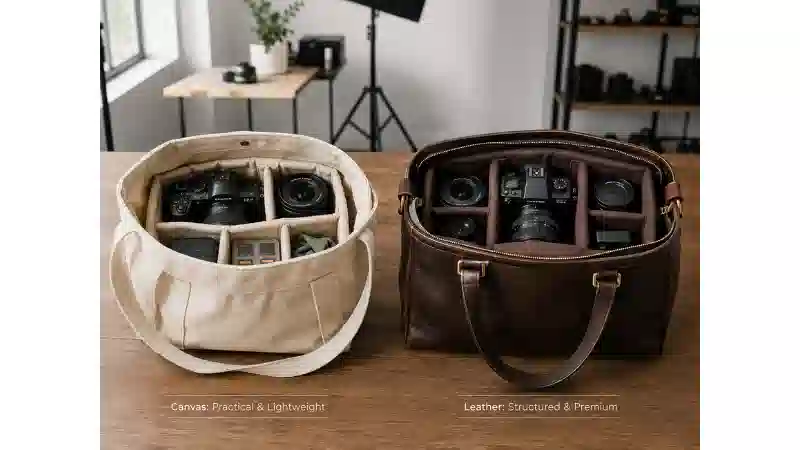
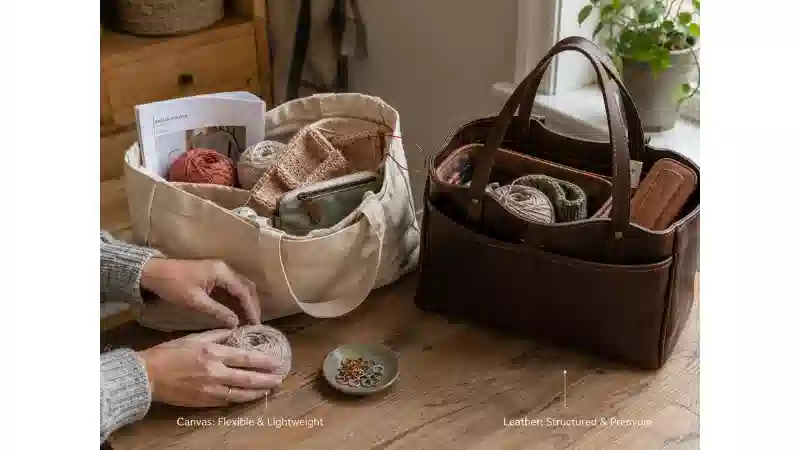
A garden tool tote has to manage contents that are awkward, dirty, uneven, and sometimes sharp. Pruners need controlled blade storage, trowels may return covered in soil, damp gloves must be separated from seed packets, and a small spray bottle can upset the balance of the entire bag.
For routine vegetable, flower, and container gardening, a well-constructed canvas garden tool tote is usually the more practical option. Canvas can support varied exterior pockets, a wide opening, a removable base insert, and visible custom artwork without necessarily adding the empty weight of a substantial leather construction.
A leather garden tool tote can work for a smaller and carefully controlled hand-tool set, especially when structured presentation, tactile finish, or premium personalization matters. It requires more protection from wet soil, standing moisture, fertilizer residue, and frequent cleaning.
The material name does not settle the decision. Pocket dimensions, blade protection, base stability, handle balance, internal separation, closure design, cleaning instructions, and replaceable components often have a greater effect on everyday use.
This article provides a product-selection and sample-review framework. It does not report a laboratory load test or establish a universal carrying capacity for any tote construction.

Quick Comparison: Canvas or Leather for Garden Tools?
| Decision Factor | Canvas Garden Tool Tote | Leather Garden Tool Tote |
|---|---|---|
| Typical empty weight | Often lower when dimensions and reinforcement are comparable | Can be higher when thick material, lining, panels, and metal fittings are used |
| Soil exposure | Practical when dry dirt can be brushed away and inserts can be removed | Requires more careful material-specific cleaning |
| Moisture | Untreated canvas may absorb water; treated canvas still depends on seams and openings | Response depends on leather composition and finish; prolonged moisture should be avoided |
| Pocket construction | Can accommodate varied sewn pockets and replaceable organizers | Complex pockets may increase weight, material use, and repair cost |
| Shape | Flexible unless reinforced with lining or a base panel | Often more structured, although this varies by material and construction |
| Customization | Supports printing, embroidery, patches, and woven labels | Often suits embossing, debossing, initials, and restrained details |
| Best starting point | Routine gardening, workshops, community programs, and garden-center promotions | Controlled tool kits, premium gifts, and traditional presentation |
Choose canvas when the bag will regularly carry soil-covered hand tools and needs flexible organization. Choose leather when the tool list is smaller, exposure to dirt and water is limited, and premium presentation justifies more careful maintenance.
Choose the Tote by Gardening Task
A short seed-starting session does not require the same bag as a pruning or planting job. Start with the gardening task before comparing materials.
| Gardening Task | Typical Contents | Priority Tote Feature |
|---|---|---|
| Balcony or container gardening | Small trowel, gloves, labels, ties | Compact dimensions and a clean zippered pocket |
| Planting and transplanting | Trowel, cultivator, gloves, plant ties | Wide tool pockets and a stable removable base |
| Pruning | Locked pruners, snips, gloves, ties | Deep reinforced pocket and controlled blade position |
| Harvesting | Snips, gloves, ties, labels, collection pouch | Fast access and balanced carrying |
| Seed starting | Seed packets, labels, marker, small tools | Dry internal storage separated from wet supplies |
| Community workshop | Standardized hand-tool and planting kit | Clear pocket layout, repeatable specifications, and simple sample approval |
A gardener who mainly carries labels and a small trowel may not need a large stand-up tote. A pruning-focused user may care more about one correctly reinforced tool pocket than about the total pocket count.
Build the Bag Around the Actual Tool Set
A representative small-tool kit might include locked bypass pruners, a hand trowel, a cultivator, gloves, seed packets, plant labels, ties, a marker, and a closed spray bottle. The exact list should be replaced with the user's normal tools before the tote is selected or sampled.
Control Pruners and Sharp Tools
Pruners and snips should not move freely at the bottom of a soft bag. Their blades can damage the lining, press against the user, or cut gloves and other contents.
The tool should be locked or covered and placed in a pocket that supports the handle and blade area. A very deep pocket may control the tool but make a short handle difficult to reach. A shallow pocket improves access but can allow a heavy pruner to lean outward. Pocket depth must therefore be tested with the intended tool rather than chosen from a generic number.
Separate Soil-Covered Tools
Trowels and cultivators commonly enter the bag with soil still attached. Exterior pockets or a removable dirty-tool section help keep them away from seed packets, notebooks, phones, and clean gloves.
Covered seams and a replaceable base insert can simplify inspection and cleaning. However, a rigid insert can add weight and create another component that must be removed before the tote is cleaned.
Create a Clean Storage Area
Seed packets, plant labels, notebooks, keys, and phones need a separate dry area. A zippered internal pocket or removable clean pouch is usually more useful than an additional open exterior pocket.
Damp gloves should be removed and dried after use rather than sealed in the tote during storage. A pocket does not replace basic tool or glove maintenance.
Do Not Count Pockets Without Measuring Them
Eight narrow pockets can be less useful than four pockets shaped around the actual tools. Identical pockets may create visual symmetry while failing to accommodate a broad trowel head, a closed spray bottle, or a short-handled pruner.
Pocket count should follow the tool list, not replace it.

Compare the Exact Canvas or Leather Specification
Canvas, Cotton Canvas, and Fabric Weight
Canvas describes a fabric construction rather than a guaranteed level of strength. Fiber content, weave, fabric weight, finish, lining, reinforcement, dimensions, and stitching all affect the finished garden tool bag.
The guide to canvas fabric types, weights, and uses explains the main specification variables. Buyers should also understand that cotton identifies a fiber while canvas identifies a construction, as explained in the comparison of cotton and canvas tote bags.
When surface texture and weave matter, the differences between cotton canvas and cotton twill can help buyers evaluate swatches more accurately.
Before approving a canvas garden tool tote, request:
- fiber content and fabric construction;
- fabric weight;
- surface treatment;
- lining or backing;
- pocket reinforcement;
- handle attachment;
- base and insert construction;
- cleaning limitations;
- decoration compatibility.
Untreated canvas can absorb water and soil. Waxed or coated canvas may improve surface resistance, but the treatment can change color, flexibility, cleaning, folding, and print compatibility. A treated exterior does not make the complete bag waterproof because water can still enter through seams, pockets, the top opening, and the base.
Leather and Leather-Like Materials
Full-grain, top-grain, split, bonded, coated, and imitation leather products do not have identical weight, moisture response, surface behavior, aging, or repair potential.
The FTC Leather Guides address misleading representations about the composition and characteristics of leather and imitation-leather products. Buyers should request the exact material description rather than relying on a broad label such as "genuine leather."
Before approving a leather garden tote, confirm:
- material composition and leather type;
- thickness, backing, and surface finish;
- lining and removable insert;
- pocket and edge reinforcement;
- hardware specification;
- finished empty-bag weight;
- cleaning and conditioning instructions;
- which parts can realistically be repaired or replaced.
Leather should not automatically be described as repairable. Repair feasibility depends on the leather type, coating, stitching, hardware, construction, and access to a suitable repair service.
Measure Pockets, Base, Opening, and Handles
External width and height do not reveal the complete usable capacity. Seam allowances, lining, reinforcement, zippers, and pockets can reduce the internal space.
How to Measure a Tool Pocket
- Measure the widest part of the tool head or closed blade housing.
- Measure the usable handle length that should remain accessible above the pocket.
- Measure the full protected tool length.
- Compare the tool width with the pocket opening.
- Place the tool inside and check whether it stretches the lower corners.
- Tilt the loaded tote and confirm that the tool remains controlled.
- Verify that the handle does not block the main opening or closure.
A pocket can be wide enough at the top but too narrow at the stitched base. It can also be deep enough to retain the tool while making the handle difficult to reach.
Evaluate the Base
A reasonably stable base makes it easier to remove and replace tools. It can reduce bottle tipping, pocket collapse, and soil transfer while the tote is open.
A rigid base is not always better. It may increase weight, prevent folding, trap moisture, or complicate cleaning. A removable base panel can provide structure while allowing the interior to be emptied and inspected.
Check Balance and Handle Comfort
Metal tools create an uneven load, especially when most of the exterior pockets are filled on one side. Multiple outside pockets improve access but can pull the center of gravity away from the body.
Check handle width, stiffness, edge finishing, attachment area, clearance above the tools, and whether metal hardware presses against the hand or arm. The cotton bag protection guide provides additional context on preventing moisture and wear around fabric components.

How to Review a Garden Tool Tote Sample
Use representative clean tools with blades locked or covered. Do not use exposed blades, leaking bottles, or open chemical containers during a basic bag-fit review.
- Build the intended kit: add the pruner, trowel, cultivator, gloves, labels, clean pouch, and closed bottle.
- Check the pockets: verify tool-head fit, handle access, and blade control.
- Inspect the base: place the tote on a flat surface and remove tools one at a time.
- Carry the bag: assess balance, swinging, handle pressure, and contact between tools.
- Inspect the empty tote: check pocket corners, lining, seams, base, handles, and closure.
|
Inspection Area |
Acceptable Observation | Reason to Revise or Reject |
|---|---|---|
| Pruner storage | The locked or covered tool remains upright and accessible | The tool falls outward or the blade area presses against soft fabric |
| Trowel pocket | The head fits without forcing the pocket corners | The tool stretches, punctures, or permanently distorts the pocket |
| Clean storage | Seed packets and personal items remain separated | Soil or moisture reaches the clean section |
| Base | The tote remains usable while tools are removed | The bottom collapses, twists, or repeatedly tips the contents |
| Balance | The loaded tote hangs in a controlled position | Exterior tools pull the bag sharply to one side |
| Handles | The handles remain aligned and comfortable for the intended use | The attachment opens, remains distorted, or creates unacceptable pressure |
| Closure | The closure operates without catching on tool handles | The zipper cannot close or is obstructed by the intended load |
| Artwork | The design remains visually balanced when loaded | Filled pockets or the expanded gusset distort the design excessively |
A single sample review cannot establish long-term durability or a universal load rating. Formal performance claims require documented testing of the exact material, dimensions, seams, pockets, handles, and base construction.

Recommended Sample Approval Sequence
- Approve the material and construction specification.
- Check an undecorated structural sample with the intended tools.
- Revise pocket dimensions, base, handles, and closure if required.
- Approve artwork placement on the corrected construction.
- Review a decorated pre-production sample while it is loaded.
- Confirm packaging, tolerances, quantity, and delivery requirements before production.
Garden Tote vs Bucket, Toolbox, Backpack, or Cart
| Carrier Type | Best For | Main Limitation |
|---|---|---|
| Soft garden tote | Small hand tools, gloves, labels, and workshop kits | Limited rigid protection and stability |
| Bucket organizer | Dirty tools, quick access, and stable upright storage | Bulkier shape and limited clean internal storage |
| Rigid toolbox | Sharp, fragile, or heavy small tools | Higher empty weight and less flexible packing |
| Backpack | Longer walking distances and hands-free carrying | Slower tool access and possible soil transfer to the back panel |
| Wheeled cart | Large or heavy tool sets | Requires suitable ground and more storage space |
A tote is mainly suitable for small hand tools and light supplies. Long-handled shovels, rakes, hoes, loppers, large saws, heavy power tools, and equipment requiring rigid protection belong in a more appropriate carrier.
Pesticides and similar regulated products should remain in their original labeled containers. The EPA guidance on storing pesticides safely advises against transferring them to soft-drink bottles or other unsuitable containers. A garden tote should only carry properly closed products in accordance with their labels.
Cleaning, Repairability, and Long-Term Value
Canvas Care
After gardening, empty loose soil, brush away dry dirt, remove damp gloves, wipe removable inserts, and let the bag dry before storage.
Do not assume every canvas tote can be machine washed. Wax treatments, coatings, printed artwork, leather trim, foam, zippers, lining, and base panels can require different care. The article on whether canvas bags get dirty easily explains how color, finish, and use affect visible staining.
For branded programs, the guidance on keeping branded bags clean provides additional maintenance considerations.
Leather Care
Leather should not remain in contact with wet soil or standing moisture. Remove surface dirt carefully, blot moisture, allow the bag to dry naturally away from direct heat, and use only products intended for the exact leather finish.
A removable liner can reduce contact between the permanent leather interior and soil-covered tools. Whether handles, hardware, pockets, or lining can be repaired should be confirmed before purchase rather than assumed.
Replaceable Components
Long-term value can improve when the most exposed parts are removable or replaceable. Ask whether the following components can be serviced separately:
- base insert;
- dirty-tool liner;
- clean storage pouch;
- handle or handle wrap;
- zipper slider;
- metal hardware;
- individual exterior pockets.
A replaceable insert can simplify cleaning, but it also adds material, cost, and another component that must fit correctly.
Cost per Use
Do not compare prices until dimensions, material grade, reinforcement, pocket construction, lining, decoration, and quantity are aligned.
Approximate cost per use = total ownership cost divided by expected uses
Total ownership cost may include the purchase price, cleaning supplies, replacement inserts, handle or zipper repairs, artwork setup, sampling, packaging, and replacement of an unsuitable tote.
The guide to hidden costs behind cheap bags explains why the lowest quotation may reflect differences in material, reinforcement, and quality control.
Environmental value should also consider sourcing, processing, durability, repairability, actual reuse, and disposal. The comparison of sustainable bag materials offers a broader evaluation framework.
For Garden Centers, Community Programs, and Gift Buyers
Custom garden tool totes can support garden-center promotions, community-garden workshops, seed-starting events, horticulture-club memberships, school garden programs, employee activities, and gardener gifts.
The guide to customizable reusable-bag giveaways provides additional ideas for group programs.
Prepare a Complete Specification
Before requesting a quotation, define:
- the intended users and gardening task;
- the exact tools included;
- tool-head widths, protected lengths, and handle access requirements;
- pocket widths, depths, and reinforcement;
- finished bag dimensions and usable opening;
- base structure and removable components;
- handle design and finished empty weight;
- lining, clean pouch, and dirty-tool zone;
- closure;
- artwork size and location;
- quantity, packaging, sample stages, and delivery date.
Select the Decoration Method After Construction
Canvas commonly supports screen printing, transfer applications, embroidery, patches, and woven labels. Leather often suits embossing, debossing, initials, stamping, or restrained metal branding.
The overview of six tote bag printing methods can help buyers compare decoration options before sampling.
Artwork should be approved on the corrected construction, not on an unrelated flat template. A design that appears centered on an empty tote can shift when exterior pockets are filled or the gusset expands.
Check Documentation, MOQ, and Lead Time
Material and environmental claims should be supported by appropriate documentation. The guide to environmental certifications for custom tote bags explains what procurement teams may need to request.
The MOQ, lead-time, and cost guide can help buyers prepare a complete sourcing brief. The explanation of how MOQ affects bulk bag production provides additional context for quotation comparisons.
PrintTotes provides information about its OEM bag services. Buyers with confirmed tools, dimensions, artwork, quantity, packaging, and delivery requirements can submit them through the custom inquiry page.
FAQ
Q: Is canvas or leather better for a garden tool tote?
A: Canvas is generally more practical for regular garden work, varied exterior pockets, removable inserts, and repeated contact with dry soil. Leather is better suited to controlled tool sets, limited moisture exposure, and premium presentation. The finished construction remains more important than the material name alone.
Q: How many pockets should a garden tool bag have?
A: There is no ideal number. Assign the intended tools to pockets and check each pocket's opening, base width, depth, reinforcement, and position. Several correctly sized pockets are more useful than many identical narrow pockets.
Q: Should a garden tool tote stand up on its own?
A: A reasonably stable base improves access and reduces tipping while tools are removed. Complete rigidity is not essential, and an overly rigid base can increase weight and make cleaning more difficult.
Q: Can a garden tool tote carry pruning shears?
A: Yes, provided the shears are locked or covered and the pocket controls both the blade area and the handle. Exposed blades should not press directly against soft fabric.
Q: Is waxed canvas better for gardening?
A: Waxed canvas can improve surface water resistance, but it also changes the material's appearance, flexibility, cleaning requirements, and decoration compatibility. It does not make the seams, pockets, or opening completely waterproof.
Q: Can a leather garden tote get wet?
A: The response depends on the leather type and finish. Leather should not remain wet or be stored with damp soil inside it. Follow the finished product's care instructions and use a removable liner where practical.
Conclusion
Choose canvas when the tote will be used regularly, carry varied soil-covered hand tools, require flexible pockets, or support a community garden, school program, garden center, or branded event.
Choose leather when the tool set is smaller and controlled and structured presentation, tactile finish, or premium personalization matters more than easy cleaning and low empty weight.
Choose a bucket organizer, rigid toolbox, backpack, cart, or another purpose-built carrier when the tools are long, heavy, powered, fragile, or unsafe in a soft-sided tote.
The most reliable decision begins with the actual tools. Measure the pruners, trowels, cultivators, gloves, bottles, and clean supplies first. Then evaluate pocket fit, opening, base, balance, handles, lining, closure, replaceable parts, material, and sample performance.