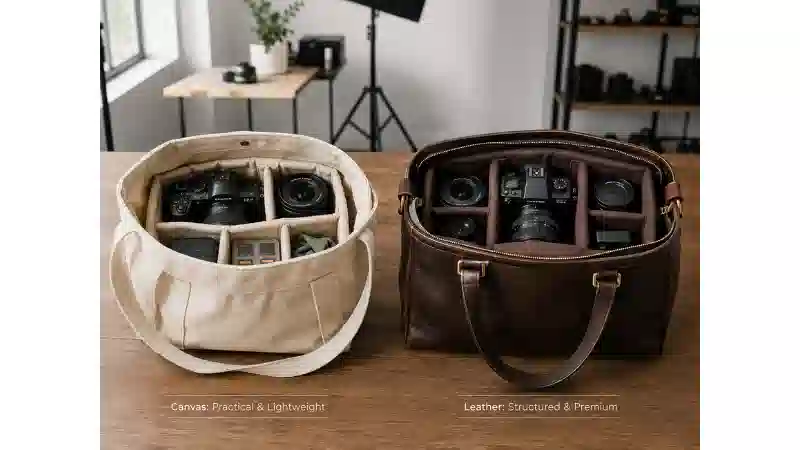
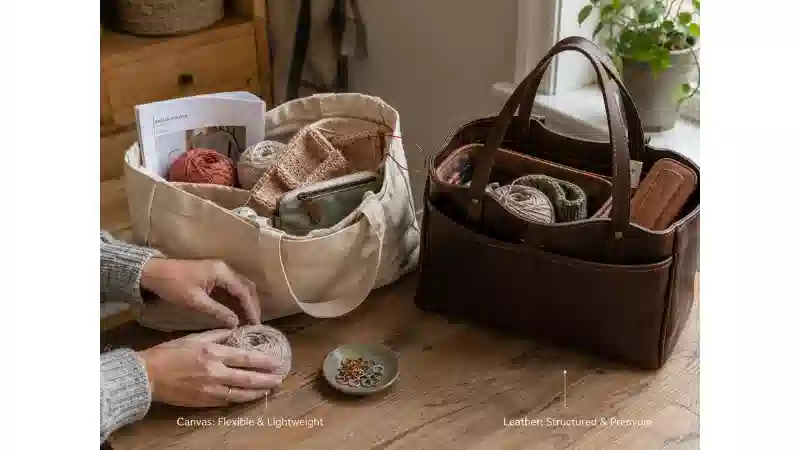
A knitting project bag has to manage more than yarn. It needs to protect the work in progress, keep needle tips under control, prevent small notions from disappearing, and let the working yarn move without repeatedly catching on the interior.
For everyday knitting, classes, knit nights, and projects that travel frequently, a well-constructed canvas knitting project bag is usually the more practical starting point. It can combine relatively low empty weight with flexible internal space, removable organizers, a wide opening, and several decoration options.
A leather knitting project bag can work well for a compact, carefully organized project when structured presentation, premium personalization, or a more formal appearance matters. It generally requires more material-specific care and benefits from a smooth removable organizer that keeps yarn and tools away from the permanent leather interior.
The useful question is therefore not simply "canvas or leather?" Start with the project: the yarn, expected WIP size, needle type, closure, lining, notions, and travel pattern should define the bag.
This guide provides a selection and sample-review framework. It does not establish a universal bag capacity, yarn-snag rating, needle-puncture resistance, or long-term durability claim for any finished construction.

Quick Comparison: Canvas or Leather for a Knitting Project Bag?
| Decision Factor | Canvas Knitting Project Bag | Leather Knitting Project Bag |
|---|---|---|
| Typical empty weight | Often lower when dimensions and reinforcement are comparable | Can be higher when substantial leather, lining, panels, and hardware are used |
| Growing WIP | Flexible constructions can accommodate changing project volume | Structured interiors may work better for smaller, controlled projects |
| Yarn protection | Depends on lining, covered seams, zipper position, labels, and hardware | Depends on lining, edge finishing, hardware, pockets, and closure |
| Organization | Easy to specify with sewn pockets or removable organizers | Complex permanent organization can add material and weight |
| Cleaning | Depends on fiber, finish, decoration, lining, and base construction | Requires care suitable for the exact leather and surface finish |
| Customization | Printing, embroidery, patches, and woven labels | Embossing, debossing, initials, and restrained details |
| Best starting point | Daily projects, classes, yarn shops, clubs, and workshops | Compact project kits and premium gifts |
Canvas is the practical default for most portable knitting projects. Leather becomes more attractive when the load is smaller and presentation matters enough to justify additional care. In either case, a smooth interior and a workable opening matter more than the exterior material name.
Choose the Bag Around the Project, Yarn, and Needles
A sock project and a nearly finished sweater place very different demands on a project bag. Before comparing materials, assemble the items that will actually travel together.
A representative kit may include the current WIP, yarn cakes or skeins, needles, a pattern, stitch markers, a measuring tape, tapestry needles, small scissors, a row counter, waste yarn, and a removable notions pouch.
Plan for the Late-Stage WIP
The project itself often becomes the largest item in the bag. A sweater that fits comfortably at cast-on may occupy most of the available space once the body and sleeves are developed.
Fit the bag around the expected later-stage WIP, not only the starting skeins. The opening should also allow the project to be removed without folding, compressing, or dragging it across rough hardware.
Match the Bag to Project Type
| Project Type | Typical Storage Priority | Useful Bag Direction |
|---|---|---|
| Socks and hats | Compact WIP, small notions, protected needles | Small project bag with secure closure and simple organizer |
| Scarves and shawls | Growing fabric and easy opening | Flexible medium bag with room for the later-stage WIP |
| Sweaters | Growing garment volume | Wide opening and flexible central compartment |
| Colorwork | Several working yarns | Removable separation and stable skein area |
| Large blankets | High project volume | Large soft carrier, basket-style bag, or another dedicated format |
Do not use a fixed number of skeins as a universal sizing rule. Skein dimensions, yarn thickness, winding format, pattern, gauge, and WIP stage all change the space required. The Craft Yarn Council Standards and Guidelines provide common terminology for yarn, needles, and hooks, but actual project-bag sizing should still be based on the physical project.
Consider Yarn Surface Sensitivity
Not all yarn responds to the same interior surface in the same way. Smooth, tightly spun yarn may tolerate minor contact points that become frustrating with fuzzy, haloed, loosely spun, or delicate blends.
Pay particular attention to exposed seam allowances, rough labels, unfinished rivet backs, hook-and-loop fasteners, zipper ends, decorative metal pieces, and coarse interior edges.
The goal is not to label one fiber as universally fragile. It is to identify whether the exact yarn used in the project moves through the bag without catching or developing unnecessary surface abrasion.
Protect Different Needle Types
Long straight needles can extend beyond a compact bag and concentrate pressure at the lower corners. Double-pointed needles, or DPNs, are shorter but can move through loosely knitted fabric or press directly against the lining. Circular needles require less overall bag length, although sharper tips and stiff cables still need controlled storage.
A needle roll, sleeve, rigid case, or reinforced pocket is usually preferable to leaving loose needles beside the yarn. Needle protection works both ways: it protects the tool and reduces repeated pressure on the bag.

Compare the Exact Canvas or Leather Specification
Canvas Is Not One Fixed Performance Level
Canvas describes a fabric construction, not a guaranteed strength or cleaning method. Fiber content, weave, fabric weight, finish, lining, stitching, handles, and reinforcement all affect the finished knitting bag.
The guide to canvas fabric types, weights, and uses explains the main specification variables. Buyers should also distinguish fiber from construction: cotton and canvas tote bags are not interchangeable descriptions.
When comparing swatches, the differences between cotton canvas and cotton twill can provide additional context about weave and surface character.
For a knitting project bag, request information about:
- fiber content and fabric construction;
- fabric weight and finish;
- lining surface;
- covered or exposed interior seams;
- pocket and divider construction;
- closure components;
- handle attachment;
- base reinforcement;
- cleaning limitations;
- decoration compatibility.
Leather Requires Exact Material Disclosure
Full-grain, top-grain, split, bonded, coated, and imitation leather products do not have identical weight, aging, moisture response, surface finish, or repair potential.
The FTC Leather Guides address representations about the composition and characteristics of leather and imitation-leather products. For sourcing purposes, ask for the exact material description instead of relying only on a broad term such as "leather."
Also confirm the lining, backing, edge treatment, hardware, finished empty-bag weight, cleaning instructions, and which components can realistically be repaired or replaced.
Prevent Yarn Tangling and Snagging
Use a Smooth Interior
A project bag should be inspected with the same attention given to the exterior fabric. Run the yarn path past the opening, lining, seams, labels, pockets, and closure components. Any point that repeatedly catches the working strand deserves revision.
Covered seams and a smooth lining can reduce unnecessary contact, but the exact finished sample matters more than the lining material name alone.
Do Not Treat Every Zipper as a Problem
A zipper improves containment during commuting and travel. The risk comes from poor placement or rough components rather than the mere presence of a zipper.
A well-positioned zipper can work when the active yarn does not repeatedly cross the teeth or slider. A zipper that sits directly in the yarn path can be inconvenient for knitters who work from the bag while it is open.
Drawstring and snap closures reduce direct contact with zipper teeth, but they provide different levels of containment. Closure selection should follow how the bag will actually be used.
Evaluate Yarn Guides and Grommets Before Adding Them
A yarn guide can help separate the working strand from the skein compartment, particularly when several yarns are being managed. A permanently closed grommet, however, can make project removal inconvenient once the active yarn has been threaded through it.
Before approving a yarn guide, ask:
- Can the yarn be removed without cutting it?
- Can the full WIP leave the bag easily?
- Can the user switch between projects?
- Is the guide smooth around the entire yarn-contact surface?
- Can several working colors be managed without crossing unnecessarily?
An open or removable guide may provide more flexibility for knitters who rotate projects frequently.

Organize the WIP, Needles, and Notions Without Overbuilding the Interior
The most useful organization usually separates functions rather than assigning a permanent pocket to every object.
Project Zone
The largest area should hold the WIP and working yarn. It needs flexibility because the fabric grows as the project progresses. Too many fixed dividers can create an organized appearance while reducing the usable space for a sweater or shawl.
Needle and Notions Zone
Needles should have controlled storage, while small notions can move in a removable zippered pouch. Stitch markers, tapestry needles, cable needles, row counters, measuring tape, and small scissors are easier to transfer between projects when they are kept together.
A removable organizer can also make cleaning easier, but its thickness should not reduce the bag opening or flat internal width so much that the WIP becomes difficult to remove.
Personal Items and Patterns
Keys, phones, wallets, and transit cards should be kept away from loose yarn where possible. Keys and exposed metal edges can create snag points, while a phone can disappear beneath a large project.
Printed patterns benefit from a flat section or folder. A tablet or electronic pattern reader should be separated from needles, scissors, drinks, and other hard objects.
Choose the Closure, Base, and Handles as a System
| Closure | Useful For | Main Tradeoff |
|---|---|---|
| Open top | Quick access and large WIPs used beside the knitter | Limited containment during transport |
| Drawstring | Flexible project volume and knitting directly from the bag | Does not create a rigid or sealed opening |
| Snap | Fast access and compact controlled projects | Leaves open areas around the top |
| Zipper | Commuting, travel, and secure containment | Requires careful placement away from the active yarn path |
Base Structure
A reasonably stable base can keep yarn cakes separated and make the project bag easier to use beside a chair or table. It should not be assumed that maximum rigidity is always better.
A stiff permanent base may add weight and reduce foldability. A removable panel can provide support while allowing the bag to be emptied or cleaned more easily.
Handle Comfort and Opening Access
Large knitting projects can become bulky even when they are not especially dense. The handles should not pull the opening closed, trap long needles, or force the WIP against a zipper or rough edge.
For fabric care and moisture considerations, the guidance on protecting cotton bags from moisture and wear provides useful background for natural-fiber constructions.
How to Review a Knitting Project Bag Sample
A meaningful sample review should use a representative project rather than soft filler.
- Load the project: add the intended yarn, later-stage WIP or a representative volume, needles, notions pouch, and pattern.
- Check the opening: remove and return the WIP without forcing it against the closure or hardware.
- Test the yarn path: work with the yarn feeding from the bag and watch for repeated contact or catching.
- Carry the bag: check handle comfort, closure behavior, needle position, and project movement.
- Inspect the contents: look for snagged yarn, compressed fabric, needle pressure, lost notions, and lasting bag distortion.
| Inspection Area | Acceptable Observation | Reason to Revise |
|---|---|---|
| Yarn path | Working yarn moves without repeated catching | Yarn consistently catches on seams, labels, hardware, or closure parts |
| WIP access | Project enters and leaves without forced compression | Fabric must be dragged or squeezed through the opening |
| Needle storage | Tips remain controlled inside a case, sleeve, or protected pocket | Needles repeatedly press against or puncture the lining |
| Multi-skein organization | Working yarns remain manageable | Skeins repeatedly roll together or cross in the organizer |
| Closure | Operates without interfering with the active yarn | Hardware or zipper repeatedly catches fibers |
| Base | Bag remains usable beside the knitter | Base collapses and continually mixes yarn or tools |
| Handles | Carry position remains comfortable without distorting the opening | Handles squeeze the project or twist the loaded bag |
| Artwork | Branding remains visually balanced when the bag is filled | Gusset expansion or filled pockets distort the design excessively |
| Artwork | Branding remains visually balanced when the bag is filled | Gusset expansion or filled pockets distort the design excessively |
This review identifies fit and usability problems. It does not establish a universal load rating, long-term snag resistance, or durability claim without additional documented testing.
Sample Approval Checklist for Custom Orders
- Confirm the exterior material and lining.
- Check the bag using the intended WIP size.
- Inspect all yarn-contact surfaces.
- Verify the needle pocket or case.
- Test the selected closure while knitting from the bag.
- Confirm base behavior and handle comfort.
- Approve artwork only after functional construction is settled.
- Review the decorated pre-production sample in its loaded shape.
-

When a Tote Is Not the Right Project Carrier
A conventional tote may not be suitable for very large blankets, several large WIPs at once, long rigid needles that extend well beyond the opening, or projects requiring substantial additional equipment.
A larger project case, structured craft organizer, basket-style carrier, backpack, rolling bag, or separate needle case may provide better control in those situations.
Travel introduces another consideration. Rules for needles, scissors, and other tools can vary by jurisdiction and mode of transport. For U.S. air travel, check the Transportation Security Administration's current What Can I Bring? guidance before packing the project.
Cleaning, Repairability, and Long-Term Value
Canvas and Fabric Care
Do not assume every canvas project bag can be machine washed. Fiber content, coating, embroidery, printing, foam, lining, leather trim, metal hardware, and base panels can change the recommended care method.
The article on whether canvas bags get dirty easily explains how color, surface finish, and daily use affect visible soil. For branded project bags, guidance on keeping branded bags clean can help buyers consider decoration as part of the care plan.
Leather Care and Repairability
Keep leather away from wet yarn, spilled drinks, hand products, or cleaners that are not compatible with the exact finish. A removable fabric organizer can reduce direct contact between the project and the permanent leather interior.
Repairability should be confirmed rather than assumed. Handles, hardware, lining, pockets, and closures differ greatly in how easily they can be serviced.
Think Beyond Initial Price
Approximate cost per use = total ownership cost divided by expected uses
Total ownership cost may include purchase price, removable organizer replacement, cleaning, zipper or handle repair, leather-care products, sampling, decoration, packaging, and replacement of an unsuitable bag.
The guide to hidden costs behind cheap bags explains why the lowest quotation may conceal differences in construction and quality control.
Sustainability should also be evaluated beyond the words "canvas" and "leather." Sourcing, manufacturing, durability, repairability, actual reuse, and end-of-life all matter. The comparison of sustainable bag materials provides a broader framework.
Custom Knitting Project Bags for Yarn Shops and Workshops
Custom project bags can support yarn-shop merchandise, knitting classes, fiber festivals, craft retreats, knitting clubs, subscription kits, and maker gifts. The guide to customizable reusable-bag giveaways provides additional planning ideas for group programs.
Define the Project Before the Artwork
Before requesting a quotation, confirm:
- intended project type and expected WIP size;
- typical yarn format and number of working yarns;
- needle types and storage method;
- notions organization;
- lining requirements;
- closure;
- internal dividers or removable organizer;
- yarn-guide preference;
- base structure;
- handle design;
- finished dimensions and usable opening;
- artwork location;
- quantity, packaging, and delivery date;
- sample stages and approval criteria.
Select Decoration After Functional Construction
Canvas commonly supports screen printing, transfer applications, embroidery, patches, and woven labels. Leather often suits embossing, debossing, initials, or restrained branding.
The overview of six tote bag printing methods can help buyers compare decoration options before sampling.
A logo should be reviewed on the loaded bag. A design centered on an empty flat panel can shift when the gusset expands or exterior pockets are filled.
Documentation, MOQ, and Production Planning
Environmental and material claims should be supported with relevant documentation. The guide to environmental certifications for custom tote bags explains what buyers may need to request.
The MOQ, lead-time, and cost guide can help yarn shops and event organizers prepare a sourcing brief, while the explanation of how MOQ affects bulk bag production provides additional context for quotation planning.
PrintTotes provides information about its OEM bag services. Buyers with confirmed project requirements, dimensions, materials, artwork, quantity, packaging, and delivery needs can submit them through the custom bag inquiry page.
FAQ
Q: What is the best material for a knitting project bag?
A: Canvas is the practical starting point for most everyday projects because it can combine relatively low empty weight, flexible project space, and customizable organization. Leather can suit smaller controlled projects where structured presentation and premium personalization are priorities.
Q: What size knitting project bag do I need?
A: Size the bag around the later-stage WIP rather than only the yarn at cast-on. Check the WIP, yarn, needle case, notions pouch, usable opening, internal base, and gusset together.
Q: Should a knitting project bag have a zipper?
A: A zipper is useful for commuting and travel when containment matters. It should be positioned so the active yarn does not repeatedly cross rough zipper components. Drawstrings and snaps can provide easier access for knitting directly from the bag.
Q: Are yarn-feed grommets useful?
A: They can help guide a working strand, especially in a project that remains in one bag. They become less convenient when the WIP is frequently removed or the knitter rotates between projects. An open or removable yarn guide can provide more flexibility.
Q: How should knitting needles be stored in a project bag?
A: Use a needle case, sleeve, roll, or protected pocket that controls the tips. Long straight needles, DPNs, and sharp circular tips place different pressure on the bag, so the storage method should be checked with the actual tools.
Q: Should a knitting project bag stand upright?
A: It does not need to be rigid, but reasonable base stability can make yarn management easier beside the knitter. A removable base panel is one way to add structure without permanently turning the bag into a stiff case.
Conclusion
For most knitters, canvas is the practical default when the bag will travel frequently, hold a growing WIP, use removable organization, or support a yarn shop, class, club, or fiber event.
Leather becomes more suitable when the project is compact, the interior is carefully protected, and structured presentation or premium personalization matters more than minimum weight and simple cleaning.
The strongest buying decision begins with the actual project. Check the later-stage WIP, yarn surface, needle tips, notions, closure, opening, lining, base, and handles first. Then choose the exterior material that supports that system rather than expecting the material name to solve the storage problem on its own.