

A cotton tote can meet every measurement on its purchase order and still disappoint its user after the first wash. The opening becomes narrower, the handles feel shorter, the print no longer sits where the brand intended, or a once-flat bag twists at the seams. Those outcomes are not resolved by choosing a heavier canvas or by adding the words "pre-shrunk" to a specification.
For a reusable cotton shopping bag intended to be washed, the buyer needs two different answers: does the supplied bag meet its initial dimensions, and what happens to its dimensions after the defined care process? A useful cotton tote bag shrinkage test records the material and sample revision, measures a defined baseline, applies an agreed washing and drying procedure, measures again in the same way, and judges both numerical change and the bag's continued usefulness.
This guide addresses dimensional stability as a buyer's product-approval task. It does not provide a universal shrinkage percentage for every cotton weave, finish, weight or bag style. The PrintTotes canvas weight guide discusses fabric selection; the task here begins after the intended bag construction and care expectation are known.
First Decide Whether the Finished Bag Is Intended to Be Washed
A washing test is meaningful only when it reflects the care the product is supposed to tolerate. An unlined cotton shopping tote, a coated promotional bag, a structured canvas bag with an insert, and a tote with incompatible trims may not share the same appropriate care process. "Cotton" on the shell does not establish that every component can be machine washed.
Before setting a shrinkage criterion, document whether the intended consumer care is machine wash, hand wash, a limited spot-clean process or another verified method. Consider the full build: shell, thread, lining, backing, webbing, handles, print or transfer, embroidery, labels, closures and any stiffener. If the product is not designed for machine washing, do not run an arbitrary hot-wash demonstration and present it as the expected normal-use result.
The planned care instructions and the test procedure should be consistent. If a marketing claim says "machine washable," the test must evaluate a relevant machine-washing and drying condition rather than a gentler, unrelated treatment.
Three Different Measurements That Buyers Often Mix Up
| Question | What Is Measured | Why the Difference Matters |
|---|---|---|
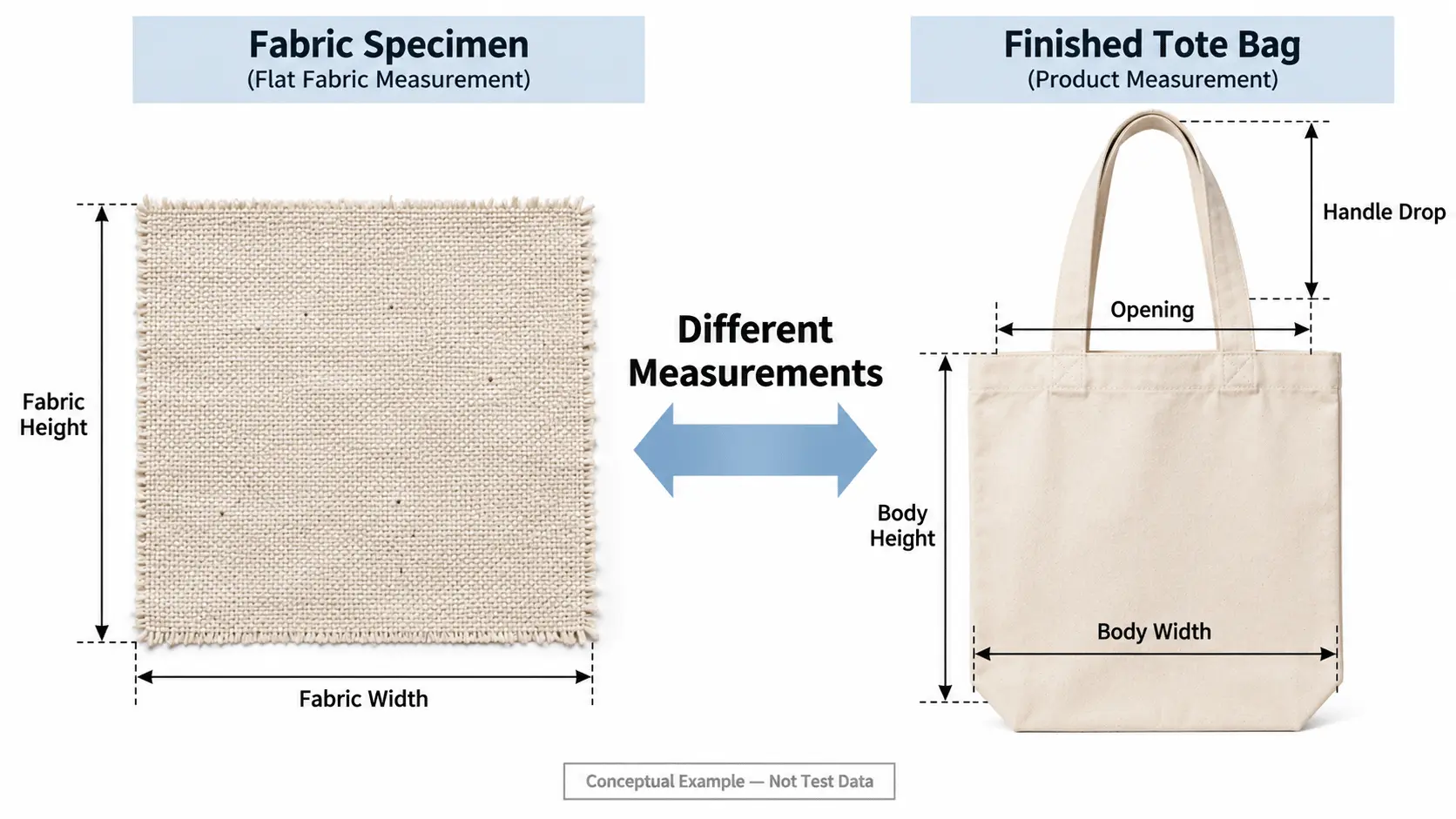
| Fabric dimensional change | Marked distances on a representative fabric specimen before and after treatment | Helps evaluate material behavior, but does not by itself prove finished bag fit |
| Finished-bag dimensional change | Specified bag measurements and feature positions before and after treatment | Captures the assembled result, including seams, handles and combined materials |
| Finished-bag conformity | Whether the bag remains within an agreed post-care dimension and functional requirement | A small percentage change may still make a tight-fit product unusable |
A fabric report and a finished-bag sample answer complementary questions. A shell fabric can behave acceptably while a different handle material shortens or a lining pulls the top edge out of shape. Conversely, a finished bag can have a changed measurement without every panel sharing the same percentage change.
Which Published Test Methods Are Relevant?
ISO 3759:2011 addresses preparing, marking and measuring textile specimens and made-up articles for dimensional-change testing. ISO 6330:2021 describes domestic washing and drying procedures used in textile tests, while ISO 5077:2007 addresses determination of dimensional change after a specified washing and drying combination. These are related functions, not three interchangeable names for one "shrink test."
For the fabric-specific route, AATCC TM135-2025 is the current AATCC method for dimensional change of fabrics after home laundering. It should not be casually cited as a certified whole-bag procedure: its published scope is fabrics. Choose the applicable method with the testing organization, define the finished-article measurements separately where needed, and obtain the complete standard if formal compliance to it is being claimed.
None of these references supplies PrintTotes with a universal acceptance limit. The buyer and supplier must agree the limit for the particular product and care claim.
Build a Baseline That Another Inspector Can Repeat
Use the actual approved sample or controlled pre-production lot. Record the sample ID, material article, finishing status, colorway and pattern revision. Identify whether the fabric was already washed, compacted or otherwise treated before sewing; processing history matters when comparing a first consumer wash with later cycles.
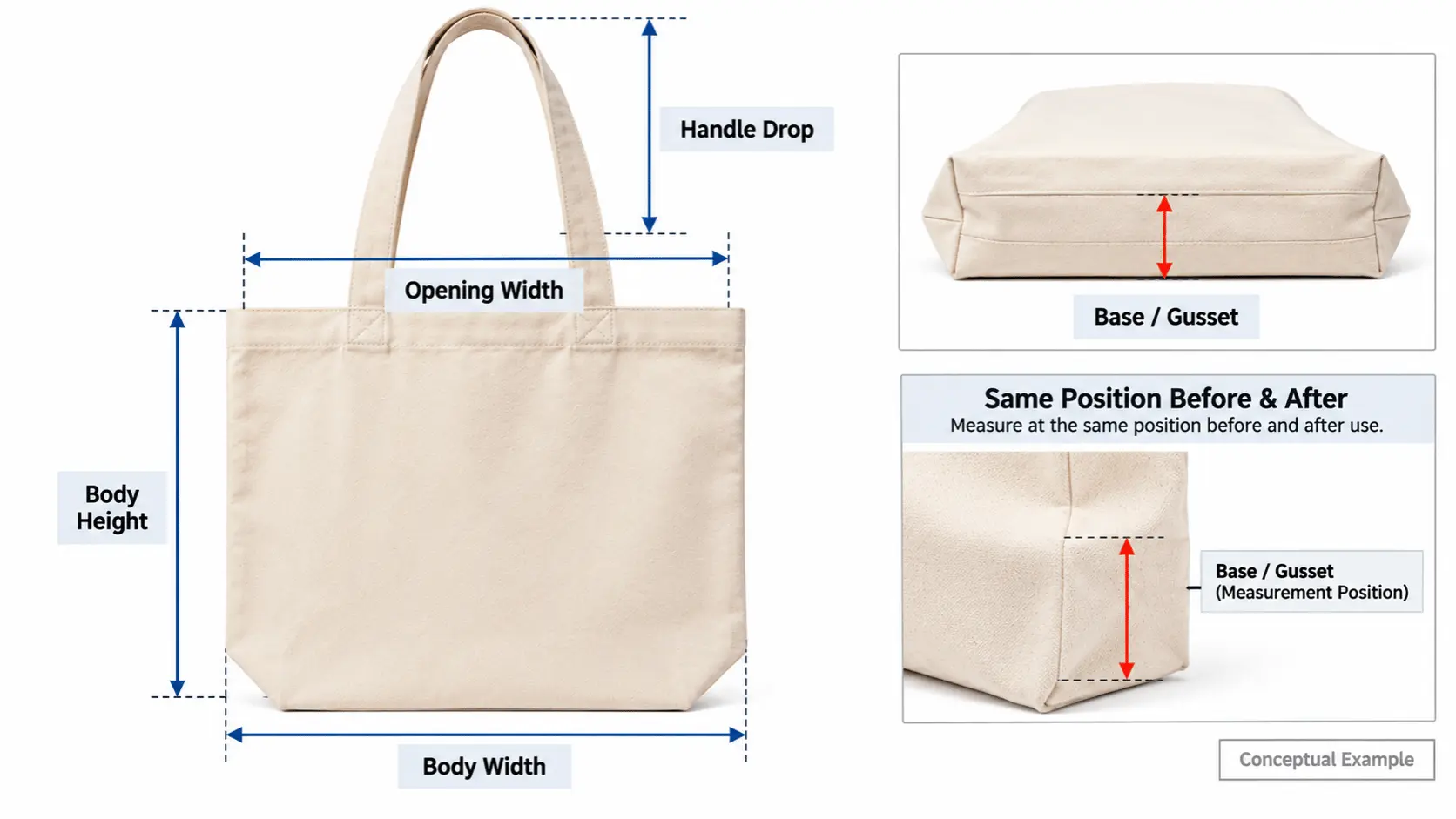
Lay out how the tote is to be measured. A soft empty bag changes apparent width when pulled flat, hung by its handles or placed on a table. "Width" may refer to a flat upper panel, the opening between seams, the internal usable opening or the base with a gusset expanded. Each produces a different number.
| Measure | Define the Reference Points | Post-Wash Effect to Observe |
|---|---|---|
| Body width | Named seam-to-seam or edge-to-edge line at a stated height | Narrowing, skew or difference between front and back |
| Body height | Named upper edge to bottom reference with consistent orientation | Shortening, top-edge distortion or bottom deformation |
| Opening width | Usable opening with the closure in a defined position | Reduced insertion clearance |
| Gusset/base | Specified base edges with consistent gusset expansion | Twisting, uneven corners or loss of usable volume |
| Handle drop | Top bag edge to top of handle under a defined no-load/measurement condition | Changed shoulder fit or asymmetrical handles |
| Decoration position | Distance from stable seam or edge reference to print/embroidery | Apparent misalignment or puckering after care |
Take dated, scale-referenced photographs when helpful, but keep the actual numeric measurement record. Do not replace defined measurements with a phone image of a bag beside a ruler at an unknown angle.
Run the Agreed Wash and Dry Route, Not an Improvised Stress Test
- Confirm test purpose. Decide whether the test represents the care-label claim, a development comparison, a repeat-lot check or a deliberately harsh investigation. Do not confuse those purposes.
- Specify laundering conditions. Record the procedure, machine type or route, temperature, detergent, agitation, drying method and number of complete care cycles. ISO 6330 notes that different washing and drying parameters can affect results.
- Prepare and identify specimens. Use the required specimen preparation/marking procedure if reporting a published method. For finished totes, document the relevant sample dimensions and construction before treatment.
- Wash and dry as specified. Maintain the selected process across all compared samples. A line-dried result must not be presented as equivalent to a tumble-dried one without evidence.
- Allow a consistent post-care condition. Follow the method's conditioning and measurement requirements when a formal standard is used; do not stretch, iron or forcibly reshape one sample but not another.
- Repeat the measurements. Use the same reference points, orientation and rules as the baseline, including the handle and opening dimensions.
- Inspect function and appearance. Note twisted seams, gusset distortion, print damage, lining tension, handle asymmetry or a reduced usable opening separately from the numeric dimensional change.
Calculate Dimensional Change Without Hiding Growth
For any defined measured distance, the percent dimensional change is:
Dimensional change (%) = (after-care dimension − before-care dimension) ÷ before-care dimension × 100.
A negative result indicates shrinkage; a positive result indicates growth. For example, if a hypothetical reference line measures 400 mm before treatment and 392 mm afterward, the result is −2%. That is an illustration of the calculation, not a PrintTotes test result or an acceptable limit for a bulk order.
Report width and length separately. Do not average a width decrease and height increase into a reassuring single figure. If a bag contains dissimilar materials, report feature-level changes where they matter. Handle drop, zipper opening, pocket alignment and bag width are not necessarily governed by one material shrinkage value.
If a buyer needs the absolute finished size after washing, percentage change alone is insufficient. A nominal bag might show a modest percent change and still fall outside the acceptable opening or fit requirement. Record both final measurement and change.

Define Acceptance Before Seeing the Result
"No noticeable shrinkage" is an unclear approval instruction. A useful acceptance rule names the sample, care method, required dimensions, allowable changes and critical functions. It may establish separate requirements for body width, height, handle drop, opening width and visible distortion. Those limits are product decisions; the article cannot invent them.
For example, a gift bag designed around a specific retail box needs enough opening and base clearance after the care process. A standard open tote with flexible use may tolerate a different dimensional outcome. Both must be measured against their own approved design and intended use.
If a test fails, determine which condition failed: material shrinkage, finished dimensions, twisting, decoration, lining fit, closure function or an incorrect test procedure. Each calls for a different corrective action. Adjusting the paper pattern without reviewing the fabric's processing route may solve one sample and create another problem later.
Why Shell-Fabric Shrinkage Is Not the Whole Bag Story
Handles Can Change the Fit Before the Body Looks Wrong
Handles may be woven from a different yarn, tape or construction from the body. Their response to washing can differ. A shoulder tote that loses usable drop may fail the user's task even when the body retains an acceptable width.
Linings and Coatings Can Restrain or Distort Panels
A lining, fused layer, coating or internal insert can create uneven shrinkage and tension between layers. Check the exact approved construction and care compatibility; do not assume a cotton outer fabric makes the entire assembled product washable.
Prints and Embroidery Change the Visible Result
A printed logo may appear closer to a seam after the body changes dimensions, and dense embroidery may create puckering on a softened panel. Assess the approved artwork on the finished bag, not only the unprinted fabric specimen. The PrintTotes printing-method guide addresses method selection; this test checks the result after the approved care treatment.
Separate Care Evidence from Other Performance Evidence
A bag can pass a dimensional-change requirement while a printed logo fails a wash-durability requirement. Similarly, clean seams after laundering do not establish a certified carrying capacity. If the program also requires colorfastness, print adhesion, seam strength or handle load performance, define separate evidence and acceptance criteria for those tasks.
The Quality & Certifications page owns broad factory quality capabilities; the narrower role here is helping a buyer define a repeatable dimensional-stability decision for one approved cotton tote.
Use the Result to Control Bulk and Repeat Orders
A development test is useful only while the production material and construction remain representative. If the mill, finishing treatment, cotton composition, lining, handle webbing, print process or care label changes, determine whether the previous evidence still applies.
For a completed order, the custom bag reorder consistency guide explains how to compare a new production lot with a released baseline. If the bag's material or care route changes during production, the change-control workflow helps identify which tests and approvals need to be reopened.
Copy-Ready Dimensional Stability Request
Please evaluate dimensional change for the identified custom cotton tote sample under the agreed care procedure. Record sample ID and construction, applicable method and laundering/drying parameters, pre- and post-care width/height/opening/handle measurements, calculated change in each direction, visible or functional defects, and a pass/review decision against the separately approved requirements. Do not substitute fabric-only test results for finished-bag fit without identifying the limitation.
Release a Measurable Care Claim
For cotton totes intended to be washed, the correct buying decision is not "heavy canvas is safe" or "cold wash prevents shrinkage." Specify the actual care route, mark and measure the right features, document dimensional change, and decide whether the finished bag remains fit for its intended use. Carry that approved evidence into the production specification and any future material changes.
For custom cotton tote development, material sampling and production requirements, start with the PrintTotes cotton shopping bag category or the OEM/ODM service, which own the commercial product and sourcing discussion.
FAQ
Q: Questions Buyers Ask
A: Will every cotton canvas tote shrink the same amount?
No. Fiber and fabric construction, prior processing, finish, other components and wash/dry conditions all affect the result. There is no reliable universal percentage that replaces testing of the relevant material or finished bag.
Q: Is pre-shrunk canvas guaranteed not to change size?
A: No. "Pre-shrunk" or "pre-washed" describes processing, not a universal zero-change guarantee. Request a defined dimensional-stability result under the intended care conditions.
Q: Can AATCC TM135 verify the finished tote?
A: AATCC TM135-2025 is a fabric dimensional-change method. It can help establish material behavior, but the buyer should separately specify how finished-bag measurements and functional fit will be evaluated.
Q: Should I wash a sample before approving the logo?
A: The answer depends on the intended production and care route. Approve decoration after the correct substrate and processes are defined, then verify any required after-care appearance or position on a representative finished sample.
Q: What if body dimensions pass but the handles change?
A: Record the handle outcome as a separate feature-level result. If the bag no longer meets the approved carry requirement, it can fail the finished-product task even when shell-fabric shrinkage is acceptable.


