

Picture a bottle of shampoo opening inside a travel pouch. The user does not care whether the outer polyester was advertised as "water-resistant." They care whether liquid reaches the clothes beside the pouch, whether the lining can be cleaned, and whether the bag still works afterward.
Those outcomes are separate. A wipe-clean lining does not necessarily contain liquid. A coating that resists water on a flat specimen can still be interrupted at a sewn seam. A zipper that sheds rain from outside may not hold liquid pooled against its teeth from inside. This is why toiletry bag spill-containment testing needs a finished sample and a defined incident, not just a claim about the lining material.
This guide is for brands, retailers and product-development teams deciding what protection a custom makeup or toiletry pouch should offer before bulk approval. It does not promise that all PrintTotes pouches are leak-proof. For a broader guide to travel-bag features and materials, see Polyester Travel Toiletry Bags: What Frequent Fliers Actually Look For.
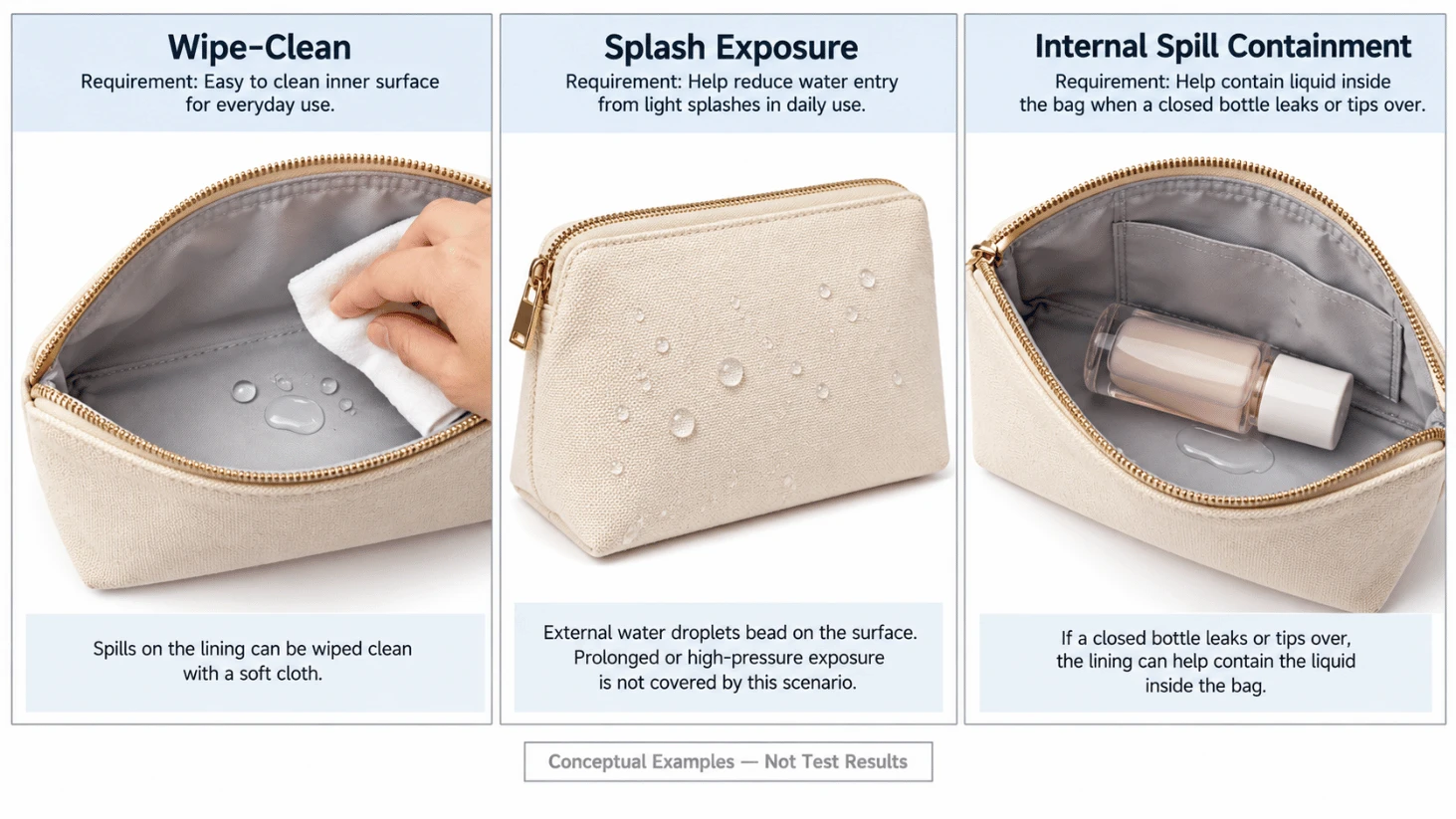
Choose the Promise You Actually Need to Make
Start with the consumer problem, then select a test. The words "wipe-clean," "water-resistant" and "leak-proof" should never be treated as equivalent.
| Buyer Requirement | Useful Evidence | What It Does Not Establish |
|---|---|---|
| Wipe-clean interior | Specified soil or product residue can be removed from an approved interior sample by an agreed cleaning process | That the bag holds pooled liquid |
| Splash protection | Defined brief moisture exposure does not cause an unacceptable outcome under the test condition | That the bag is watertight when inverted or compressed |
| Short-duration spill containment | Finished pouch holds a defined liquid exposure in a stated position for an agreed period without reaching the protected exterior area | That all cosmetic formulas, pressures or orientations are covered |
| Validated waterproof or specialist barrier claim | Documented, applicable product-level test method, scope and acceptance criteria | That a fabric certificate alone verifies the entire pouch, zipper or seams |
For a gift-with-purchase pouch containing sealed makeup samples, easy cleaning may be adequate. For a travel kit stored next to clothing, the buyer may need a stronger, testable containment requirement. Neither should be inferred solely from the outside material or a photograph of the lining.
Trace the Liquid Before Choosing the Construction
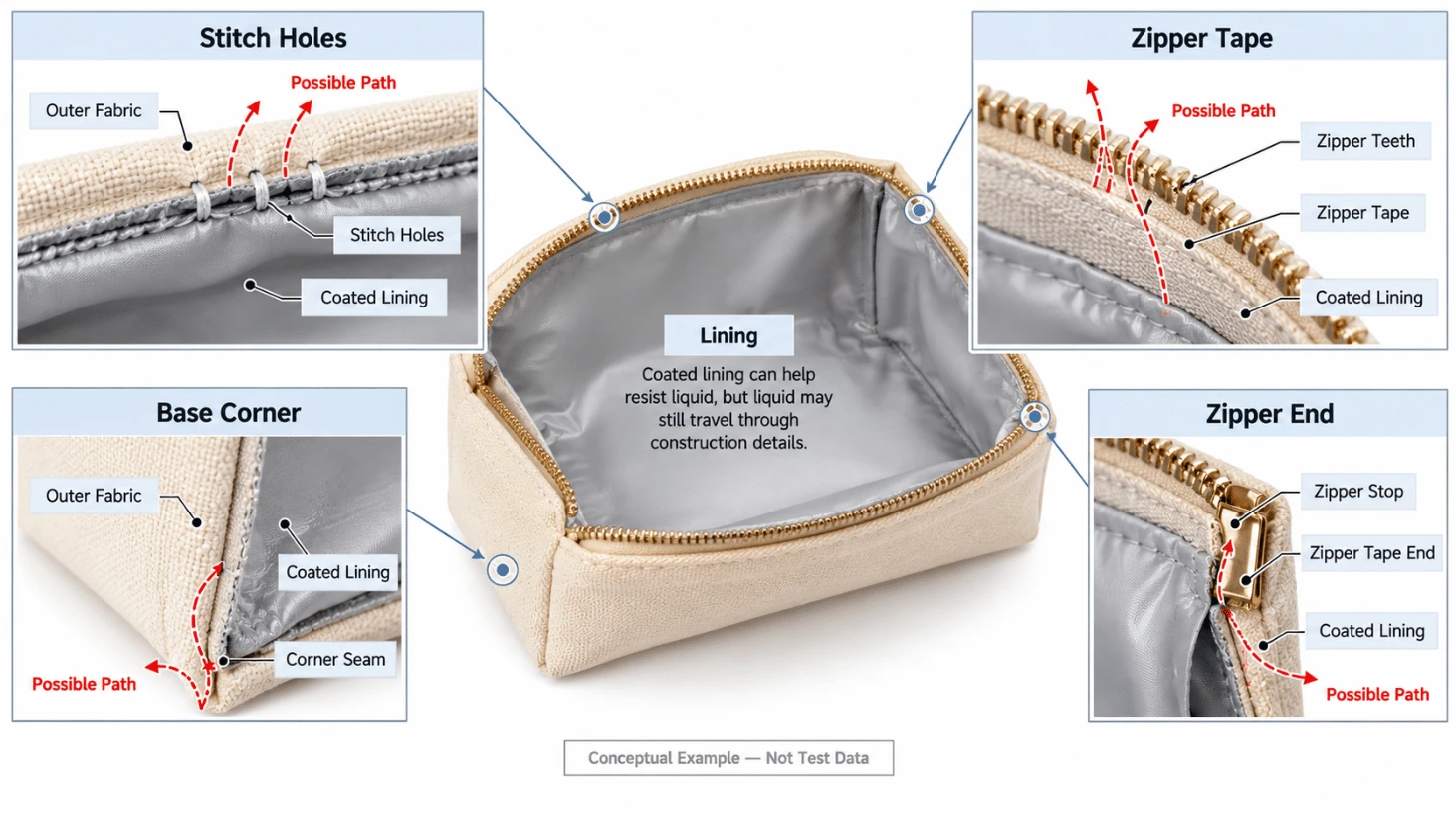
In a finished pouch, liquid finds a route through an assembly. A useful leak-path audit follows the liquid from the inside face to the outside environment, including locations that may be hidden when the bag is closed.
The Lining Surface
A smooth coated surface may resist wetting and make cleaning easier, but the actual material identity matters. Polyester with a treatment, a film-laminated textile, a separately assembled film liner and another polymer sheet are not interchangeable specifications. Confirm material composition and construction through supplier documents and physical samples rather than translating a catalog phrase such as "waterproof lining" into an unsupported claim.
Bottom Corners and Gusset Junctions
Liquid pooling at the base can contact sewn corners, seam allowances, bindings and multi-layer intersections. A continuous lining panel may behave differently from a liner built from several stitched panels. The relevant question is whether the approved assembly presents a continuous barrier along the actual pooling path.
Stitch Holes, Seam Tape and Bonded Joints
Sewing creates penetrations through the layers being joined. Whether those holes become liquid paths depends on materials, seam geometry, surface tension, time and pressure. Seam tape, adhesive, welding or another sealing approach may be proposed, but compatibility and sealing quality must be proven for the specific layers and final construction. More stitches are not necessarily more liquid containment.
Zipper Teeth, Tape and End Stops
A conventional zipper is an access mechanism, not automatically a liquid seal. The tape, teeth/coil, slider path and zipper ends can create routes between the pouch interior and the outside. A zipper marketed as water-resistant may be designed to resist entry from the outside under particular conditions; do not infer that it contains an internal shampoo spill when the pouch is turned upside down.
The custom bag zipper specification guide explains how opening geometry, chain type, slider and surrounding construction need to be approved together. Here, the zipper is evaluated only as a possible liquid path under the defined spill scenario.
Map the Bag's Vulnerable Zones on the Sample
Before testing, mark the points where liquid may collect or reach the outside. For a simple rectangular pouch these often include bottom-center seam, bottom-to-side corners, zipper-end junctions, lining-to-zipper join and any internal pocket attachment penetrating the lining. For a boxy toiletry case, add gusset turns, divider attachments and the base-to-wall seam. For a hanging organizer, include suspension and pocket anchor points that may penetrate the interior surface.
A useful map should show which seams penetrate the proposed barrier and which lie outside it. Do not assume a textile lining with a water-resistant coating is a continuous internal reservoir. If the design needs one, its construction and test must demonstrate the required result.
Material Tests and Finished-Pouch Tests Are Not the Same
AATCC TM127 measures resistance of fabric to water penetration under hydrostatic pressure. It is a fabric test and is not, by itself, a proof that a stitched pouch with zipper and end openings is waterproof. AATCC also explains why impact penetration is a different measurement question from general material descriptions.
Work on protective garments has likewise examined seams and closures as separate penetration concerns: a NIOSH-indexed research record describes tests of liquid penetration around different seam and zipper configurations. That research concerns protective clothing and should not be presented as a test method or certification for cosmetic bags. It illustrates only why testing a flat material does not close the construction question.
For a consumer toiletry bag, a buyer can specify a product-specific spill simulation for development. If a formal regulated, chemical-resistant or waterproof claim is needed, select an applicable standard and qualified testing route with the relevant experts rather than inventing a certification from a bench demonstration.
Design a Finished-Bag Spill Simulation
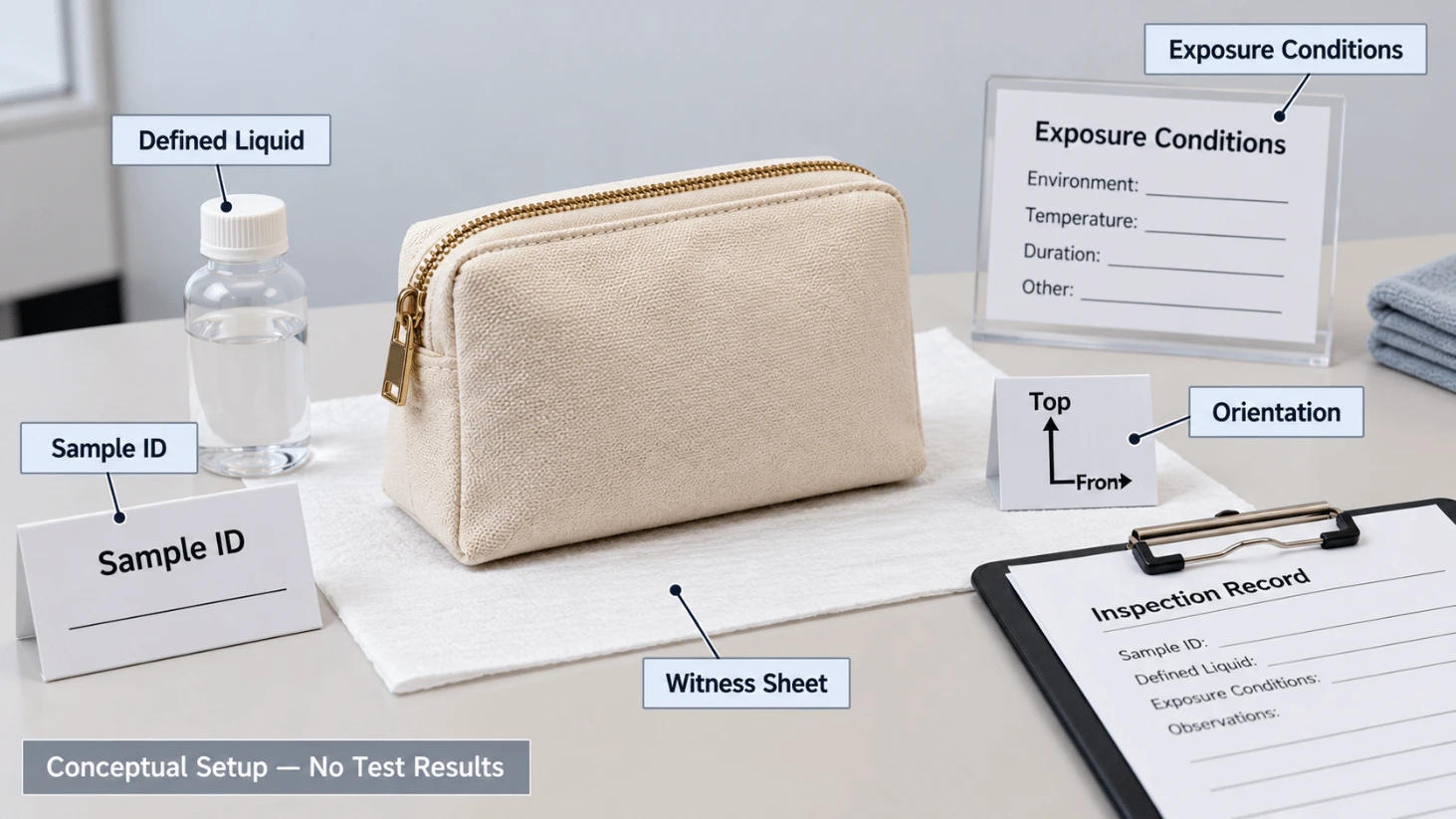
The following is a buyer-facing test-planning sequence, not a published universal standard or a claim that any specific supplier uses this SOP.
- Define what can spill. Identify the intended contents: water-like liquid, lotion, oil-based cosmetic, cleanser or another relevant product. Different viscosities and chemistries may affect penetration, staining and cleaning. A colored-water demonstration is not necessarily representative of all cosmetic formulas.
- State the event. Is the problem a few drops during opening, an upright bottle leak in a packed bag, a full-container spill, or a pouch inverted inside luggage? Choose a realistic scope rather than an arbitrary dramatic scenario.
- Fix the amount, contact time and positions. The buyer must approve test quantities, durations and orientations for the actual claim. No universal volume, pressure or time is prescribed here.
- Identify the sample. Record the bag construction, lining, coating/laminate, seam and zipper references, size, revision and whether the specimen is production representative.
- Prepare the receiving surface. Use a clean, inspectable absorbent or other agreed witness surface outside the bag where transferred liquid can be observed. Define how wetting or staining will be recorded.
- Perform the defined exposure. Add the specified liquid to the agreed zone, maintain the orientation and time, and avoid changing test conditions midway through a comparison.
- Inspect multiple locations. Check base, corners, seams, zipper tape, zipper ends, under-lining zones and the external witness surface. Record location and type of any escape.
- Evaluate subsequent use. If the program requires repeated packing, flexing or cleaning, define that sequence and retest as appropriate. A pristine flat sample cannot represent every repeated-use condition.
- Apply the agreed decision rule. Record pass, review or failure against the requirement written before the test. Capture photographs, observations and any limitations.
An Illustrative Failure Map Helps Locate the Right Fix
| Observed Result | Possible Path to Investigate | Do Not Assume |
|---|---|---|
| Interior wipes clean but witness sheet underneath gets wet | Bottom stitching, corner seam, puncture or discontinuity in lining | That a wipe-clean surface provides containment |
| Dry base but wet zipper end | End-stop area, tape-to-lining transition, closure position | That replacing the whole shell fabric solves the issue |
| Leak only after the pouch is compressed | Pressure acting on opening, seams or displaced liner | That an upright countertop test covered the packed-luggage case |
| Water passes but lotion behaves differently | Liquid viscosity, wetting behavior and exposure conditions | That either liquid proves performance against every cosmetic formula |
| Visible staining without liquid passing through | Surface finish, dye or pigment transfer, cleaning compatibility | That staining and leakage are the same defect |
| Delamination or bubbling after cleaning | Layer bonding, cleaning chemistry, heat or flex | That the initial spill-only test captured care durability |
These are hypothetical observations for diagnosing a failure, not test results or customer cases from PrintTotes. The point is to distinguish a seam design problem from a lining-material problem, a zipper-path issue or an incompatible cleaning expectation.
What Should a Buyer Ask to See Before Bulk Approval?
A supplier's statement that a pouch is "waterproof" is not an approval record. Ask for the specific construction and proof that supports the requested claim.
- The approved exterior and lining material identity, including any coating or laminate.
- A construction drawing identifying liner joints, side/base seams, zipper ends and penetrations.
- A physical sample with the actual zipper, binding, corner construction and pockets.
- The test scenario, liquid, volume, exposure duration, position and acceptance rule.
- Evidence showing where liquid was observed inside and outside after the run.
- The intended cleaning method and any observed after-care change.
- A statement of which performance claims the evidence supports and does not support.
- A controlled revision that can be handed to sampling, production and final inspection.
The sample approval stages guide is useful for separating material submissions from pre-production samples. A material swatch can support choosing a lining; the finished product test addresses the actual leak path.
Match the Design to the Requirement Rather Than Overengineering Everything
If the product needs only occasional wipe-down cleaning, a buyer may prefer a simple, easy-to-clean lining and avoid an unsupported containment claim. If it must protect luggage from an accidental bottle spill, ask for a defined finished-bag containment test and consider how the zipper and seams are integrated with the lining.
If the intended contents are dry makeup tools, a separate washable insert or removable liner may offer useful cleaning access without asking the outer case to function as a liquid reservoir. If the product is intended for regulated or hazardous liquids, ordinary toiletry-bag sampling is not a substitute for relevant product qualification.
Trade-offs matter: added film layers, coatings, seal treatments and more elaborate zipper configurations can affect appearance, weight, flexibility, cleaning, printing, cost and repairability. Choose them only when they serve a defined function.
Turn a Sample Result into a Controlled Release
Once the buyer approves a sample and its performance evidence, record the lining, seam construction, thread/needle process where critical, zipper article, attachment details and any approved sealing operation. Production can then be checked against the correct reference.
A final random inspection can look for visible seams, correct materials, construction continuity and basic closure operation, but a visual pass is not proof of full liquid containment. For the wider lot-release task, use the pre-shipment inspection planning guide.
Changes to lining source, coating, seam, tape, zipper, thread or assembly process may invalidate earlier results. The custom bag change-control guide explains how to reopen evidence when an approved input changes.
A More Defensible Product Claim
Define the accident the pouch is meant to handle; map the paths liquid can travel; test a finished, representative construction; and report what happened under specified conditions. Only then choose claim language that matches the evidence. A bag that can be wiped clean is still useful even when it has not been verified to contain an internal spill.
For project-specific bag construction, materials and sample development, use the PrintTotes travel bag category or OEM/ODM service as the commercial next step. This guide supports that decision; it does not replace product-level evidence.
FAQ
Q: Does a waterproof lining make a toiletry bag leak-proof?
A: No. A lining material may resist water while sewn joints, zipper ends or lining penetrations remain possible paths. Evaluate the intended finished construction under a defined scenario.
Q: Can I test a pouch by filling it with colored water?
A: That can be a useful development demonstration if the liquid, amount, time, orientation and acceptance rule are documented. It is not automatically an approved standardized test, and water does not represent every oil, lotion or cleaning product.
Q: Is a water-resistant zipper enough?
A: No. The zipper is integrated with tape, end openings, seams and the bag body. A product-level result is needed to support any complete-pouch containment claim.
Q: Will seam tape always stop leakage?
A: No. It depends on the seam geometry, coating and adhesive compatibility, application process, flexing and intended exposure. Approve the actual sealed construction and retest after changes.
Q: Can an inspector confirm leak-proof performance by looking at the bag?
A: Visual checks can reveal gaps and workmanship problems. They cannot establish an untested liquid-containment claim. A defined performance requirement needs appropriate evidence.


