Whether you are buying one bag for a summer road trip or sourcing a production run for a retail line, the core questions are the same: which fabric handles salt air and daily sunscreen contact, what zipper specification holds up past the first season, and how do you tell the difference before you commit. This guide covers all of it - from a manufacturer's standpoint, where the shortcuts get taken and where the right spec actually shows up.
What Is a Large Beach Tote Bag With Zipper?
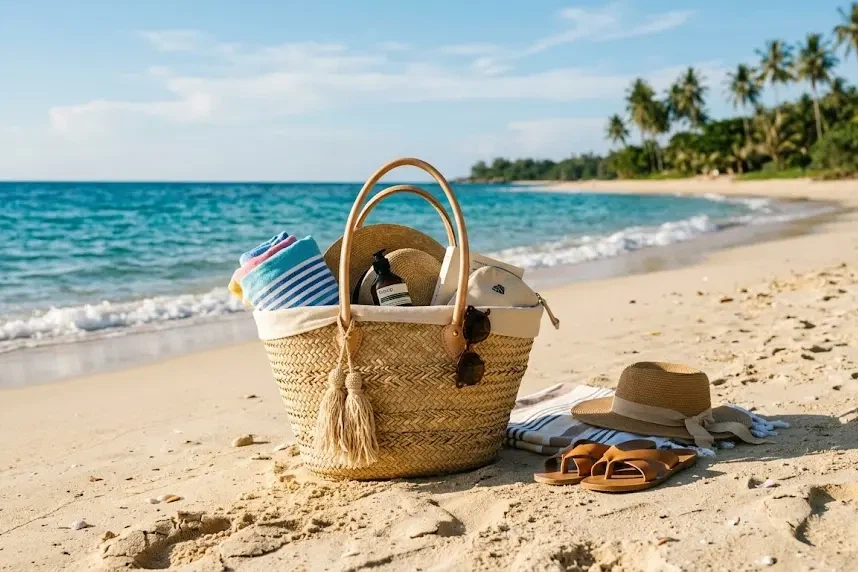
A large beach tote bag with a zipper is a structured open-carry bag - typically 18 to 22 inches wide and 14 to 17 inches tall - built from water-resistant fabric with a full-length zipper across the top that seals out sand, seawater, and casual theft. At minimum, it should hold two standard 30-by-60-inch beach towels plus sunscreen, a water bottle, sandals, and a wallet without forcing the zipper closed. That translates to roughly 15 to 18 liters of usable interior volume, a figure based on packing standardized test loads across bag prototypes in our production facility.
The zipper is not a styling upgrade. It converts a decorative carrier into a bag you can actually trust on the sand. An open-top tote works at a pool deck for twenty minutes; over a six-hour beach day, it accumulates sand in every crevice, offers no protection when a wave catches you off-guard, and requires you to watch it every time you swim. A zipper changes all three of those problems at once.
Why a Zipper Closure Makes a Beach Tote Worth Carrying
Sand migrates. Over a full beach day, fine particles work into every open bag regardless of how carefully you position it. A single splash from a nearby wave - or the tide coming in faster than expected - reaches the bottom of any unzipped tote within seconds. On a crowded beach, an open-top bag creates real security exposure for phones, wallets, and cards.
A zipper addresses all three mechanically. The physical barrier requires a deliberate action to open, which means you do not accidentally leave it gaping while you swim, and a casual grab from a stranger becomes meaningfully harder. Sand stops at the teeth.
The catch is that "zipper" covers a wide range of hardware quality. A standard #3 nylon coil zipper - the kind found on lightweight gym bags - corrodes in salt air and begins sticking within a season. For a large beach tote that will see real use, the right specification is a #5 or #8 coated nylon or metal zipper with rubberized tape and a large loop pull that works with wet, sunscreened hands. Double pulls - two sliders meeting in the middle - become genuinely useful on bags wider than 18 inches, where reaching across to a single pull on the far end is awkward under full load. YKK, the industry benchmark for zipper hardware, publishes gauge specifications and load ratings that most serious manufacturers reference when selecting components for outdoor bags.
What Size Actually Counts as a Large Beach Tote Bag
The word "large" gets applied loosely enough on retail platforms that it becomes nearly meaningless. A bag listed as large might measure 14 inches wide. A specialty outdoor brand using the same label might mean 21 inches wide and 17 inches deep.
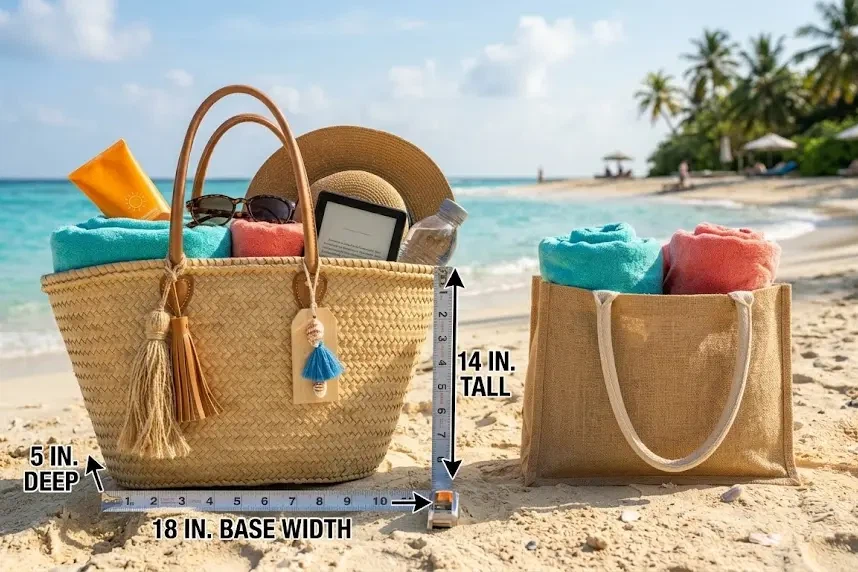
For practical use, here is the real threshold: a genuinely large beach tote holds two full-size adult towels simultaneously without compressing them, alongside a full day's worth of essentials. In working dimensions, that means at least 18 inches wide at the base, 14 inches tall, and 5 inches deep. Anything shorter than 14 inches will not zip closed over a folded towel once you add anything else inside.
Gussets make a significant difference. A flat-sewn tote collapses to the thickness of its contents - the listed volume is theoretical. A bag with a gusseted base holds its shape from the first item you drop in, which means the available space is predictable. When comparing bags, check the base dimensions, not just the top-opening measurement.
If you are also thinking about how a beach tote fits into a broader packing setup alongside duffels, backpacks, and travel organizers, our guide covering the five core travel bag types and how to choose between them walks through the decision systematically.
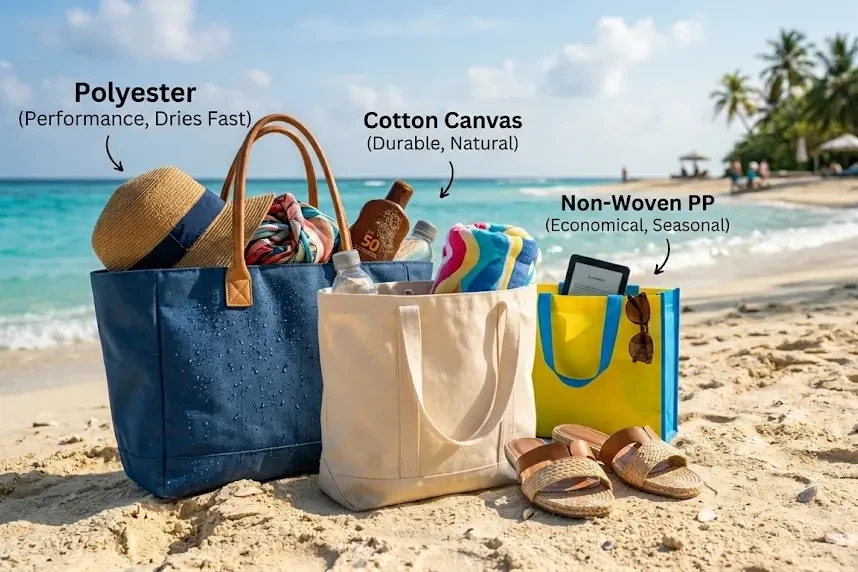
Polyester, Cotton, and Non-Woven Beach Totes: Which Material Fits Your Use Case
Material selection is where beach-specific engineering diverges from general tote bag production. Each material has a different performance ceiling and a different failure mode in coastal conditions.
Polyester - 600D and 900D
600D and 900D polyester - the "D" refers to denier, a measure of yarn thickness - is the dominant material for performance beach totes, and for good reason. Higher denier means more abrasion resistance: 600D is adequate for most consumer applications, while 900D is appropriate for heavy-use or commercial bags. A polyurethane or PVC coating on the reverse face adds water resistance - surface splashes bead off rather than saturating the fiber. Polyester also dries in under an hour after full immersion, which matters when you are packing a damp bag into a car and will not deal with it until the next morning.
Coated polyester does not mildew when stored slightly damp, a common failure point with uncoated natural fibers. It is also the most compatible fabric for sublimation printing, which makes it the default choice for branded and promotional applications. Our custom polyester beach tote bag line uses double-stitched seams at the four structural stress points - handles, zipper attachment, and base corners - because those are the exact locations where production shortcuts show up first under real carrying loads.
For a detailed breakdown of polyester tote construction, denier selection by use case, and print method compatibility, our complete buying guide for reusable polyester tote bags covers the spec decisions that matter most for brands and retailers.
Cotton Canvas
A 12-oz or 14-oz natural cotton canvas has structural integrity that lighter synthetics cannot match at equivalent weights - the weave resists tearing in ways that 600D polyester does not under sustained abrasion. Cotton also carries a sustainability narrative that is increasingly meaningful to retail buyers and end consumers. OEKO-TEX Standard 100 certification, which screens textile products for harmful substances at every stage of production, is available for both cotton and polyester and worth requiring in any consumer goods specification.
The trade-off in beach conditions is moisture management. Uncoated cotton absorbs salt water and dries slowly - in warm, humid conditions above 70% relative humidity, a damp cotton bag stored closed creates a mildew environment within 24 to 48 hours, based on the moisture retention behavior of natural cellulose fibers. A waterproof PEVA or PVC interior liner resolves this at the cost of added weight. Waxed canvas is another route for exterior waterproofing, though it changes the surface texture and limits logo printing options.
Our cotton beach bag line uses pre-washed fabric as a standard specification - skipping that step produces post-purchase shrinkage that shows up in returns rather than in factory QC data. For how cotton performs against synthetic alternatives across a range of functional bag applications, our analysis of cotton insulated bags and their real-world performance covers the durability and maintenance comparisons in detail.
Non-Woven Polypropylene
Reinforced laminated non-woven PP is the most economical option and handles light water exposure adequately. It is not a material that survives a full season of regular beach use - the substrate delaminates under repeated UV exposure, and punched or heat-sealed handles stretch under real weight. Non-woven beach bags have a clear and legitimate niche: promotional giveaways, event bags, and single-season retail applications where cost per unit drives the decision. Our non-woven beach bag line is manufactured with laminated PP for improved durability, but the material category has real ceiling limits that buyers should factor in from the start.
| Material | Water Resistance | Drying Speed | Abrasion Resistance | Best For | Expected Lifespan |
|---|---|---|---|---|---|
| 600D Polyester (PU-coated) | High | Under 1 hour | Good | Consumer, promotional | 3–5 seasons |
| 900D Polyester (PU-coated) | Very High | Under 1 hour | Very Good | Premium retail, heavy use | 5+ seasons |
| 14-oz Cotton Canvas (lined) | Medium (with liner) | 4–8 hours | Excellent | Premium retail, gifting | 5–8 seasons with care |
| Non-Woven PP (laminated) | Low to Medium | Fast | Limited | Events, single-season | 1–2 seasons |
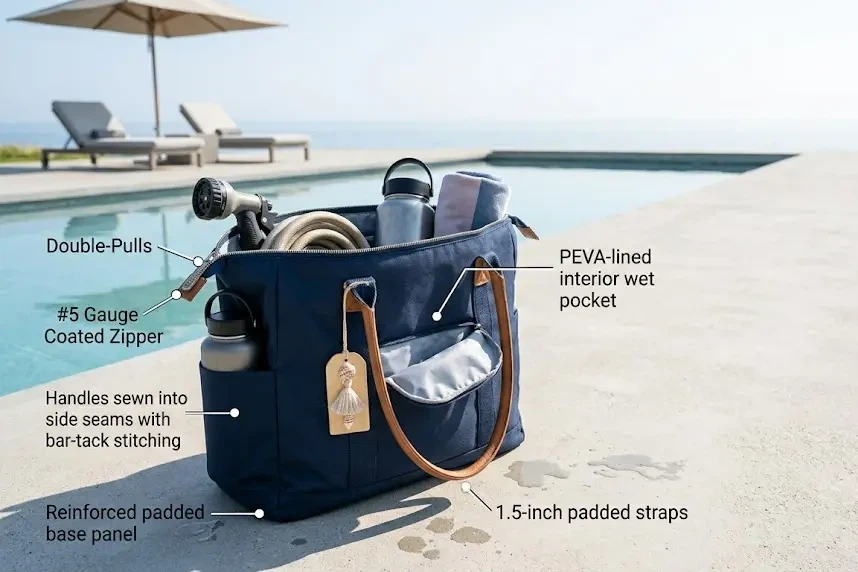
Seven Things to Check Before Buying a Zippered Beach Tote
These are the structural and physical features that separate a beach tote that works from one that just photographs well. Each applies whether you are evaluating a single bag in a store or reviewing a pre-production sample from a factory.
- Zipper gauge and pull design. A #5 coated zipper is the minimum for a bag this size. The pull tab needs to be large enough to grip with wet, sunscreened hands - a small plastic loop is a design failure on a bag built for outdoor use. Double pulls on bags over 18 inches wide are worth prioritizing.
- Handle attachment method. Handles sewn into the side seams distribute weight along a structural line. Handles looped through exterior D-rings or stitched only to the outer fabric panel concentrate stress at a single point and are the first thing to fail at 10 to 15 pounds of loaded weight. Look for bar-tacking at the attachment point - a compact rectangle of stitching, sometimes with an X through it - as a quick visual confirmation that weight distribution was part of the design.
- Interior wet compartment or waterproof pocket. A PEVA-lined zippered pocket inside the main compartment lets you stow a wet swimsuit or sandy sandals without contaminating dry items. This feature is increasingly standard on quality beach totes and worth specifying explicitly on any production order.
- Side pocket sizing. Exterior pockets that fit a 32-oz wide-mouth water bottle eliminate the need to open the main zipper for every drink. Pockets sized only for a phone are useful, but not the primary function here.
- Base construction. A double-layered or foam-padded base panel extends wear life noticeably. Dry sand is abrasive, and a bag set down and shifted across it - which happens constantly - wears through unlined bottom fabric before any other part of the bag fails.
- Strap width. A loaded beach bag reaches 10 to 15 pounds without much effort. Straps narrower than 1 inch cut into bare shoulders before you reach the water. Straps at 1.5 to 2 inches, or any padded strap, are the practical threshold for full-day comfort.
- Fabric coating and UV stability. Polyurethane coatings retain color and water resistance better than uncoated or PVC-coated fabrics under sustained UV exposure - relevant for a bag that sits in direct sun all day across multiple seasons. For custom production runs, UV-stable inks and coating specifications should be written into the order rather than assumed.
How Long Should a Quality Zippered Beach Tote Actually Last?
Lifespan expectations almost never appear in buying guides, which leaves consumers without any reference point. Here is a realistic framework based on production materials and construction grades.
A well-built 600D polyester beach tote with a #5 coated zipper, reinforced seams, and PU-coated exterior should hold up for three to five full beach seasons under moderate use - two to four beach days per week during a 12-week summer. Upgrading to 900D polyester and a #8 zipper pushes that estimate to five seasons or more. A properly maintained 14-oz cotton canvas bag with a waterproof liner routinely outlasts polyester equivalents by several years: the cotton weave strengthens slightly with washing rather than degrading, and the failure mode is typically handle wear rather than fabric breakdown.
Non-woven bags are not built for multi-season durability and should be evaluated on that basis. A bag designed for a single season or a single event is not a design failure - the error is expecting multi-season performance from a single-season specification.
The first components to fail in any beach tote are the zipper track at corner stress points, the handle attachment stitching, and the base panel at the drag point. Reinforce those three locations in the original construction and everything else in a quality bag will outlast them.
Wholesale and Custom Zippered Beach Tote Bags: What Buyers Need to Know
Most of what applies to a consumer buying one bag applies equally to a brand ordering five thousand - zipper spec, fabric weight, handle attachment, base reinforcement. The difference at production scale is that quality failures compound across units and end up attributed to the brand, not the factory.
Print method matters in ways that do not show up in a product photo. Sublimation printing requires 100% polyester fabric and bonds dye directly into the fiber, so the print does not crack, peel, or fade the way a surface coating does. Screen printing works on both polyester and cotton but tops out at approximately four colors before per-unit cost climbs. Heat transfer covers edge cases - detailed small-run artwork, specific Pantone matches, and mixed-fabric constructions where sublimation is not an option. The wrong print method for a given fabric produces a quality problem that shows up in the customer's hands, not in factory inspection.
Lead time for a fully custom large beach tote - specific zipper hardware, fabric color, print placement, and handle configuration - runs 30 to 45 days in our standard production workflow, not including shipping. Pre-production sampling is the correct process for any order above 500 units: a physical sample reviewed for actual zipper hardware, handle attachment method, and print placement before full production begins. For details on how we structure our specification and sampling process, see our OEM and ODM custom bag manufacturing service.
Brands managing multiple bag types in a product line - a beach tote alongside custom polyester duffel bags for travel or polyester travel toiletry bags for overnight kits - can reduce per-unit shipping costs and simplify QC considerably by consolidating production with a single manufacturer.
How to Spot a Well-Made Zippered Beach Bag Without Relying on Photos
Run the zipper the full length of the bag and back. It should move without catching, sticking, or requiring force at the corners. The zipper tape - the fabric strip the teeth are attached to - should lie flat against the bag's opening edge. Puckering or folding in that tape indicates tension in the attachment seam that accelerates wear at exactly the point where the zipper sees the most stress.
Turn the bag inside out and look at the base corner seams. Eight stitches per inch is adequate for medium loads; ten or more indicates construction built for weight. At the handle attachment points, look for bar-tacking: a compact rectangle of stitching, often with an X through it. Two parallel straight stitch lines at the same location distribute stress less effectively under sustained load. In our own QC process, we hold a loaded sample bag by a single strap for 60 seconds - stress points reveal themselves faster under sustained tension than under any visual inspection.
For production samples specifically: verify that the zipper hardware matches the specification document exactly, that the handle attachment method matches the approved prototype, and that fabric weight feels consistent across the main body and pocket panels. Inconsistent weight within a single sample often indicates mixed-denier material sourcing - a cost-cutting measure that produces uneven wear in the field.
If you are sourcing bags across multiple categories at once, our guide to choosing the right travel bag for any trip offers a practical framework for matching bag construction to intended use.
Frequently Asked Questions About Large Beach Tote Bags With Zippers
What dimensions make a beach tote genuinely large?
At least 18 inches wide, 14 inches tall, and 5 inches deep, with a gusseted base. This provides approximately 15 to 18 liters of usable interior volume - enough for two adult beach towels plus a full day of essentials without forcing the zipper closed. Bags smaller than this may be labeled large, but they function as medium totes under real beach loads.
Is polyester or cotton better for a large zippered beach tote?
Polyester with a PU coating is the better choice for pure beach performance: it resists water absorption, dries fast, and does not mildew when stored slightly damp. Lined cotton canvas handles abrasion and multi-year use better, but requires more careful care after wet beach days. For single-season or promotional use, polyester is the practical choice. For premium retail or a bag you plan to use for years, lined cotton canvas is worth the extra maintenance if you account for it upfront.
What zipper type holds up best on a beach tote?
A #5 or #8 coated nylon or metal zipper with rubberized tape and a large loop pull. Uncoated nylon coil zippers corrode in salt air within a season. Double pulls are worth specifying on bags wider than 18 inches. For branded production runs, zipper gauge and pull size should be documented explicitly in the spec sheet rather than left to the factory's standard component.
How do you clean a large polyester beach tote bag?
Shake out sand before washing. For most use, spot-cleaning with a damp cloth and mild soap is sufficient. Most coated polyester beach totes tolerate a gentle machine wash in cold water - air-dry afterward, as the dryer can degrade PU coatings and warp zipper tape over time. Cotton canvas bags should be air-dried completely after wet beach use before storing, and washed without fabric softener, which breaks down waterproof coatings.
Can a large zippered beach tote be used as a carry-on bag?
Most large beach totes - 18 to 22 inches wide - exceed standard overhead bin dimensions and would need to be checked or go under the seat as an oversized personal item. Bags in the 14-to-16-inch width range can typically meet personal item requirements on major U.S. carriers, but confirm against the specific airline's current policy before packing. For bags designed specifically for travel days, our eco travel organizer bags cover the structured, compact options built around airline personal item dimensions.
What is the minimum order quantity for custom large beach totes with zippers?
For a fully custom large beach tote with a specific fabric, zipper hardware, color, print, and handle configuration, minimum order quantities in our facility typically start at 300 to 500 units. Stock bags with logo addition only can accommodate smaller runs. Pre-production sampling is standard on orders above 500 units. Fully custom rush timelines involve real trade-offs in QC bandwidth, and any manufacturer worth working with will explain those trade-offs directly rather than simply accepting a compressed schedule without qualification.
Are large zippered beach totes available in sustainable or certified materials?
Yes. Recycled polyester (RPET) made from post-consumer plastic bottles is available in the same denier ranges as virgin polyester and can carry GRS (Global Recycled Standard) certification for verified recycled content. Organic cotton certified to GOTS (Global Organic Textile Standard) is available for canvas beach totes. Both materials are increasingly required by retail buyers in EU and North American markets. Our certified cotton tote bag options include available organic and GOTS-certified specifications.