The five core travel bag types are the duffel bag, the travel tote, the backpack, the beach tote, and the toiletry organizer. Most travelers need two or three working together - a primary carry-all, a day-use bag, and an organizer for the small stuff. Which combination makes sense depends on trip length, how you're getting there, and how much you're willing to deal with checked luggage.
At PrintTotes, we manufacture reusable bags across polyester, cotton, and non-woven materials - which means we see, firsthand, which constructions hold up to actual travel use and which ones fail at the handle seam after twenty trips. What follows is a practical breakdown of each bag type: what it does well, where it falls short, what to look for in construction, and how to decide which ones belong in your rotation.
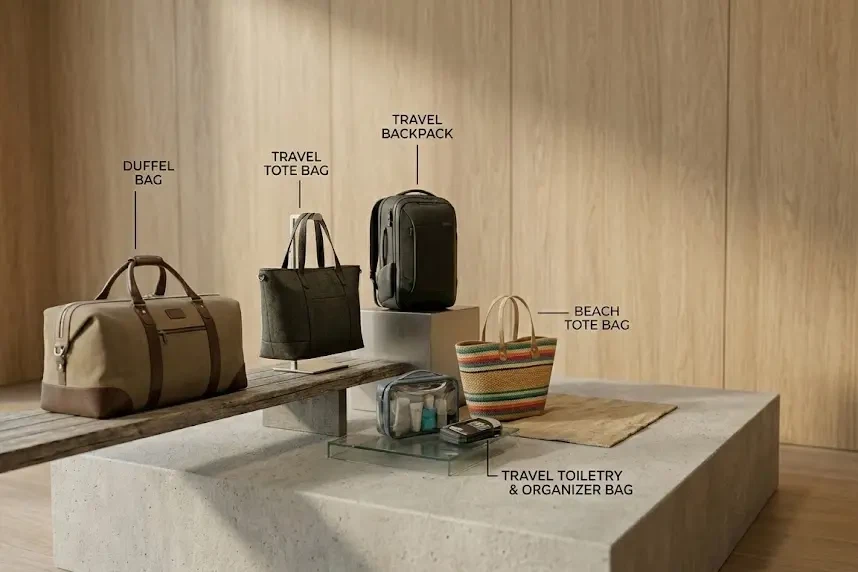
The Five Core Travel Bag Types at a Glance
- Duffel bag - high-capacity, soft-sided, best for weekend trips and short hauls where you want to avoid checking bags
- Travel tote bag - flat-pack versatile, works as a personal item on flights and a daily carry at the destination
- Travel backpack - hands-free, structured for airport security and extended carry, best for active or carry-on-only travel
- Beach tote bag - open-top, sand-and-water-friendly, doubles as a resort day bag or pool-side catch-all
- Travel toiletry and organizer bag - keeps liquids, cables, and grooming gear from overtaking your main bag
These aren't arbitrary categories. Each one solves a different problem that comes up in real travel - and understanding what each one is actually for makes it easier to see which combination fits your specific trip.
Duffel Bags for Travel: Capacity, Construction, and When They Make Sense
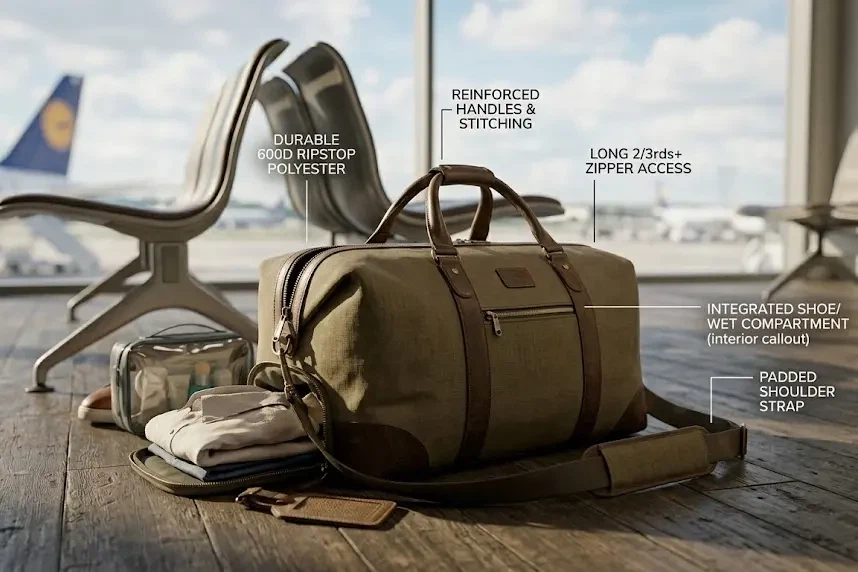
The reason duffel bags show up in nearly every traveler's rotation isn't nostalgia - it's physics. A soft-sided duffel compresses. Airline overhead bins are not standardized in depth or shape, and a 40L duffel can squeeze into a space a rigid carry-on cannot. For a two-to-four night trip, a duffel in the 35L to 50L range handles a full clothing change per day, a pair of shoes, and a separate toiletry kit - without forcing you to the check-in counter.
Fabric construction matters more than most buyers factor in at the point of purchase. Polyester duffels - particularly those made from 420D to 600D ripstop polyester - resist abrasion, wipe clean, and hold their structure under weight without adding bulk to the bag itself. The ripstop weave specifically resists tearing along stress lines, which is where cheaper bags fail first: at the handle attachment points and the zipper base. Non-woven duffel options are a lighter-weight alternative suited to shorter trips where the bag won't take heavy loads.
What to look for beyond the label: a zipper that runs at least two-thirds of the bag's length (anything less makes access awkward), a dedicated wet or shoe compartment if you're packing for the gym or beach, and shoulder straps that are padded rather than just webbing - the difference matters after ten minutes of walking. A top carry handle should be reinforced at the stitch, not just looped through a D-ring.
Where duffels fall short: trips longer than five days where you need a full wardrobe, travel involving a lot of cobblestone or uneven terrain where wheeled luggage genuinely earns its keep, and itineraries with strict airline weight limits where the bag's own weight is already eating into your allowance.
For construction specifics across polyester and non-woven options, the polyester duffel bag range and non-woven duffel bags cover both directions, with handle reinforcement and zipper specs listed per model.
Travel Tote Bags as Personal Items: The Most Underused Airport Advantage
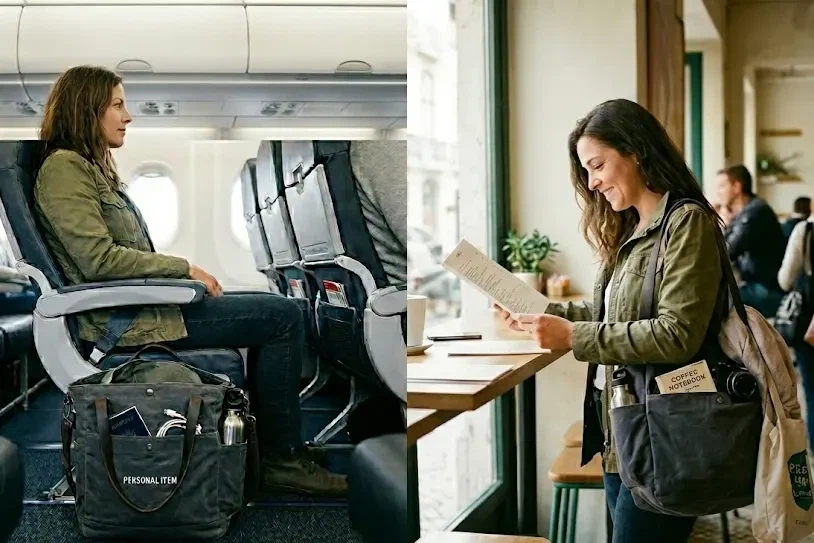
Most travelers flying with a carry-on leave a significant amount of free space on the plane unused - not in the overhead bin, but under the seat in front of them. Major U.S. airlines allow a personal item in addition to a carry-on, and a well-structured tote is the most versatile way to fill that allowance. It sits at your feet during the flight with your passport, phone charger, headphones, and anything else you'd rather not dig through an overhead bag mid-flight to find.
At the destination, the same bag becomes your daily carry. A tote that doesn't scream "tourist luggage" matters in cities where visible travel gear increases your risk profile, and it matters on day trips where hauling your full carry-on to a museum or market is simply unnecessary. A well-made tote with a shoulder strap long enough to wear comfortably handles a water bottle, a light jacket, a wallet, and the afternoon's purchases without the bag becoming the problem.
The structural decision comes down to closure type. An open-top tote packs flat, loads fast, and is fine in low-risk environments. A tote with a full zip or magnetic snap closure is the better choice in crowded transit, rainy cities, or anywhere pickpocketing is a realistic concern. A gusseted base - where the bottom panel is a separate, wider piece rather than a flat fold - adds meaningful capacity without adding bulk to the carry.
On material: polyester handles moisture better and wipes clean after a market or beach day. Cotton reads as more polished in urban environments and takes printed designs with sharper color detail over time. The choice isn't one being better than the other - it's which properties match where you're taking the bag.
| Property | Polyester | Cotton |
|---|---|---|
| Moisture resistance | High - dries fast, wipes clean | Low - absorbs water and stains |
| Durability under abrasion | High - resists surface wear | Medium - strong but stains permanently |
| Print quality over time | Good - color holds with sublimation printing | Excellent - takes screen and DTG printing with fine detail |
| Feel and appearance | Functional, casual | Elevated, natural texture |
| Best for | Active travel, beach day-bags, outdoor markets | Urban travel, business trips, daily carry in the city |
The reusable polyester tote range and cotton travel totes cover both options with a variety of gusset depths and handle lengths.
Travel Backpacks for Carry-On-Only Travel: The Numbers Behind the Strategy
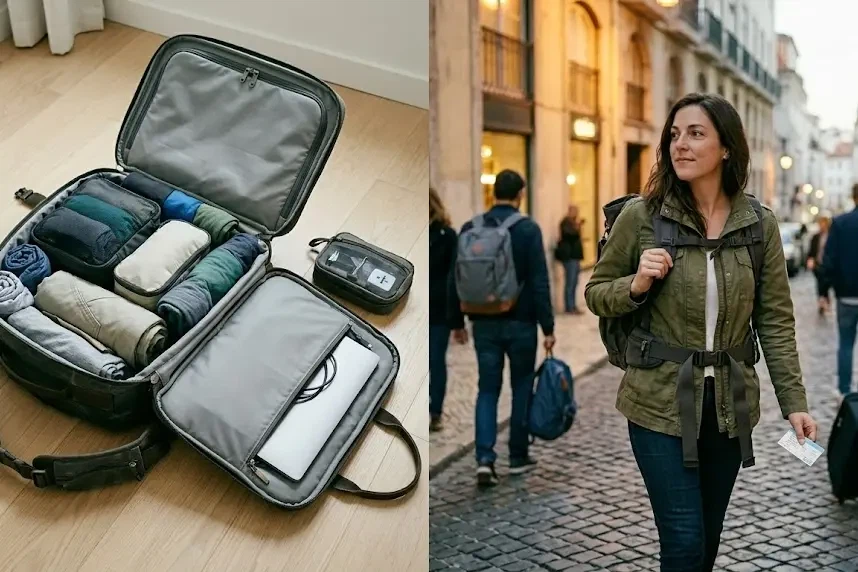
A travel backpack is a different piece of equipment from the daypack sitting in your closet. The distinction isn't just size - it's engineering priority. A daypack is optimized for short excursions from a fixed base: light, fast to open, simple. A travel backpack is optimized for airports, long carry days, and multi-day packing without a fixed home base - which means clamshell access, load distribution across your hips rather than just your shoulders, and enough organizational structure that the bag doesn't become a single compartment of chaos by day two.
For carry-on-only travel, the relevant number is 45 linear inches - the sum of length, width, and height that most major U.S. carriers use as their carry-on size limit, though TSA does not set this limit itself and individual airlines vary. A 28L to 35L travel backpack fits within this window on most carriers while carrying substantially more than travelers typically expect. The math: at 30L, you're packing roughly five to seven days of clothing if you roll rather than fold and use compression packing cubes. For ten-day trips, 30L is achievable if you have access to laundry along the way - it's not a guarantee, it's a constraint that requires intentional packing.
The three features that separate a real travel backpack from a regular bag marketed as one:
- Clamshell opening: the bag opens flat like a suitcase rather than loading from the top, giving you suitcase-style access without the suitcase
- Dedicated laptop sleeve accessible from the outside: at airport security, you remove the laptop without unpacking the rest of the bag - this matters more than it sounds when you're in a long line
- Hip belt straps: often removed from "fashion" travel backpacks, but they redistribute 60–70% of the bag's weight from your shoulders to your hips, which is the difference between a comfortable six-hour walking day and a painful one
Who this bag type suits best: solo travelers moving between cities, anyone taking trains or regional buses where rolling luggage is genuinely inconvenient, and business travelers who want one bag that works from the plane to the meeting room without stopping to check luggage.
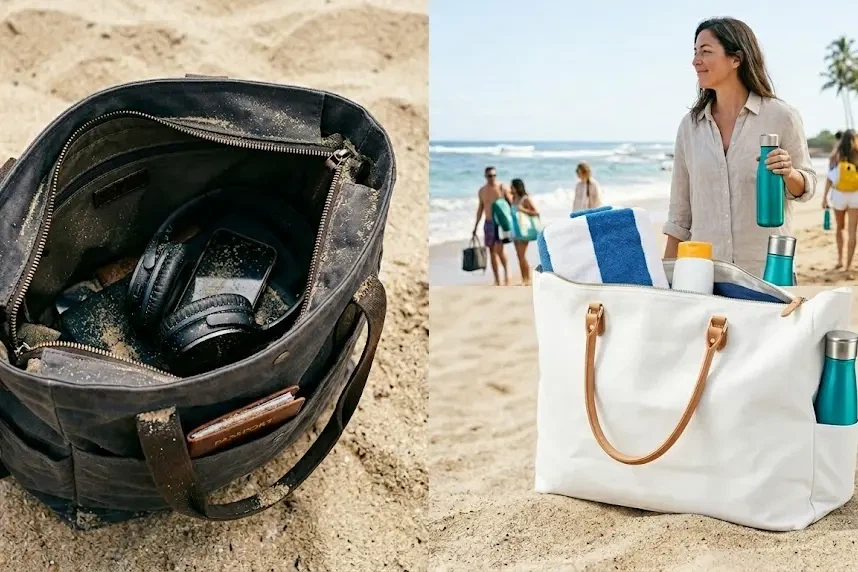
Beach Tote Bags: What Happens When You Bring the Wrong Bag to the Sand
Sand is not a passive nuisance - it's abrasive. Fine beach sand works into zipper teeth, abrades fabric from the inside out, and accelerates wear on stitching at a rate that has nothing to do with how carefully you carry the bag. Taking a good travel tote to the beach is a reliable way to shorten its life. A dedicated beach tote exists precisely so that none of that damage reaches your main gear.
The functional requirements of a proper beach tote are specific: a mesh or open-weave structure that lets sand fall through rather than accumulate, a base material that can sit directly on wet sand or a boat deck without degrading, handles long enough to go over the shoulder (short-handled beach bags are a design failure that somehow persists), and enough interior width to carry a towel, sunscreen, a change of clothes, and a water bottle simultaneously without everything compressing into an unusable mass.
For wet-gear containment - wet swimsuits, snorkel equipment, water shoes - the most useful construction is a waterproof-lined interior or a separate wet-dry compartment. Without it, moisture transfers to everything else in the bag within minutes. Polyester mesh dries faster than any other fabric option and shakes clean of sand in seconds. Non-woven materials offer a lighter, more packable alternative that works well for pools and casual beach days where the bag won't take heavy loads.
Beyond the beach itself, the same bag type handles outdoor markets, picnic days, lake trips, and resort pools - any situation where a structured bag is overkill and you want something that folds flat in your luggage until you need it. A good beach tote adds almost no weight and takes up minimal packing space; the downside of not having one is that you use your good tote instead.
Waterproof-lined and mesh options in both polyester beach tote bags and non-woven beach bags are available with a range of interior lining treatments. For beach trips that also involve food and drinks, an insulated cooler bag does the same job with thermal lining rather than standard polyester.
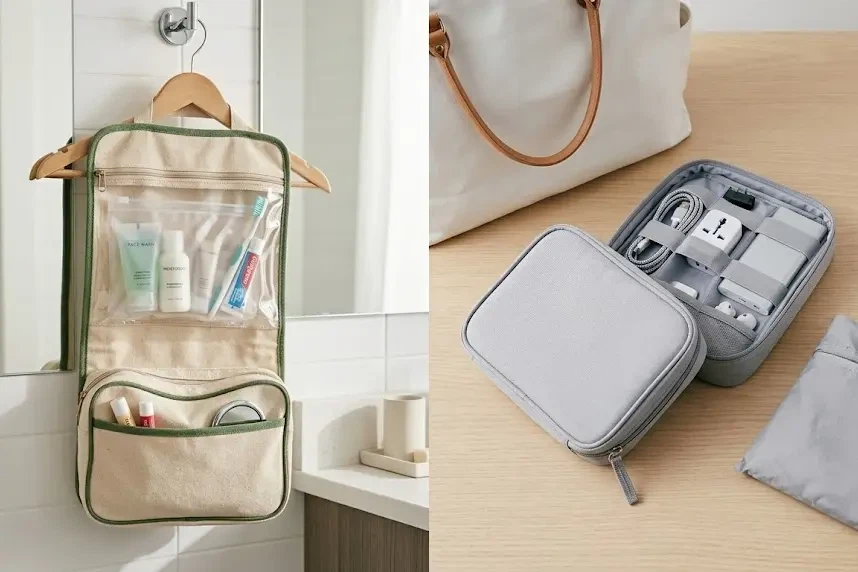
Travel Toiletry and Organizer Bags: The Fix for the Chaos at the Bottom of Every Bag
The disorder that accumulates inside a travel bag is rarely caused by packing too much. It's caused by not having a dedicated place for the small things that multiply the moment you close the zipper. A phone charger wraps around a lip balm, which ends up wedged under a passport holder, which is somehow sitting on top of the full-size shampoo you forgot to transfer to a travel bottle. The toiletry organizer solves this problem at the source rather than at the rummaging end.
For air travel specifically, the TSA's 3-1-1 liquids rule requires all carry-on liquids to be in containers of 3.4 oz (100ml) or less, placed in a single clear quart-sized bag. A dedicated toiletry bag keeps this compliance-ready and physically separated from dry items, so you're not unpacking at the security bin. Better designs include a hanger loop that lets the bag open fully in a hotel bathroom without clearing counter space, separate zipper compartments for dry items (toothbrush, razor, hair tools) versus liquid-risk items (face wash, moisturizer, contact solution), and a PVC or PEVA-lined interior that contains leaks rather than letting them spread.
The same organizational logic extends to tech gear. Cables, adapters, portable batteries, earbuds, and SD cards are the items most likely to disappear inside a large bag. A compact electronics organizer pouch - separate from the toiletry bag - keeps these findable in the bottom of an overhead bin, a taxi, or a hostel bunk. If you're also managing dirty laundry on longer trips, a lightweight polyester laundry bag stored flat in your duffel takes care of the clean/dirty separation problem that becomes real after day three.
Construction specs that matter: the zipper pull should be large enough to operate with one hand when the bag is hanging on a bathroom hook, the hanger loop needs to be stitched at the body of the bag rather than just to the zipper pull, and the base needs to be rigid enough to stand upright when partially full. A bag that collapses every time you set it down stops being useful quickly.
The polyester travel toiletry bags handle the liquid-containment role with PEVA-lined interiors; the eco travel organizer bags are a lighter option suited to dry-item organization and tech gear.
How to Choose the Right Travel Bag Combination
Most people don't need all five bag types for every trip. The more useful question is which two or three form the right combination for a specific set of travel conditions.
Choose by Trip Length
One to three nights: A 35L to 40L duffel as the primary bag plus a structured tote as the personal item covers most scenarios. The toiletry bag goes inside the duffel. No need for a backpack unless you're planning significant walking.
Four to seven nights: A travel backpack in the 28L to 35L range as the carry-on, a tote as the personal item, and a toiletry organizer inside the backpack. If any part of the trip involves beach or outdoor time, add a beach tote - it packs flat and adds nothing meaningful to your carry weight.
Eight or more nights: You're almost certainly checking a bag or making strategic laundry stops. A duffel or wheeled carry-on handles volume; a backpack covers the plane and day-trip mobility; the tote and toiletry bag are constants regardless of trip length.
Choose by Transport Mode
Flights: Structured bags with defined dimensions are easier to manage through check-in and security. A backpack with a clamshell opening and external laptop access beats a top-loading bag at every point in the airport process. Duffels work if they're sized for your specific airline's carry-on limits - check the carrier's published dimensions, since the 45-linear-inch figure varies between airlines.
Trains and regional buses: Overhead storage on European and Asian rail is designed for smaller bags than American overhead bins. Soft-sided bags that compress into irregular spaces are significantly easier to manage than rigid carry-ons. A duffel or a backpack that can be compressed is a meaningful practical advantage.
Road trips: Maximum flexibility. A duffel in the trunk, a tote in the back seat for day-stop gear, and a cooler bag or beach tote for outdoor days - no size constraints, no security theater.
Choose by Travel Style
Moving locations every two days: A backpack keeps your hands free and your pace fast when you're navigating transit with all your gear. A rolling bag is a liability on stairs, cobblestones, and crowded train platforms.
Based in one city with day trips: Your primary bag stays at the accommodation most of the time. The tote becomes your daily workhorse. Size and weight of the primary bag matters less; quality and comfort of the day bag matters more.
Outdoor and active itinerary: A duffel handles base camp; a backpack covers day hikes and excursions; a beach tote handles any water day. The toiletry organizer earns its place as soon as you're sharing bathroom space or changing in public facilities.
Three Mistakes Worth Avoiding
Buying one "do-everything" bag: No bag genuinely does everything well. A bag optimized for airline carry-on dimensions is not the same bag you want for a beach day. Buying two purpose-specific bags that work together is almost always more practical than one expensive compromise.
Ignoring material for the use case: A cotton tote is the wrong choice for a beach bag. A mesh beach tote is the wrong choice as a carry-on personal item in rainy weather. The material spec determines the bag's actual usefulness in a given environment, not just its appearance. The non-woven shopping bag category and cotton shopping bags both serve similar tote functions but behave very differently in wet or abrasive conditions.
Underestimating the toiletry organizer: Travelers consistently rank packing organization as one of the highest sources of travel frustration. A dedicated organizer bag is the cheapest, lightest fix for the problem of finding things at the bottom of a dark bag in a dim hotel room. It's the item most people add after their second or third trip and wish they'd started with.
FAQ: Travel Bag Decisions
Can a tote bag count as a personal item on a flight?
Yes, on most major U.S. carriers. Airlines including Delta, United, American, and Southwest allow a personal item in addition to a carry-on, typically defined as anything that fits under the seat in front of you. Most publish a size limit in the range of 18 x 14 x 8 inches, though this varies by airline. A structured tote with a defined base fits this category cleanly. Budget carriers such as Spirit and Frontier have stricter policies and may charge separately for personal items - always confirm with the specific airline before you fly.
Can a duffel bag be used as a carry-on?
Yes, provided it fits within your airline's published carry-on size limit. Most major U.S. carriers use a limit of approximately 45 linear inches (length + width + height combined), but this is not an industry-wide standard - verify the specific airline's policy before packing. The advantage of a soft-sided duffel over a rigid carry-on is that it can compress slightly to fit an irregular bin. The risk is that a fully loaded duffel may look oversized at the gate even if it technically meets the dimensions. When in doubt, keep it under 40L and don't pack it to the absolute limit.
What is the real difference between a travel backpack and a regular daypack?
Travel backpacks are built for airports and extended carry days: clamshell openings let you access contents without unpacking, laptop sleeves deploy flat for TSA screening, and padded hip belts redistribute the bag's weight across your hips during long walking days. Daypacks are optimized for short excursions from a fixed base - lighter and faster to access, but without the structural support or organization depth for multi-day travel.
Is polyester or cotton better for a travel tote?
It depends on the environment. Polyester handles moisture, abrasion, and spills better - it dries fast and wipes clean, making it the stronger choice for active travel, beach day-bags, and outdoor markets. Cotton reads as more polished in urban or professional settings and takes printed designs with better long-term color fidelity. For trips where the bag may get wet or dirty, polyester wins on practicality. For city travel and daily carry where appearance matters more than waterproofing, cotton is the better fit.
How many bags should I actually travel with?
For carry-on-only travel: one primary bag (backpack or duffel), one personal item (tote), and one toiletry organizer packed inside the primary - three pieces, two of which ride inside the third at the airport. If you're checking a bag, the checked duffel handles volume, a carry-on backpack holds valuables and in-flight essentials, and the tote manages the flight itself. Beach bags and organizer pouches are interior items, not separate bags to carry through the terminal.
What bag materials hold up best to frequent travel?
Ripstop polyester - typically 420D to 600D denier - is the most durable option for bags that see regular use. It resists tearing along stress lines, repels light moisture, and cleans easily. For toiletry bags, a polyester exterior with a PVC or PEVA-lined interior prevents liquid leaks from transferring to other items. Cotton canvas resists tearing but absorbs moisture and stains more readily, making it better suited to low-abrasion urban use than rugged travel conditions.