

A supplier can show you an amfori BSCI audit, a SMETA report, an OEKO-TEX certificate, a GRS scope certificate and an ISO 9001 certificate-and those documents still do not prove the same thing.
The mistake is treating every compliance document as a generic "factory certificate."
For a custom bag buyer, the useful question is not "Which badge does the supplier have?" It is what claim or sourcing requirement are you trying to verify, and what evidence actually answers that question?
A social audit may assess working conditions at a manufacturing site. A material standard may verify recycled content and chain of custody. A product certification may address harmful substances in a textile article. A quality-management certification addresses the organization's management system. None should be silently substituted for another.
Quick Map: Requirement First, Document Second
| Buyer Question | Relevant Evidence Type | What It Does Not Prove by Itself |
|---|---|---|
| What are labour and workplace conditions at the manufacturing site? | Social audit such as amfori BSCI monitoring or a SMETA audit, when required by the buyer | Recycled content, harmful-substance testing, product quality or order conformity |
| Does the certified supply chain support the recycled-content claim? | Applicable Textile Exchange certification and chain-of-custody documents such as scope and transaction certificates | That every unrelated product from the factory is recycled or certified |
| Has the textile article been tested for harmful substances under OEKO-TEX STANDARD 100? | Valid OEKO-TEX STANDARD 100 certificate/label scope covering the applicable article | Recycled content, factory labour conditions or complete legal compliance in every market |
| Does the organization operate a certified quality-management system? | ISO 9001 certificate with the correct legal entity/site and scope | That a specific bag lot passed inspection or meets a particular product specification |
| Does this specific shipment meet the approved bag specification? | Order records, approved references, inspection/test evidence and applicable order-specific certificates | That the factory's general social or management-system audit is enough |
This document-to-question mapping is more useful than collecting certificates without understanding their scope.

amfori BSCI Is a Social Due-Diligence and Monitoring System, Not a Product Certificate
amfori BSCI is used by amfori members to monitor and improve social performance in global supply chains. amfori's own support material describes a BSCI social audit as a monitoring activity conducted for a selected business partner/site.
That site specificity matters. A buyer should identify the legal entity and physical production site represented in the report or platform record instead of assuming that an audit associated with a trading company automatically covers every subcontracted factory.
amfori also explains that producers participate when their client involves them in the BSCI system; producers are not simply purchasing a universal "BSCI product certificate." See amfori's BSCI audit request guidance and its producer participation guidance.
For bag sourcing, BSCI evidence can be relevant when a retailer or brand has a social-compliance requirement for the manufacturing site. It does not verify the fiber composition of a tote, the recycled percentage, print durability, colorfastness, dimensions, load performance or the conformity of a specific shipment.
SMETA Is an Audit Methodology, Not a Certification
Sedex is explicit on this point: SMETA is a social audit methodology, and neither SMETA nor Sedex membership is a certification or a Sedex "stamp of approval."
SMETA evaluates conditions and management practices at a worksite. Sedex describes the methodology as covering Labour Standards and Health & Safety in every audit, with Environment and Business Ethics included in the 4-Pillar scope. Sedex also states that SMETA audits are carried out by approved independent Affiliate Audit Companies rather than by Sedex itself.
The current Sedex overview identifies SMETA 7 as the latest version. See the official SMETA audit page and Sedex's explanation of the difference between Sedex and SMETA.
A buyer reviewing a SMETA report should therefore ask about the audited site, audit date, audit scope, 2-Pillar or 4-Pillar selection where relevant, findings and corrective-action status-not ask for a "SMETA certificate."
BSCI and SMETA Should Not Be Treated as Interchangeable Badges
Both are used in responsible-sourcing programs, but a buyer should follow the requirement imposed by its own customer, retailer, policy or due-diligence program.
amfori states that SMETA audits are not recognized as substitutes within the amfori BSCI system. That alone is a strong reason not to tell a supplier "BSCI or SMETA, either is fine" unless your organization has deliberately decided that either methodology satisfies its own requirement. See amfori's official note on recognition of SMETA audits.
The correct sourcing question is therefore:
Which social-audit framework does our program require, for which production site, with what current status and corrective-action expectations?
That is different from ranking BSCI and SMETA as universally "better" or "worse."
GRS Answers a Material and Chain-of-Custody Question
The Global Recycled Standard belongs to a different evidence category.
Textile Exchange describes GRS as a full product standard that verifies and tracks recycled raw materials through the supply chain and includes additional processing criteria. Its chain-of-custody system is built on scope and transaction certificates.
Textile Exchange explains that scope certificates verify that an organization is qualified to produce certified products, while transaction certificates verify specific certified products moving through the supply chain. See Textile Exchange's chain-of-custody guidance and GRS overview.
A GRS document therefore should not be used as proof that a factory's working conditions have passed the buyer's separate BSCI or SMETA requirement. GRS includes its own social and environmental criteria, but that does not make it a drop-in replacement for a buyer-mandated site-audit program.
OEKO-TEX STANDARD 100 Answers a Harmful-Substances Question
OEKO-TEX describes STANDARD 100 as a label for textiles tested for harmful substances. The certification can apply from yarn through finished textile products, and the requirements become stricter with more intensive skin contact.
The key buyer task is to check that the certificate or label information actually covers the article, components and product class relevant to the order. A supplier presenting an OEKO-TEX document from an unrelated material or scope does not automatically prove that the custom bag being quoted is certified.
See the official OEKO-TEX STANDARD 100 overview for the current certification scope.
OEKO-TEX STANDARD 100 is also not a recycled-content chain-of-custody standard and not a social-audit methodology. It answers a different question.
ISO 9001 Is About the Quality Management System
ISO 9001 is another document that sourcing teams often place in the same folder even though its purpose is different.
ISO published ISO 9001:2026 on 16 September 2026 as the current edition of its quality-management-system requirements. ISO describes the standard as a framework for establishing, maintaining and continually improving a QMS. See the official ISO 9001:2026 page.
An ISO 9001 certificate can give a buyer information about the certified organization's management-system scope. It does not prove that a particular bag is GRS-certified, that the factory has passed a specific social-audit requirement, or that a shipment passed the buyer's final inspection.
For PrintTotes, broad QC and certification capability is owned by the Quality & Certifications page. This article has the narrower job of helping buyers interpret different evidence types correctly.
Build a Requirement-to-Evidence Matrix Before You Ask the Supplier for Documents
Requests such as "send all certifications" create document volume without necessarily reducing sourcing risk.
A better supplier-onboarding record states the requirement, evidence type, entity or product scope, freshness requirement and decision owner.
| Requirement | Evidence Requested | Identity / Scope Check | Decision |
|---|---|---|---|
| Social-compliance requirement | Specified BSCI/SMETA or other buyer-required report/record | Correct manufacturing site, current report, required audit scope | Accept / follow up / corrective action / reject |
| Recycled-content claim | Applicable GRS/RCS scope and order-chain documents | Certified entity, product/material scope and transaction evidence where required | Claim supported / evidence incomplete |
| Harmful-substances requirement | Applicable OEKO-TEX certificate or buyer-specified test evidence | Article, component and product-class scope | Applicable / not applicable / further test needed |
| Quality-management requirement | ISO 9001 certificate if required | Correct legal entity/site, certification body, scope and current status | Requirement met / further review |
| Finished-order conformity | Approved references, tests, inspection report and order documents | Specific SKU/lot/shipment | Release / hold / corrective action |
The PrintTotes custom bag RFQ checklist explains why performance tests, social audits, material certifications and regulatory documents should be requested by scope instead of bundled under "all certificates required."
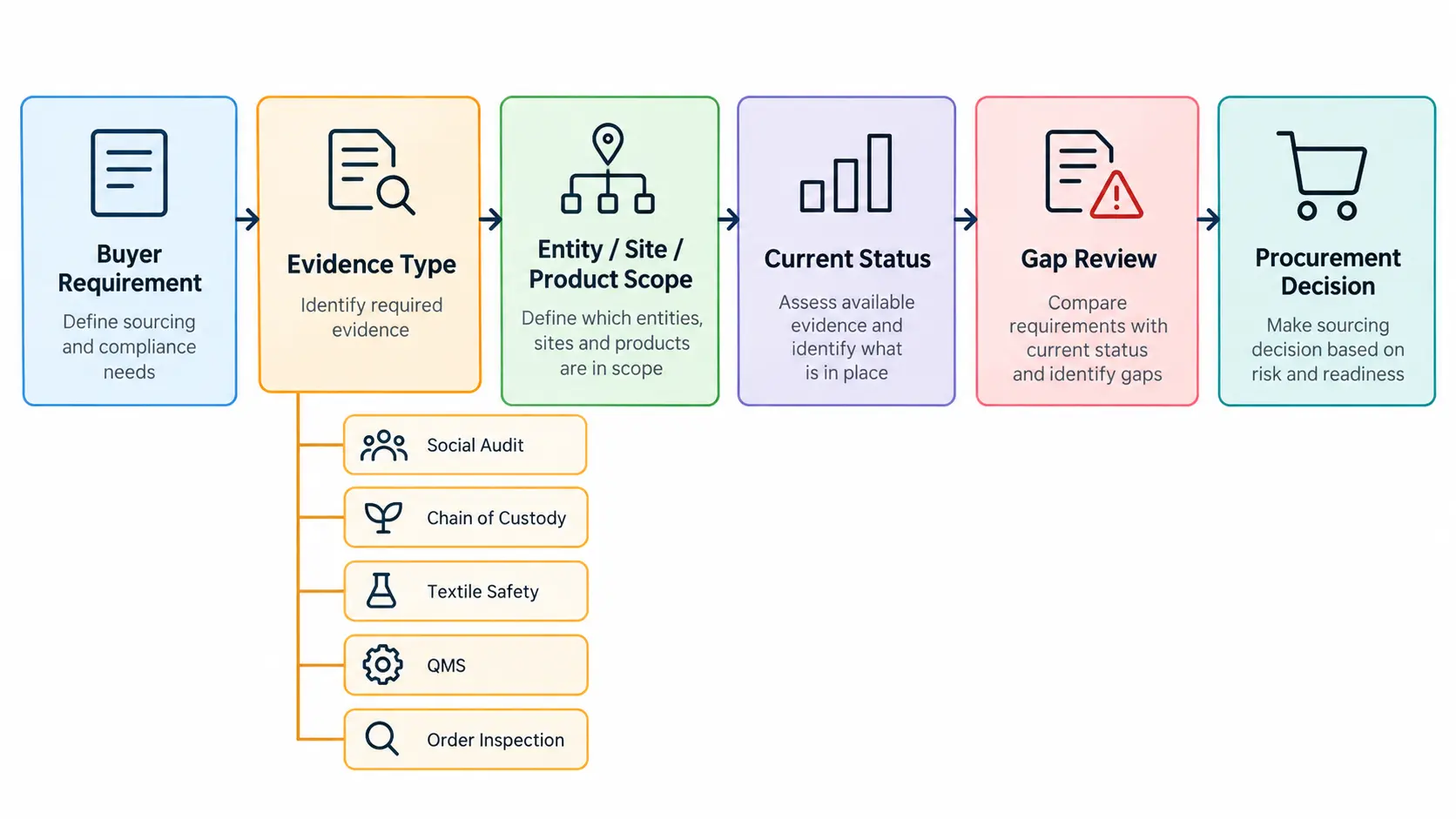
Verify the Entity Before Reading the Badge
Many document mistakes are identity mistakes.
The name on the audit or certificate may belong to:
- a trading company rather than the manufacturing site;
- another factory in the same group;
- a material mill rather than the bag sewing facility;
- a certification holder upstream in the supply chain;
- a supplier whose certificate does not include the quoted product category.
Before interpreting the technical meaning of the document, compare the legal name, address/site, certificate or report identifier, scope, issue/validity information and applicable product or process.
Then ask whether that scope answers the requirement in your sourcing brief.

Do Not Convert Facility Evidence Into Product Claims
A recurring compliance error is the sentence:
"The factory has certification X, therefore every bag we buy from it is X-certified."
That conclusion often fails because certification can apply at different levels: facility, legal entity, material, process, product/article, supply-chain transaction, management system or order.
The existing PrintTotes guide to environmental certifications for custom tote bags discusses GRS, FSC and OEKO-TEX in more depth. Use that page for environmental/material certification selection; use this page when the sourcing problem is distinguishing those documents from factory social audits and management-system evidence.
Corrective Action Matters More Than a Clean-Looking Audit Cover Page
Social audits are designed to identify conditions and management weaknesses that may require action.
Sedex describes SMETA as a continuous-improvement methodology rather than a pass/fail certification, and it provides a Corrective Action Plan to help address findings. That makes the findings and follow-up status relevant evidence-not just the existence of the audit.
Similarly, responsible sourcing should not be reduced to a badge collected once during supplier onboarding. Buyers should define how unresolved findings, severe issues, expired evidence or a change of production site affect approval of the supplier for the program.
Supplier Document Checklist for a Custom Bag Program
- What requirement is each document intended to satisfy?
- Is it a factory/site audit, material certificate, product/article certificate, management-system certificate, test report or transaction/order document?
- Does the legal entity and physical site match the facility actually involved in production?
- Is the scope relevant to the product, material or process being quoted?
- Is the document current for the period in which it must be relied on?
- Does the buyer require a specific social-audit methodology rather than an unspecified "ethical audit"?
- Are corrective actions or unresolved findings relevant to supplier approval?
- Does a sustainability claim require order-specific chain-of-custody evidence?
- Does the finished product require a separate lab test or inspection beyond the supplier's certificates?
- Has anyone incorrectly converted a site-level document into a claim about every SKU?
Final Takeaway
Compliance becomes easier to manage when every document is tied to one question.
Use social audits to evaluate the relevant worksite under the required social-compliance framework. Use material and chain-of-custody standards for material claims. Use product/article certifications or tests for the risks they actually cover. Use ISO 9001 for quality-management-system evidence. Use order-specific inspection and test records to decide whether the shipment conforms to the bag specification.
If your program requires OEM/ODM development together with defined social-audit, material-certification, product-testing or documentation requirements, specify those needs at enquiry stage through the PrintTotes OEM/ODM custom bag service rather than requesting a generic bundle of certificates after production has started.
FAQ
Q: Is BSCI a product certification for custom bags?
A: No. amfori BSCI is used for social-performance monitoring and audits of business partners/sites. It does not certify the recycled content, chemical safety or finished quality of an individual tote bag.
Q: Is SMETA a certification?
A: No. Sedex explicitly states that SMETA is an audit methodology and not a certification or Sedex stamp of approval. Buyers should review the audited site, scope, findings and corrective-action status.
Q: Is BSCI the same as SMETA?
A: No. They are different systems/methodologies. amfori states that SMETA audits are not recognized as substitutes within the amfori BSCI system. Follow the requirement set by your own buyer, policy or due-diligence program.
Q: Does GRS prove factory labour conditions?
A: GRS includes social and environmental processing requirements, but its core sourcing role is verifying recycled material and chain of custody under the Textile Exchange system. It should not be treated as a substitute when a buyer separately requires a BSCI or SMETA site audit.
Q: Does OEKO-TEX STANDARD 100 prove a bag contains recycled material?
A: No. STANDARD 100 addresses harmful substances in textiles. Recycled-content claims require the appropriate recycled-content and chain-of-custody evidence.
Q: Does ISO 9001 prove a shipment passed inspection?
A: No. ISO 9001 addresses an organization's quality-management system. Specific shipment conformity still depends on the order specification, production controls, tests and inspection evidence required for that lot.


