

A non-woven cooler bag is an insulated tote built from 80–120 GSM spunbond polypropylene, backed with a 3–8 mm EPE foam core and finished with an aluminum-foil or PEVA inner liner. Paired with a single freezer pack at room temperature, it holds food at a safe cold range for roughly three to six hours, lands at $0.80 to $3.50 per unit on a 5,000-piece custom run (FOB China, based on our 2024 Q4 quotations), and earns its place in food delivery, grocery retail, and promotional programs where cost, print area, and recyclability matter more than freezer-grade performance.
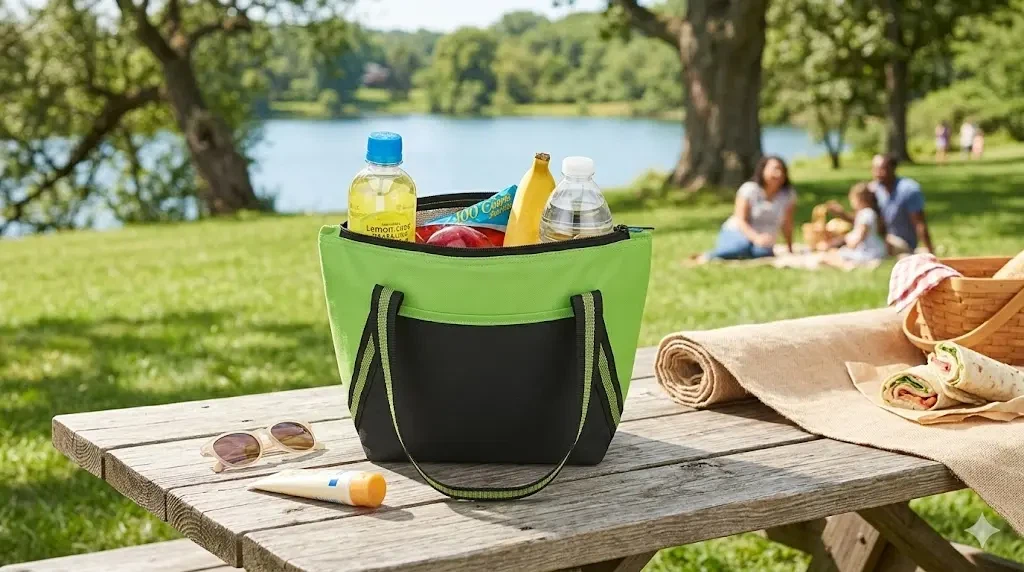
What a Non-Woven Cooler Bag Actually Is
The fabric is not woven at all. Polypropylene fibers are spun, laid down in a web, and heat-bonded under pressure, which is why the material feels closer to felt than to canvas. That process is what makes the bag cheap, light, recyclable under resin code 5, and flat-packable in volumes that would overwhelm a hard-shell cooler warehouse. The fabric itself has no thermal resistance, so the cooling performance comes entirely from the insulation sandwich tucked between the outer shell and the inner liner. Specify that sandwich correctly and a standard non-woven insulated cooler performs close to gear costing three times more.

The Anatomy: Five Layers That Do the Work
Strip a production-grade non-woven cooler bag down to its components and five layers handle the entire job:
- Outer shell. 80–120 GSM spunbond polypropylene. Takes the print and absorbs daily abuse.
- Insulation core. EPE (expanded polyethylene) foam. 3 mm for giveaways, 4 mm for grocery, 6–8 mm for meal-kit and pharmaceutical use.
- Radiant barrier. Aluminum foil laminated to foam for budget builds, food-safe PEVA film for premium builds. Reflects heat back toward the contents.
- Closure. Typically a #5 nylon zipper with a reinforced pull tab. Hook-and-loop still shows up on grocery-focused formats.
- Handles. Self-fabric webbing, either double-stitched or heat-welded into a box pattern. This is where most first-time orders fail.
Specifying each layer is where margin and performance are either won or lost. The single most common spec first-time buyers misread is the difference between a thermal liner and true insulated construction, and that one mistake usually explains why an order underperforms on cold retention.
Matching GSM and Foam Thickness to the Mission
How heavy does the fabric need to be? It depends on how many trips the bag will take. The table below collapses a decade of production data into a single view.
| Use case | GSM | EPE foam | Liner | Typical cost (FOB, 5,000 pcs) |
|---|---|---|---|---|
| Trade-show giveaway | 80 | 3 mm | Aluminum foil | $0.80–$1.00 |
| Grocery weekly use | 100 | 4 mm | Foil + PE | $1.10–$1.60 |
| Meal-kit delivery | 120 | 6 mm | PEVA | $2.00–$2.80 |
| Pharmaceutical cold chain | 120+ | 8 mm | Food-grade PEVA | $2.80–$3.50 |
For a short-life giveaway, 80 GSM with a silk-screen box-style cooler bag is plenty. For grocery rotation, step up to 100 GSM before the handles start fraying around month three. For delivery fleets that reload twice a day, 120 GSM with PEVA is the minimum that survives the "toss it on the passenger seat" reality. The temptation to shave a dime off the spec is real, and it is almost always the wrong call. We've audited the replacement-order math on 60 GSM stock enough times to know that a single reship usually erases two years of per-unit savings.
Non-Woven vs. Polyester vs. Cotton vs. RPET
Non-woven polypropylene is not the only fabric that shows up in cooler-bag briefs. Before locking a spec, most buyers compare four substrates.
| Material | Cost | Durability | Print quality | Recyclability | Best for |
|---|---|---|---|---|---|
| Non-woven PP | Low | 50–100 uses | Excellent (silk-screen, heat-transfer) | Yes (resin code 5) | Giveaways, grocery, short-cycle delivery |
| Polyester 210D/600D | Medium–High | 2–5 years | Excellent (sublimation) | Limited (PET) | Corporate gifts, delivery fleets |
| Cotton canvas | High | Years | Very good | Fully biodegradable | Premium brands, sustainability messaging |
| RPET | Medium | 1–3 years | Good | Already recycled content | ESG-driven retail programs |
If the brief calls for a longer service life or a premium hand-feel, an insulated polyester cooler bag tends to be the next step up, and how polyester carries branding differently is worth reading before switching substrates. For programs that lean into natural fibers, a cotton cooler bag adds weight and story but drops the price-per-impression advantage. A full breakdown of how polyester holds up as a bag material usually decides which side of the table the brief lands on.

Top Business Use Cases
Food delivery and meal-kit rotation
A Minneapolis-area meal-kit client came to us in summer 2024 after their previous supplier's bags were failing at roughly 8 weeks of daily use. We speced 120 GSM with 6 mm EPE and a PEVA liner, added a heat-welded base, and the same fleet is still rotating those bags through a fourth quarter. Food delivery is the most demanding use case because the bag is loaded, unloaded, and handled twice daily. Under-speccing here is expensive.
Grocery retail and checkout upsell
Grocery chains typically run 100 GSM with a 4 mm foam core, hook-and-loop closure, and a single-color silk-screened logo. Unit retail hits $2.99–$4.99 and gross margin sits comfortably in the mid-50% range. These bags do double duty as branded packaging and as reusable totes for return customers.
Trade shows and corporate giveaways
Here the math is cost-per-impression. An 80 GSM bag that runs $0.90 FOB and lives in the recipient's kitchen for six months beats almost every other trade-show premium on the floor. The bag does not need to last three years. It needs to last long enough to get the logo in front of the right eyeballs.
Bottle carriers and premium beverage
Wine clubs, cold-pressed juice brands, and craft beverage lines gravitate to tall, narrow formats like a tall bottle cooler tote because the proportions read as packaging rather than as a giveaway. Insulation needs are modest (most bottles are pre-chilled), but fit and finish carry disproportionate weight.

Wholesale Pricing, MOQ, and Lead Times
A standard 5,000-piece custom run with 100 GSM fabric, one-color silk-screen print, and a zippered closure runs $1.10–$1.60 per unit FOB China based on our 2024 Q4 quotations. An 80 GSM trade-show build with hook-and-loop lands $0.80–$1.00. A 120 GSM delivery-grade build with heat-welded seams and a four-color heat transfer sits $2.20–$3.50 depending on dimensions. MOQ holds at 3,000 pieces on custom runs because that is where print plates and foil-lamination rolls amortize cleanly. Pre-production samples take 5–7 days and bulk production runs 20–35 days. Ocean freight to the U.S. West Coast adds another 18–25 days on top of that. A deeper walk through how MOQ, lead time, and landed-cost math interact saves most first-time importers at least one painful cycle.
What to Verify Before You Sign a PO
Sourcing is more than price and MOQ. Before the deposit wire leaves the account, our U.S. buyers typically confirm six items:
- Pre-production sample policy. Ask whether one sample iteration is free and how many paid rounds follow. Industry standard is one free, two paid.
- AQL inspection level. Grocery and giveaway runs usually pass at AQL 2.5 (general). Delivery and pharmaceutical runs should hold to AQL 1.0 or 0.65 on critical defects.
- Color tolerance. Written Delta E tolerance for logo printing. Without it, "close enough" becomes a post-production dispute.
- Payment terms. The default is 30% T/T deposit and 70% against copy of bill of lading. L/C is negotiable on orders above roughly $50,000.
- FOB vs. CIF. FOB leaves ocean freight and insurance to the buyer. CIF rolls them in. Know which one your logistics team prefers before negotiating unit price.
- Third-party inspection. SGS, Bureau Veritas, or Intertek pre-shipment inspection is worth the $300–$500 fee on any order above $10,000.
Buyers who want help walking through all six can request a pre-production sample and quote from our factory directly.
Branding and Print Methods
Non-woven polypropylene does not accept ink the way cotton or coated polyester does, and that single detail decides how your branding ages. In spring 2024 a regional cold-pressed juice brand reordered 8,000 bags after the first 5,000, bought from a promotional catalog, came back with logos cracking at four washes. The fix was not a richer ink. It was the correct print process for the substrate. The three options that actually hold up on PP fabric are:
- Silk-screen printing. One to three colors, bright and opaque, cost-effective at volume, and forgiving on the fabric. The default for most orders.
- Heat-transfer printing. The right call for photographic or gradient artwork. A heat-transfer non-woven cooler bag holds a four-color image through normal wipe-down care, though the printed area feels slightly rubberized.
- BOPP lamination. Wraps the outer shell in a printed film for a near-retail finish. Cost jumps roughly 30 percent and the outer hand-feel becomes plastic rather than fabric.
If the brief is still open on print technology, our side-by-side breakdown of six printing methods that work on fabric-based bags covers trade-offs in detail.
Compliance, Certifications, and What Auditors Actually Ask
Procurement teams sourcing into the U.S. and EU routinely require three things on file before a private-label contract signs: a factory social-compliance audit, food-contact documentation on the inner liner, and at least one recognized environmental certification on the fabric.
- Food contact. In the U.S., the foil or PEVA inner liner should meet FDA 21 CFR 177.1520, which governs olefin polymers for food-contact applications.
- Social compliance. amfori BSCI audits are the most widely accepted across European retail supply chains.
- Recycled content. If the bag carries a recycled-content claim, the factory needs a valid Global Recycled Standard certificate, traced back through the supply chain.
- Chemical safety. OEKO-TEX Standard 100 confirms the fabric has been tested for harmful substances against an annually updated list.
Suppliers who cannot produce the paperwork behind these claims will eventually cost the buyer a contract. A longer walk through what GRS, FSC, and OEKO-TEX actually certify is the fastest way to separate real documentation from marketing language.
How We Test Cold Retention
Any supplier who quotes a cold-retention number without a test protocol is guessing. Here is how our factory runs the test, and how we recommend buyers replicate it.
- Ambient temperature: 75 °F (24 °C) for baseline, 95 °F (35 °C) for stress test.
- Load: One quart of whole milk plus two 12-oz beverages, pre-chilled to 40 °F.
- Ice source: One 16-oz gel pack, pre-frozen to 10 °F for 24 hours.
- Measurement: Digital probe thermometer, readings logged every 30 minutes.
- Pass criterion: Internal temperature stays below 40 °F for the target window.
Under those conditions, a 100 GSM / 4 mm EPE build passes the 4-hour mark with about 15 minutes of cushion. A 120 GSM / 6 mm PEVA build passes 6 hours and usually pushes into 7. Results drop roughly 30 percent under the 95 °F stress test, which is why our Phoenix meal-kit client (2023 summer rollout) runs exclusively 8 mm PEVA on delivery routes over 90 minutes.
Three Common Sourcing Mistakes
- Ordering from a catalog photo, not a physical sample. Non-woven fabric hand-feel, stitching density, and foil lamination adhesion are all invisible on a website. A $15 sample freight bill has saved many six-figure orders.
- Skipping the AQL spec in the purchase contract. "Commercially acceptable quality" is not a standard. Write the AQL level into the PO.
- Under-speccing the fabric on multi-year programs. The lowest unit price on a 12-month contract is rarely the lowest total cost once replacement rates are factored in.
Frequently Asked Questions
How long does a non-woven cooler bag actually keep food cold?
Three to four hours at 75 °F with a 4 mm EPE build and no ice pack. Five to six hours with one freezer pack. Close to eight hours with a 6–8 mm build and two packs. Expect roughly 30 percent less in 90 °F+ delivery conditions.
Can these bags be machine washed?
No. Machine washing delaminates the foil from the foam and warps the EPE core. Wipe the inner liner with a damp cloth and mild soap, then air-dry the bag fully open before storage.
What is the minimum order quantity for custom printing?
3,000 pieces for a custom run. Blank inventory pulls are available in smaller lots from stock.
Is non-woven polypropylene really recyclable in practice?
Technically yes, in reality it depends on where the bag ends up. Resin code 5 is accepted by a majority of U.S. curbside programs today, but real-world recovery rates for PP remain modest according to the Association of Plastic Recyclers. The honest message on a hang-tag is "widely accepted at curbside, check locally," not "guaranteed recycled."
Non-woven vs. polyester cooler bag, which wins?
Non-woven wins on price, print area, and recyclability. Polyester wins on tear resistance, water beading, and service life. The comparison table above summarizes the trade-off cleanly.
Can the same bag keep food hot?
Yes. The reflective liner works in both directions, which is why restaurant couriers use the same construction for pizza and for iced drinks.
What sizes are common for 6-pack, 12-pack, and grocery formats?
6-pack can carrier runs roughly 8"W × 6"D × 6"H. 12-pack sits around 13"W × 8"D × 10"H. Grocery-size tote formats reach 14"W × 12"D × 10"H. Bottle carriers scale by height, typically 14–16" tall.
The Bottom Line
A non-woven cooler bag is not the most sophisticated piece of thermal packaging on the market. It is the most economically rational one. Specify the fabric weight, the foam thickness, and the liner to match the mission. Insist on the compliance paperwork. Lock the AQL into the PO. Do those four things and the bag quietly becomes one of the best-performing line items in a branded-merchandise or cold-chain budget.
For buyers evaluating a full program, our non-woven cooler bag catalog covers the standard size range, and the team can turn around a custom quote within 48 hours.


