Cotton cooler bags are insulated carry bags with a woven cotton canvas exterior and a food-safe PEVA or foil-backed lining. They keep contents cold for four to six hours, machine wash clean, and take screen printing better than most synthetic alternatives-which is why they've become a go-to for brands that want a reusable promotional product people actually keep.
Most insulated bags look similar in a product catalog. The outer shell material, though, changes almost everything that matters in practice: how cleanly it prints, how long it holds up, and whether recipients actually keep it. This guide covers cotton cooler bags specifically-what sets them apart from synthetic alternatives, where they perform well, and what to verify before placing a bulk order.

Cotton vs. Polyester vs. Non-Woven: How the Materials Actually Compare
Before settling on a material, it helps to see the key differences side by side. Here's how cotton canvas stacks up against the two most common alternatives in the promotional bag market:
| Feature | Cotton Canvas | Non-Woven Polypropylene | Polyester |
|---|---|---|---|
| Machine washable | Yes (cold, gentle cycle) | No - spot clean only | Yes, with caveats |
| Screen print quality | Excellent - high contrast, textured finish | Moderate - ink can bleed at edges | Good - clean but flat |
| Embroidery option | Yes | No | Limited |
| End-of-life | Biodegradable | Non-biodegradable (plastic) | Non-biodegradable (plastic) |
| Perceived value | High | Low to moderate | Moderate |
| Sustainability certifiable | Yes (GOTS, OEKO-TEX) | No | Partially (recycled content only) |
| Typical cost level | Moderate to high | Low | Moderate |
Non-woven bags dominate the budget promotional market for good reason-they're cheap and fast to produce at volume. The catch is durability: most non-woven bags can't survive a machine wash cycle, which puts a firm ceiling on how long your brand impression lasts. Cotton's combination of washability, print quality, and biodegradability at end of life is what makes it the right material for brands that need a bag people keep using, not just one they receive. For a broader look at how canvas holds up against other substrates, our canvas tote bag overview covers construction comparisons in more detail.
Insulation Performance: Realistic Numbers, Not Marketing Claims
A cotton cooler bag with a properly bonded PEVA lining and a zippered closure will keep contents cold for roughly four to six hours-measured under standard ambient conditions (approximately 72°F), with two reusable ice packs and pre-chilled contents loaded at the start. That's a meaningful window for grocery runs, catered lunch deliveries, beach days with an early start, or trade show giveaways that end up living in someone's car.
Performance drops when you load room-temperature items you're trying to cool rather than items already chilled, when the bag sits in direct sunlight, or when you use loose ice instead of ice packs-meltwater accelerates heat transfer through the bag floor. It also matters whether the PEVA lining is bonded to the outer shell or simply inserted as a loose liner. Bonded linings maintain full contact with the bag wall; loose liners shift under load and create gaps that reduce insulation efficiency, especially after repeated washing.
For applications requiring cold retention beyond six to eight hours-outdoor catering, long-haul deliveries-a hard-sided cooler is the appropriate tool. For the large majority of everyday use cases your customers will actually encounter, cotton cooler bags deliver reliable performance without asking recipients to manage anything complicated.
Why Brands Choose Cotton Cooler Bags for Custom Orders
The promotional product market is full of insulated bag options. Here's what specifically makes cotton a defensible choice at the brand level:
Recipients keep them. Cotton canvas communicates quality in a way that crinkly non-woven polypropylene simply doesn't. The tactile difference is immediate-and it influences whether a bag enters regular rotation or gets left on the conference table. A bag that gets used generates ongoing brand impressions; a bag that gets discarded doesn't. The economics compound in your favor when the product is good enough to keep.
The print surface is genuinely better. Screen printing on 10 oz natural canvas produces high-contrast, slightly textured results that photograph well and hold up through repeated washing. On synthetic bags, logos tend to crack or peel after 12 to 18 months of regular laundering. On cotton, a well-applied screen print can last the life of the bag. For brands where visual consistency matters across years of use, that difference is worth the slightly higher per-unit cost. Our custom cotton tote bags page shows how different print methods read on natural canvas if you're evaluating artwork options before committing to a run.
The sustainability story holds up to scrutiny. Unlike "recycled polyester"-which is still plastic and still non-biodegradable-cotton is a natural fiber with a documented end-of-life pathway. When sourced with GOTS or OEKO-TEX certification, that story supports marketing copy, CSR reporting, and retail compliance submissions without hedging.
Customization depth goes further. Cotton canvas supports screen printing, embroidery, woven labels, patch applications, and multi-color artwork. A polyester bag gives you one or two workable decoration options; cotton gives brand designers a genuine surface to work with across formats.
At a corporate gifting event, the difference between a cotton bag and a non-woven bag isn't subtle-it's the difference between something recipients photograph and something they leave on the table. That gap in perceived value is why brands with real marketing budgets consistently come back to cotton for promotional cooler bags specifically.
Canvas Weight Explained: 8 oz, 10 oz, and 12 oz
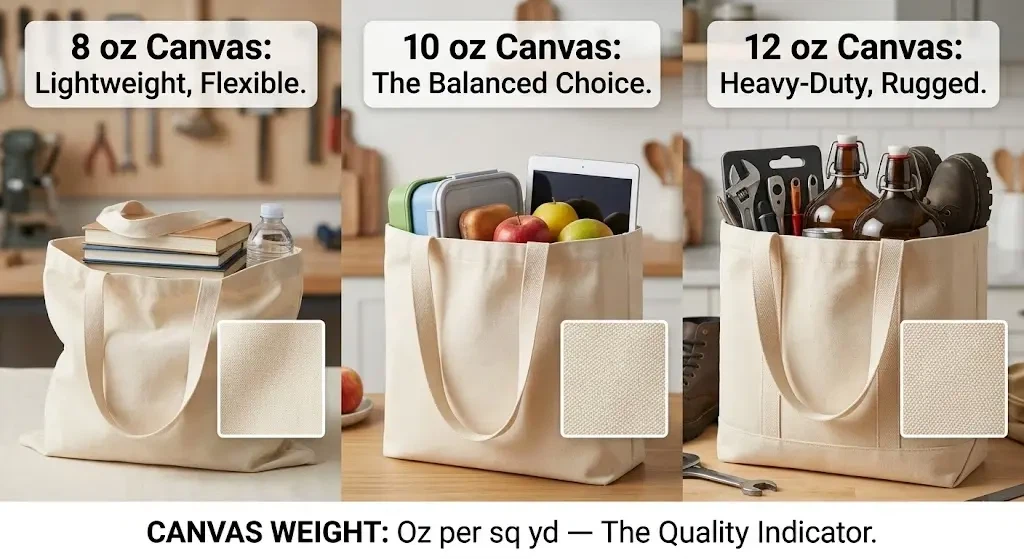
Canvas weight-measured in ounces per square yard-is the most reliable quality indicator you can evaluate before physically handling a bag. Here's what the three most common weights mean in practice:
8 oz canvas is lighter and packs flat more easily, making it well-suited for bags that need to ship efficiently, sit flat in event kits, or be mailed directly to recipients. The trade-off is structural rigidity-loaded with a six-pack, an 8 oz bag won't stand as upright as a heavier option, and the handles carry more stress under load.
10 oz canvas is the sweet spot for most promotional cooler bags. Substantial enough to stand on its own when loaded, light enough not to add meaningful tare weight. Most bulk custom orders fall in this range, and it's the spec that tends to photograph best-it holds its shape under studio lighting and in lifestyle product shots.
12 oz canvas is a heavy-duty build for bags expected to take daily punishment-contractor use, farmers market vendor bags, outdoor retail products. Noticeably stiffer and heavier than the lighter options, which some applications benefit from and others don't need. At this weight, handle reinforcement and base gusset stitching are especially worth examining closely.
Beyond canvas weight, look at whether the PEVA lining is bonded or inserted loose, and check stitching density at base corners and handle attachment points. Those stress points determine how the bag holds up past the first year of active use. Our custom canvas bag specs include lining construction and stitch details across weight classes if you want to compare builds before requesting samples.
Custom Printing on Cotton Cooler Bags: What Works and What Doesn't
Screen printing is the right call for most bulk orders. It produces vibrant, opaque color on natural canvas, holds up through repeated washing, and becomes economical quickly-usually at 50 units and above. One to three colors is the practical sweet spot; each additional color adds a screen setup charge (typically $25–$50 per screen per print location) without proportionate visual gain on a textured fabric surface.
Embroidery works well when your logo is simple and the bag is positioned as a gift-tier item rather than a mass giveaway. The raised texture reads as premium in person and photographs well for marketing use. The limitation is detail-complex logos with fine lines or small text need to be simplified for thread-based execution, sometimes significantly. Worth having that conversation with your decorator before finalizing artwork files.
Heat transfer and digital transfer are viable for short runs or artwork with color gradients that screen print can't cleanly replicate. Wash durability is lower than screen print, so they're not the right spec for bags intended to stay in active use for years. For a 500-piece corporate giveaway, screen print is the more defensible choice.
Placement matters as much as method. A large print spanning the full bag face functions as a walking billboard; a small chest-pocket logo reads more like a product label. Think about where the bag will actually be seen-grocery store aisles, beach parking lots, office break rooms-and size artwork for that context. Our promotional tote bag lineup includes artwork template guides for each standard print placement if you're setting up files for the first time.
Organic and GOTS-Certified Cotton Cooler Bags: What to Ask Your Supplier
The sustainability case for cotton is real, but not all cotton is equal. Conventional cotton farming is water-intensive and relies on synthetic pesticides that accumulate in soil over growing cycles. Organic cotton, certified under the Global Organic Textile Standard (GOTS) or OEKO-TEX Standard 100, addresses both issues-restricting synthetic inputs, requiring fair labor practices, and mandating chain-of-custody documentation from raw fiber to finished product.
According to the Textile Exchange 2023 Preferred Fiber & Materials Report, demand for certified preferred cotton grew year-over-year across apparel and accessories categories, driven by increasing accountability expectations from both consumers and retail buyers. For brands with sustainability commitments that need to hold up in marketing copy or supplier audits, being able to reference a specific certification number-rather than just a general claim-is the difference between a verifiable statement and a greenwash liability.
When sourcing certified cotton cooler bags, ask suppliers for three things: the specific certification body (GOTS or OEKO-TEX), the certificate number, and whether the certification covers the finished bag or only the raw material. Some suppliers certify their fabric but not their finished goods, which leaves a gap in the chain-of-custody documentation. Our organic cotton tote bags include full GOTS documentation available on request, and our broader eco-friendly tote bag range covers certified options across material types if you're building a comprehensive sustainable merchandise line.
For brands focused primarily on function and budget rather than formal certification, conventional cotton still outperforms synthetic alternatives in end-of-life biodegradability-a meaningful step without the premium price tag.

Sizes, Use Cases, and Matching the Right Bag to Your Order
Cotton cooler bags come in three practical size ranges, each suited to a distinct use case:
Small (approx. 9" × 6" × 6"). Built for individual daily use-a lunch, two drinks, a snack. These are common in employee wellness kits, onboarding packages, and retail checkout add-ons. They ship and store efficiently, which makes them practical for direct-mail gifting programs where per-unit shipping cost matters. If individual lunch use is your primary brief, our custom lunch bags include small-format cooler styles with specs tailored to that use case.
Medium (approx. 12" × 10" × 7"). The most versatile size and the most commonly ordered for promotional programs. Handles a family lunch, a six-pack, or a full day's worth of cold groceries. One marketing team we work with-a mid-size CPG brand running annual employee anniversary gifts-has made medium cotton cooler bags a standard line item for three years running. Their feedback: recipients actually use them, which is the benchmark that matters. Our cotton tote bag collection shows how medium-format specs vary across construction styles.
Large (approx. 15" × 12" × 9" and above). Built for picnics, beach outings, or small-scale food delivery. These make a strong impression as premium branded statement pieces but require more shipping budget per unit and more storage space on the recipient's end. Better suited to high-value gift programs or event giveaways where size is part of the message.
For most corporate gifting programs, medium bags consistently hit the best balance of usability, shipping efficiency, and perceived value. If you're unsure which size fits your distribution method and audience, our wholesale tote bag team can help narrow it down before you commit to a sample order.

How to Care for a Cotton Cooler Bag-and What to Tell Recipients
Machine wash cold, gentle cycle, air dry. That's the short version. The longer version matters for bags expected to stay in active use for years.
Avoid the dryer. Heat degrades PEVA lining over time and can cause minor canvas shrinkage-neither effect is immediately obvious, but both shorten the bag's useful life. Don't iron directly over printed or embroidered areas; if smoothing is needed before an event display or photo shoot, use a pressing cloth on low heat.
The interior lining needs separate attention. Wiping it down after each use-especially after carrying raw produce or anything that can leak-prevents the odor buildup that causes bags to get retired early. For deeper cleaning, a brief soak with mild detergent followed by thorough rinsing works well. The key is air drying the bag completely before storing it; a bag stored damp develops mildew quickly, and that's usually the end of it.
For bulk orders, including care instructions with the bag adds real perceived value. A small printed card inside or a simple hang tag communicates that the product is worth maintaining-and extends active use life in a way that directly extends your brand's visibility. Our reusable bag fulfillment options include care card inserts for brands that want that level of finish on their packaging.
Ordering in Bulk: Pricing, Lead Times, and What to Verify Before You Commit
Most suppliers set minimums at 50 units for custom screen-printed cotton cooler bags, with some offering 24-piece options for simpler decoration methods. Typical per-unit pricing for a 10 oz cotton cooler bag with a one-color screen print runs approximately $9–$14 at 100 units and $6–$10 at 500 units, depending on bag construction and supplier tier. Those ranges reflect standard U.S. promotional product pricing as of 2024; significant outliers exist in both directions.
Pricing breaks typically occur at 100, 250, and 500 units. The per-unit difference between 50 and 500 pieces often exceeds 40%-which makes the economics of a larger upfront commitment compelling for brands with consistent distribution needs throughout the year. Brands that treat cotton cooler bags as a recurring program item rather than a one-time order often establish standing arrangements that eliminate setup fees on reorders using the same artwork.
Lead times for custom orders typically run 10 to 21 business days from art approval. For event-driven orders, plan backward from your ship date with at least a three-week buffer built in-four weeks if your event date is firm and there's no flexibility. Screen setup charges ($25–$50 per screen per location) are a one-time cost that amortizes quickly on larger orders and disappears entirely on reorders. For a full picture of volume pricing across cotton and canvas styles, our bulk tote bag catalog includes per-unit pricing at standard quantity thresholds.
Before finalizing any bulk order, verify three things: that the PEVA lining is food-grade and bonded (not loose), that the canvas weight matches what's on the spec sheet, and that the supplier provides a pre-production sample for artwork approval. Skipping the sample step on a 500-piece run is how minor color registration errors become expensive problems. It's worth the extra week.
Frequently Asked Questions About Cotton Cooler Bags
How long do cotton cooler bags keep food cold?
Under standard test conditions-two reusable ice packs, pre-chilled contents, 72°F ambient temperature, zippered closure-a quality cotton cooler bag maintains cold temperatures for four to six hours. Performance improves when contents are already cold before loading and when the bag is kept out of direct sunlight. For cold retention beyond six to eight hours, a hard-sided cooler is the more appropriate tool for that job.
Are the linings in cotton cooler bags food safe?
Yes, when the lining is food-grade PEVA (polyethylene vinyl acetate) or laminated aluminum foil. PEVA has largely replaced PVC in quality cooler bags because it doesn't contain chlorine in its manufacturing process and carries a lower toxicity profile for food contact use. Always confirm the specific lining material with your supplier if food safety compliance is a documented requirement for your application.
Can cotton cooler bags be machine washed?
Yes. Cold water, gentle cycle, air dry-no dryer. Heat can degrade the PEVA lining and cause minor canvas shrinkage over time. Wipe the interior lining separately before laundering the outer bag. With consistent care, a well-made cotton cooler bag stays in active use for three to five years, which is longer than most synthetic alternatives that require spot-cleaning only and tend to degrade faster under regular use.
What's the difference between a cotton cooler bag and a regular insulated tote?
The distinction is primarily the outer shell material. Standard insulated totes typically use non-woven polypropylene or polyester exteriors. Cotton cooler bags use natural woven cotton canvas. Both styles use similar interior lining systems for insulation. The practical differences-print quality, washability, sustainability profile, and long-term durability-consistently favor cotton for brands that want a bag people use regularly over an extended period.
What is the minimum order quantity for custom cotton cooler bags?
Most suppliers start at 50 units for screen-printed designs, with some allowing 24-piece minimums for simpler decoration methods. Significant pricing breaks occur at 100, 250, and 500 units. Brands running recurring gifting or event programs often establish standing orders to lock in favorable per-unit pricing across multiple fulfillment dates throughout the year, which also eliminates per-order screen setup fees on reorders.
Are GOTS-certified organic cotton cooler bags worth the premium?
For brands with documented sustainability commitments-using these bags in CSR materials, press releases, or retail compliance submissions-yes. GOTS certification provides chain-of-custody documentation from fiber to finished product, which is a verifiable claim rather than a marketing assertion. The price premium over conventional cotton at the finished bag level typically ranges from 10 to 30 percent depending on order volume and certification tier. For brands where sustainability is a genuine differentiator, that range is generally justifiable. For brands where it isn't a priority, conventional cotton still outperforms synthetic options on biodegradability without requiring a premium budget.
Which printing method holds up best on cotton cooler bags over time?
Screen printing. It produces opaque, durable color on natural canvas and holds up through years of machine washing when properly applied. Embroidery is the premium alternative for simpler logos on gift-tier bags. Heat transfer and digital transfer work for short runs or complex multi-color artwork but don't match screen print for long-term wash durability. If the bag will be laundered regularly over a period of years, screen print is the spec to specify.